Emily Kame Kngwarreye: The Aboriginal Artist Who Turned Country, Colour, and Dreaming into Power
Emily Kame Kngwarreye: The Aboriginal Artist Who Turned Country, Colour, and Dreaming into Modern Power
Emily Kame Kngwarreye transformed ancestral knowledge into one of the most radical painting languages of the late twentieth century: vast, luminous, bodily, ecological, and impossible to reduce to Western abstraction.
Emily Kame Kngwarreye (c.1910–1996), also rendered by some institutions today as Emily Kam Kngwarray, is one of the most celebrated and influential Australian Aboriginal artists. Born in the remote Utopia region in the Northern Territory, she began painting on canvas late in life, yet produced a monumental body of work in less than a decade that reshaped global understandings of Aboriginal creativity.
Her work belongs at the centre of Contemporary Indigenous Australian Art and the wider story of Antipodean art. Like Papunya Tula, her art shows that Indigenous painting is not a decorative language but a system of knowledge, Country, ceremony, memory, and visual sovereignty.
Ancestral Knowledge, Contemporary Language
Kngwarreye’s art emerges from an intimate relationship with land, body, ceremony, and culture. A senior Anmatyerre woman from Alhalkere/Utopia, she was custodian of important Dreaming stories, especially those connected to the yam. These ancestral narratives encode spiritual, environmental, historical, and social knowledge. Her paintings embody this bond, mapping a living relationship between Country, people, plants, ceremony, and spirit.
At the same time, her visual language is boldly contemporary: abstract, expressive, expansive, and formally explosive. Through dense dotting, sweeping lines, layered colour, and rhythmic composition, Kngwarreye forged a bridge between ancient cultural knowledge and global modern painting.
Her work has often been compared with Abstract Expressionism and Color Field Painting, but those comparisons are only useful up to a point. Kngwarreye was not trying to become a Western abstract painter. Her abstraction comes from Country, ceremony, plant life, body painting, seasonal change, and Dreaming. It is not the absence of representation. It is meaning held in another visual system.
Country Is Not Landscape
To understand Kngwarreye, one must avoid reading her paintings as landscapes in the usual Western sense. Country is not scenery. Country is relation: land, law, ancestry, plants, animals, water, ceremony, responsibility, and memory.
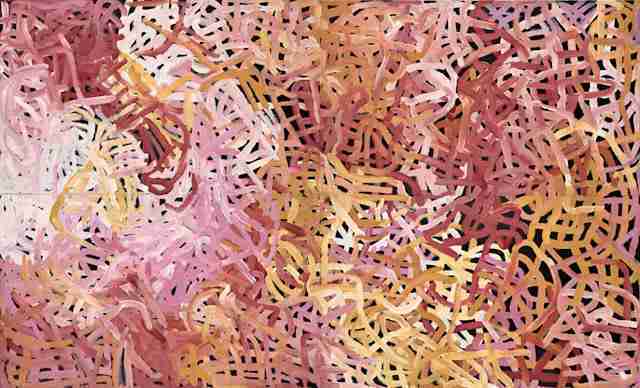
This is why her paintings can feel both cosmic and intimate. A field of dots can evoke seeds, flowers, energy, heat, movement, and the presence of the yam beneath the ground. A web of lines can suggest roots, pathways, growth, and ancestral force. The canvas becomes a living surface where what is underground, remembered, sung, danced, and inherited becomes visible.
This places Kngwarreye in a wider conversation with artists such as Doreen Reid Nakamarra, Rover Thomas, and Albert Namatjira. Each works differently, but all force viewers to rethink what Australian landscape, Country, and image can mean.

A Journey of Colour and Rhythm
Her practice evolved rapidly. Early acrylic works build dense fields of meticulously placed dots, evoking desert textures, native blooms, seasonal change, and the visual memory of ceremonial body painting. Series such as Wild Yam Dreaming marry technical precision with a meditative sense of place.
Later, her brushwork becomes freer, more gestural, and more expansive. The monumental black-and-white Big Yam Dreaming turns the canvas into a pulsating map of roots, pathways, and energies. In her final years, she layered bold reds, yellows, purples, and whites — colour as atmosphere, memory, growth, and force.
The speed of this development is extraordinary. In only a few years, Kngwarreye moved through visual languages that many artists would take decades to develop: dots, stripes, fields, linear webs, raw gestures, and chromatic explosions. Yet the work remains coherent because it returns to the same ground: Alhalkere, yam, ceremony, body, Country.

Big Yam Dreaming: Roots, Lines, and Monumental Force
Big Yam Dreaming is one of Kngwarreye’s defining works. Its vast black-and-white surface is filled with looping, crossing, tangled lines that evoke the underground growth of the yam, a plant of major cultural and spiritual importance in her Country.
The work is monumental, but its power does not come from size alone. It comes from the way line becomes life. The white marks do not simply sit on the surface. They move like roots, veins, pathways, memory, and breath. The painting makes the invisible structure of Country feel active.
This is where Kngwarreye’s achievement becomes impossible to contain within ordinary categories. The painting can be discussed as abstraction, but it is also botanical, ceremonial, ancestral, bodily, and ecological. It is not a picture of the yam. It is a painting in which yam, Country, and knowledge become one force.
Art Beyond Borders
Kngwarreye’s art travelled widely and has been shown in major exhibitions across Australia, Japan, Europe, and the United States. In 1997, a year after her passing, her work represented Australia at the Venice Biennale in Fluent, alongside Yvonne Koolmatrie and Judy Watson.
That international visibility matters, but it also raises a question: how can global audiences look at Indigenous art without stripping it of its local responsibilities? Kngwarreye’s paintings speak across cultures, but they are not universal in the vague sense. They are universal because they are deeply specific.
They come from Anmatyerre knowledge, Alhalkere, yam Dreaming, women’s ceremony, and a lived relationship to Country. Their global power depends on that rootedness.

Beyond the Western Abstraction Label
One of the mistakes often made with Kngwarreye is to praise her by saying she looks like Pollock, Rothko, Monet, or Color Field painting. The comparison may help some viewers understand scale, rhythm, or painterly intensity, but it can also reduce the work to a Western frame.
Kngwarreye does not need to be validated by resemblance to Western modernism. Her work forces Western modernism to expand. It shows that abstraction did not belong to one genealogy. It could emerge from ceremony, Country, women’s knowledge, body painting, plant life, and inherited law.
This is why her painting remains so important today. It is not only beautiful. It corrects art history. It makes the history of abstraction larger, older, and less Western.
Legacy and Reverence
Kngwarreye’s work transcends narrow expectations of “what Aboriginal art should be,” blending ancient custodianship with radical painterly invention. Her legacy continues to inspire artists and audiences worldwide, testament to cultural resilience, creative freedom, and the power of art to connect us with land and with each other.
She is also essential to any serious discussion of women artists, late artistic beginnings, and the relationship between age and creative force. Kngwarreye began painting on canvas when many careers are already over. Yet in less than a decade, she produced one of the most extraordinary bodies of work in modern and contemporary art.
Her influence sits beside broader questions raised by Fiona Foley, Tracey Moffatt, and Gordon Bennett: who controls representation, how colonial histories are remembered, and what it means for Indigenous art to enter global institutions without losing its ground.
Conclusion: Country as Colour, Line, and Living Force
Emily Kame Kngwarreye’s art is powerful because it refuses separation. Colour is not separate from Country. Line is not separate from root. Gesture is not separate from ceremony. Abstraction is not separate from knowledge.
Her paintings do not simply show the desert. They carry the living force of Alhalkere. They make visible a world where plant, body, ancestor, place, and memory are not divided.
That is why Kngwarreye remains one of the most important painters of the twentieth century: not because she entered the language of modern abstraction, but because she changed what that language could mean.
Related Readings
- Contemporary Indigenous Australian Art: A Rich Tapestry of Tradition and Innovation
- Papunya Tula: Art of the Western Desert and the Power of Story
- From Dreamtime to Digital: A Journey Through Antipodean Art
- Doreen Reid Nakamarra: Indigenous Australian Art
- Rover Thomas: A Pioneer of Aboriginal Art
- Fiona Foley: Unmasking Colonial Myths Through Art
- Tracey Moffatt: Mastering Narratives of Memory and Identity
- The Art of Disruption: Gordon Bennett’s Quest for Identity and Justice
- Albert Namatjira: Painting the Spirit of the Australian Outback
- Color Field Painting: A Vibrant Revolution in Art