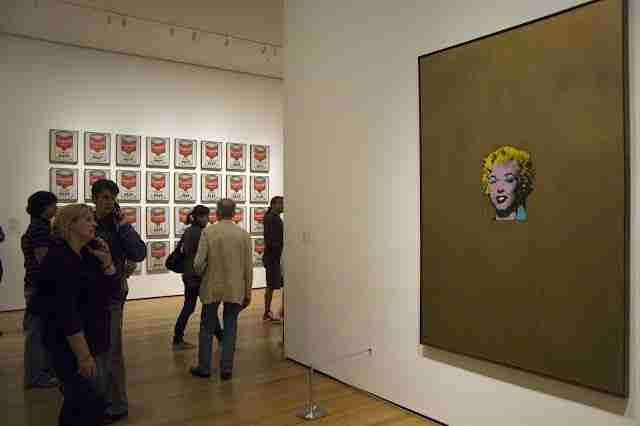
Pop Art: Icons, Consumer Culture and Visual Power Today
The Evolution and Impact of Pop Art
Introduction to Pop Art
Pop Art emerged as a groundbreaking movement in the mid-20th century, profoundly altering the landscape of art by incorporating elements from mass
culture, advertising, and the everyday. Born in the late 1950s in both the United Kingdom and the United States, Pop Art challenged traditional
boundaries of fine art, pushing the envelope with its innovative use of materials, methods, and messages derived from popular culture.
Origins and Social Context: The Bedrock of Pop Art
The end of World War II marked the beginning of an era characterized by rapid economic growth and cultural transformation in the Western world. Cities became the epicenters of a consumer culture expanding at an unprecedented scale. The mass production of automobiles, home appliances, and processed foods didn’t just fill the market with new products; it reshaped lifestyles, promising convenience and luxury previously unimaginable to the average person.
The Rise of Consumerism
In this post-war period, the American Dream was repackaged and sold in the form of shiny cars, state-of-the-art kitchen appliances, and canned goods, symbols of stability and progress. Advertising played a crucial role, painting a picture of an idealized life that could be achieved through consumption. This consumerism was not just a North American phenomenon; Europe, too, rebuilt itself economically and culturally through a similar visual economy of desire.
Urban Development and Cultural Shifts
As urban areas swelled, so did the presence of visual culture in the form of billboards, neon signs, and cinema—adding layers to the new visual landscape Pop Art would soon draw upon. Cities became canvases, displaying stark contrasts between post-war reconstruction and the glossy sheen of modern consumerist culture.
Artistic Reactions to a Consumer Society
While movements like Happenings and New Dada often rejected traditional aesthetics and embraced anti-art strategies, Pop Art took a different approach. It didn’t dismiss mass culture; it
used its icons and tools as the very materials of critique. Pop Art became a mirror, reflecting and distorting the relationship between identity, consumption, and media.
Artists recognized repetitive advertising imagery and uniform, mass-produced goods as symbols of over-consumption and waste. The movement emerged within a field of contradictions—between old and new, manufactured and handmade, durable and disposable.
The Psychological Impacts of New Consumerism
The constant bombardment of advertising—with idealized images and promises of a better life through consumption—began to shape desires and aspirations. Acquisition became a measure of personal success and happiness, altering class dynamics and perceptions of self-worth based on material wealth.
Pop Art amplified these conditions rather than denying them. It turned the adman’s language into a critical device: bold graphics, iconic images, and repetition not to sell products, but to expose the machinery of commercialized desire and the paradox of a public image-world dominated by private interests.
Key Techniques and Themes: Dissecting Pop Art’s Core

Pop Art stood out for its incisive engagement with mass production and consumerism. The movement questioned what art could be in an industrial society increasingly dominated by reproducible images and standardised goods—and that question generated new forms, new techniques, and new relationships between art and everyday life.
Mechanical Creation
Pop Art embraced methods such as screen printing and lithography, enabling repetition at speed. Andy Warhol’s serial imagery challenged the notion of the artist as a solitary producer of unique objects; art could behave like a commodity while simultaneously critiquing commodity logic.
Collage and Mixed Media
Building on Dada and Cubism, Pop artists adopted collage and mixed media, inserting newspaper clippings, packaging, and advertising into the artwork. This technique made visible how commercial imagery shapes taste and public consciousness—elevating the “low” materials of daily life into the arena of “high” art.
Live Art and Performance
Some artists extended Pop’s strategies into live actions, turning process into content and challenging passive spectatorship. In these works, the audience becomes part of the circuit that Pop Art is analysing: attention, repetition, and the mass-media choreography of desire.
Central Themes: Consumerism and Its Discontents

Pop Art’s core subject is the consumerist lifestyle of the post-war era: an explosion of goods, images, slogans, and manufactured fantasies of
happiness. It studies how objects infiltrate the psyche—and how the self becomes legible through what it buys, wears, watches, and desires.
The Allure and Critique of Consumer Culture
Roy Lichtenstein borrowed the look of commercial printing—bold contours, Ben-Day dots—to magnify the emotional flatness of mass-media narratives.
Claes Oldenburg monumentalised everyday objects, turning the banal into the absurd, revealing how consumer goods can dominate public space and
private imagination alike.
Existential Unease and Mechanical Repetition
Repetition is not only a style; it is a diagnosis. Warhol’s replicated motifs underscore the monotony of mass production and the uneasy question
beneath the glitter: can individuality persist when everything can be reproduced, distributed, and consumed at scale?
The Sinister Beneath the Surface
Pop Art often looks bright because the culture it examines is bright. Yet its sheen carries a shadow: choices pre-made by others, happiness
engineered through marketing, and desire shaped by systems that profit from dissatisfaction.
A Mirror to Modern Life: The Resonating Echo of Pop Art

Pop Art captured its time by turning everyday imagery into a critical instrument. It democratized subject matter, challenged hierarchies of taste, and exposed how commerce, media, and technology script the visible world. Today, its questions return with new urgency in a digital economy built on feeds, branding, and attention.
Commodification of Culture
Pop Art extends commodity logic beyond products to icons. Public figures become repeatable images; identity becomes a surface that can be printed, packaged, and sold—an insight that continues to resonate in the age of influencers and algorithmic visibility.
Legacy and Influence on Contemporary Art
Pop Art’s methods and themes echo through contemporary practices, from digital and post-internet art to street culture and design, because consumer society never stopped evolving. Pop Art remains a tool for reading how images circulate, how value is assigned, and how desire is produced.
Major Artists
Andy Warhol
Warhol explored the intersection of art, celebrity, and commodity through repetition and mechanical reproduction, turning consumer goods and
famous faces into a visual grammar of modern life.
Roy Lichtenstein
Lichtenstein adopted comic-strip aesthetics and commercial printing techniques to critique the artificiality and emotional scripting of mass media.
Richard Hamilton
Hamilton’s early collages captured the post-war consumer boom, dissecting how domestic life, advertising, and media converge into an idealized
image of modernity.
Claes Oldenburg
Oldenburg transformed everyday objects into monumental sculptures, challenging scale and function and revealing the surreal dominance of
consumer goods.
James Rosenquist
Rosenquist brought billboard logic into painting, fragmenting and juxtaposing images to reflect the overload of modern visual culture.
Jasper Johns
Johns’ flags, targets, and numbers occupy a crucial hinge between abstraction and Pop, using familiar symbols to probe perception and meaning.
David Hockney
Hockney brought a personal, intimate dimension to Pop, combining bright palettes with emotionally rich depictions of leisure, relationships, and
modern private life.