Chiho Aoshima: The Superflat Artist Who Makes Pop Feel Haunted
Chiho Aoshima turns the polished surface of Superflat into a world of ghosts, cities, flowers and catastrophe
Chiho Aoshima’s images do not become disturbing all at once. They first invite you in.
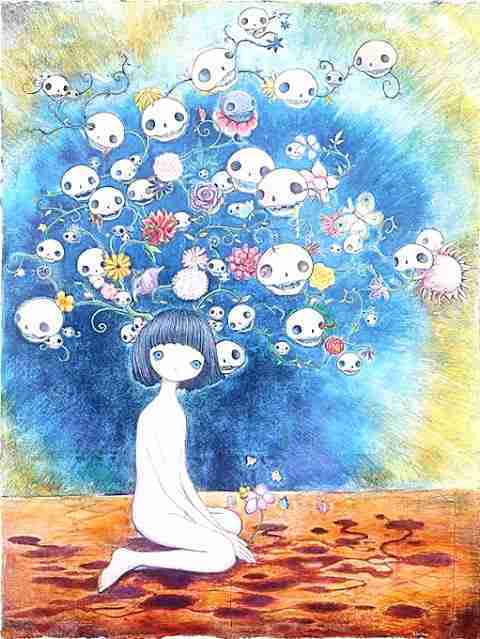
There are flowers, girls, floating spirits, glowing cities, impossible skies. Everything seems soft, almost weightless. The colors are seductive. The surfaces are clean. The world appears to have been purified of friction. Then the image begins to change temperature. The buildings breathe. The flowers look too alive. The girls seem less like characters than apparitions. Beauty remains, but it is no longer innocent.
That is where Aoshima’s art begins to matter.
She is often placed within Superflat, the movement associated with Takashi Murakami and with the collapse of distinctions between high art, manga, anime, consumer culture and Japanese visual traditions. The association is correct, but insufficient. Aoshima does not simply extend Superflat. She haunts it.
Her work takes the flat, polished, hyper-readable surface of contemporary image culture and fills it with what that surface tries to suppress: ghosts, death, ecological anxiety, myth, feminine metamorphosis, urban fragility. The result is not escapism. It is a dream after the future has already started to rot.
Superflat, but not weightless
Chiho Aoshima was born in Tokyo in 1974. She studied economics before entering the Kaikai Kiki environment around Murakami. She did not come from the usual academic path of painting or sculpture. That biographical detail is not secondary. Her work does not behave like traditional art trying to borrow the language of popular culture. It begins inside the digital and commercial image, then opens it toward something older, darker and less controllable.
Her use of Adobe Illustrator and digital drawing gives the works their unmistakable precision: crisp lines, saturated colors, flat planes, smooth transitions, surfaces that seem instantly legible. But the legibility is a trap. The more accessible the image appears, the more unstable it becomes.
This is the best way to understand her place within Superflat. In Murakami, flatness often exposes the relationship between consumer desire, postwar Japanese culture and the circulation of images. In Aoshima, flatness becomes a membrane. Something presses from behind it. Spirits, plants, cities and bodies all seem trapped inside the same enchanted skin.
Her images are flat, yes. But they are never empty.
The city is alive, and that is the problem
Aoshima’s cities do not look built. They look grown.
In City Glow, skyscrapers rise like organisms. Architecture loses its certainty. The urban landscape appears luminous, liquid, almost vegetal. It is beautiful, but not reassuring. The city does not stand in opposition to nature. It mutates into nature, or perhaps reveals that it was always part of a larger living system.
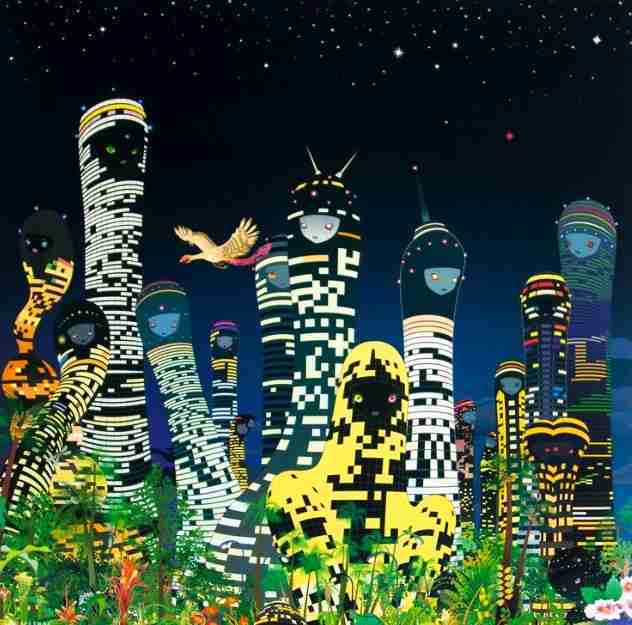
This is one of the most powerful tensions in Aoshima’s work. She does not stage a simple conflict between modernity and nature. She does something more unsettling: she makes them contaminate each other. Buildings behave like plants. Flowers carry a supernatural intelligence. Landscapes seem conscious. Urban space becomes organic, but this does not feel like healing. It feels like a warning.
The modern city in Aoshima is not dead matter. It has a pulse. And once the city has a pulse, it can also become sick.
Nature does not console us
Aoshima’s nature is often lush, excessive, radiant. But it is not pastoral. It is not a safe place outside history. It is not the decorative opposite of technology.
Her flowers, mountains, skies and rivers appear charged with agency. They do not merely surround human figures. They absorb them, transform them, sometimes replace them. The landscape is not a setting. It is a force.
This makes her work especially contemporary. We live in a culture that still likes to imagine nature as something outside us, something to visit, save, consume or fear from a distance. Aoshima refuses that distance. Her images suggest that nature has always been inside the city, inside the body, inside the image itself. It returns not as harmony, but as possession.
That is why her beauty feels dangerous. It is not the beauty of escape. It is the beauty of entanglement.
The girl is not a symbol of innocence
Aoshima’s female figures are often described through the language of kawaii. The term is useful only up to a point. Yes, there is softness. Yes, there are large eyes, delicate bodies, luminous colors, a certain visual sweetness. But in her work cuteness is not the end of meaning. It is the entrance.
The girl in Aoshima is rarely just a girl. She may be a spirit, a goddess, a flower, a corpse, a landscape, a city, a dream, a warning. She is not there to make the image gentler. She makes it harder to stabilize.
This is where Aoshima’s work gains a quiet feminist force, even when it does not announce itself as programmatic feminism. Her feminine figures do not simply represent vulnerability or fantasy. They carry transformation. They become thresholds between life and death, nature and technology, seduction and threat. They are looked at, but they also look back through the entire image.
The cute becomes a mask. Behind the mask, something older is awake.
Ghosts are not a return to the past
Aoshima’s work is full of spirits, yūrei, yōkai-like presences and supernatural figures. But folklore does not appear as nostalgia. She is not reconstructing an untouched mythic Japan. She is asking why myth still returns inside the most artificial parts of modern life.
This is crucial. Her ghosts do not belong to a remote past safely separated from the present. They enter cities, transit spaces, digital landscapes, burning worlds. They are not enemies of modernity. They are produced by it.
Aoshima seems to understand that the contemporary world has not abolished the supernatural. It has only changed its form. Ghosts now live inside screens, infrastructures, urban fantasies, ecological dread, commercial surfaces. They emerge wherever reality has been made too smooth.
The surface becomes haunted because too much has been flattened.
Catastrophe has learned to be beautiful
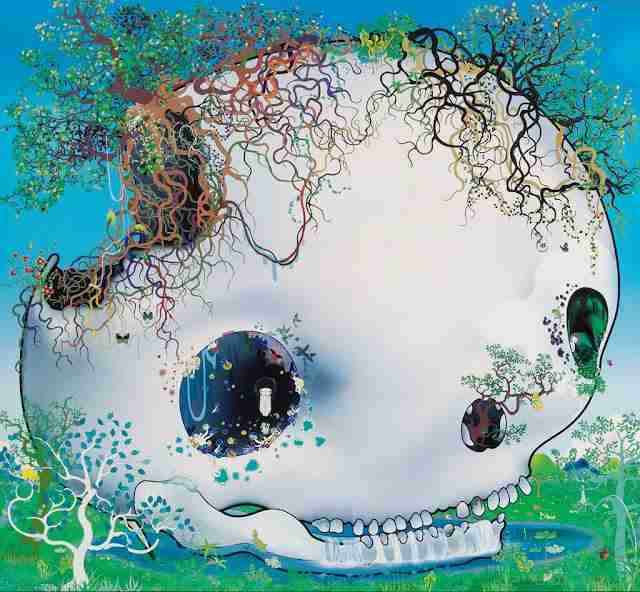
Aoshima’s darker works, including images of burning cities, skulls and ruined worlds, are never simply horrific. They are too elegant for that. Disaster appears wrapped in color, ornament, grace. Collapse becomes visually pleasurable, and that pleasure is uncomfortable.
This is one of the sharpest aspects of her art.
Contemporary culture has become extremely good at aestheticizing catastrophe. We consume images of environmental collapse, war, disaster and social breakdown through screens that make everything visually manageable. The apocalypse arrives formatted, edited, designed, circulated.
Aoshima does not stand outside that condition and condemn it from a safe distance. She works inside it. She makes images that seduce us into looking, then makes us question the seduction itself.
Why does destruction look so beautiful?
Why does a burning world still attract the eye?
What does it mean when catastrophe becomes part of visual pleasure?
These are not secondary questions in her work. They are the work.
When public space becomes a dream state
Aoshima’s public projects reveal another side of her practice. When her imagery leaves the gallery and enters a transit station or urban environment, it changes function. It no longer waits for the viewer inside the protected time of art. It interrupts ordinary movement.
Her project for Gloucester Road tube station in London is important for this reason. A place built for circulation, habit and speed becomes briefly unstable. Commuters encounter a world that does not belong to the logic of transport, productivity or routine. The image opens a crack in daily life.
This is not a minor achievement. Public art often fails because it becomes decoration for architecture or branding for the city. Aoshima’s strongest public works do something else. They do not simply beautify public space. They make public space feel less certain.
For a moment, the commute becomes a threshold. The city remembers its ghosts.
Why Chiho Aoshima matters now
Chiho Aoshima matters because she gives form to a condition that is difficult to name directly. Her work speaks about digital culture without needing to show devices. It speaks about ecological anxiety without becoming illustration. It speaks about femininity without reducing the female figure to identity. It speaks about death without abandoning pleasure.
Her art understands that the contemporary image is not empty because it is flat. It is dangerous because it can hide depth in plain sight.
That is the real force of her position within Superflat. Aoshima takes a language often associated with pop brightness, commercial circulation and visual immediacy, then turns it toward haunting. She shows that the surface is not the opposite of depth. Sometimes the surface is where the repressed returns most clearly.
In her world, flowers are not innocent. Cities are not stable. Girls are not passive. Ghosts are not past. Beauty is not consolation.
Everything is connected, but nothing is safe.
This is why her images stay with us. They do not ask us to choose between enchantment and fear. They show that the two may now be inseparable. Modernity did not kill the spirits. It gave them new places to live: screens, stations, skyscrapers, gardens, fantasies, ruins.
Chiho Aoshima does not paint another world. She shows this one after it has remembered that it was haunted all along.

Fantastic articles.