Eco Art: The Essential Guide to Artists, Methods, and Climate Justice
The Green Brushstroke: Exploring the Vibrant World of Eco Art
Start here: This is my Eco Art cornerstone hub. If you want the full archive, browse the category:
Eco Art.
In the evolving discourse around environmental conservation, art has become a powerful tool for advocacy and awareness. Eco art, where ecological thinking meets artistic practice, doesn’t only comment on the state of the planet: it often tries to intervene, restore, and activate public responsibility. Over the last decades, this movement has gathered momentum, captivating audiences with innovative approaches to sustainability and with visual statements that make environmental urgency feel immediate.
What this hub gives you: a clear map of eco art’s origins, key methods, major artists, and the political stakes of “repair” today. Use the index below to go deeper, then follow the internal links as a reading path.
Eco Art hub index (open)
- Eco art, in one sentence
- Origins and evolution
- Five methods eco art uses
- Prominent figures and reference works
- Eco art in urban landscapes
- Interactive and community-based projects
- Geographies of eco art: who faces what, where
- Eco art and politics: climate justice, extractivism, law
- The future of eco art
- Related articles
Eco art, in one sentence
Eco art is an artistic practice that engages ecological systems and environmental crisis through aesthetics plus responsibility: it may raise awareness, but it often aims to intervene, restore, or mobilize public care through research, participation, and long-duration stewardship.
Read next: Environmental Art: A Contemporary Exploration of Nature (broader field and terminology)
The Origins and Evolution of Eco Art
Eco art has roots in Land Art and Earthworks of the 1960s and 1970s, when artists such as Robert Smithson and Michael Heizer treated the landscape itself as material and site. Contemporary eco art expands that legacy by addressing climate change, pollution, biodiversity loss, and extractivism, often using research-driven methods, sustainable materials, and participatory formats to connect aesthetics with ecological responsibility.
One practical difference matters here: Land Art often emphasized scale and gesture, while eco art increasingly emphasizes consequence (repair, impact, ethics, community, and time). That shift is why eco art frequently overlaps with environmental science, activism, education, and even legal strategy.
Read next: Earth as Canvas: Exploring the Transformative World of Land Art
Five methods eco art uses
Eco art is not one look. It is a set of methods that artists adapt to different places and political realities. Here are five recurring tactics you can use to “read” eco art across media and regions.
- Make data feel physical: translating scientific knowledge into sensory experience and emotional urgency.
- Turn waste into form: using discarded materials to make extraction and consumption visible.
- Work with living systems: planting, remediation, and ecological collaboration as artistic procedure.
- Rewire public space: treating cities as ecological instruments, not neutral infrastructure.
- Make harm contestable: documentation, civic pressure, and sometimes legal imagination as part of the artwork.
These methods matter because they move the conversation from “nature as theme” to ecology as responsibility.
Prominent Figures in Contemporary Eco Art
Olafur Eliasson
Eliasson is known for immersive installations that combine scientific precision with sensory experience. Works like Ice Watch made climate change physically present, turning melting ice into a public encounter with environmental loss.
Agnes Denes
A foundational figure, Denes created monumental projects focused on long-term ecological thinking. Tree Mountain – A Living Time Capsule in Finland involved thousands of participants planting thousands of trees in a planned pattern—an artwork designed to outlive its makers.
Sayaka Ganz
Ganz transforms reclaimed plastics into animal forms that appear in motion. The beauty of the sculptures sits in tension with the origin of the material, making plastic pollution hard to ignore and hard to “unsee.”
Aviva Rahmani
Rahmani is known for ecological artworks that function as real-world interventions—where aesthetics, science, and civic pressure meet. In projects like Blued Trees Symphony, she uses living landscapes and legal strategy to make environmental harm visible and contestable, turning “nature” into both medium and witness. Her work treats repair not as a metaphor, but as a method: collaborations, field actions, and public-facing evidence of damage, and of possible recovery.
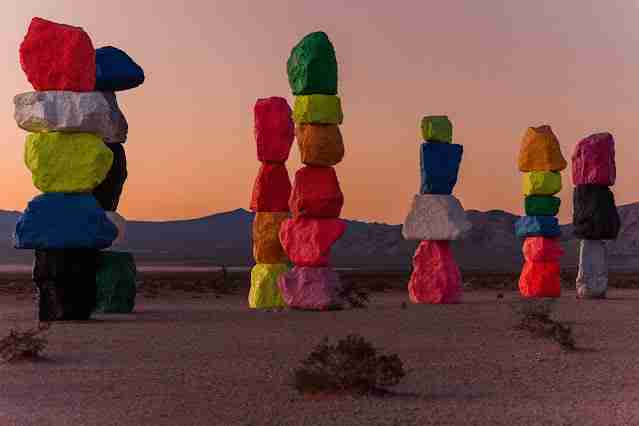
Read next: Blue Rocks: The Beginning of My Journey to Change
Andy Goldsworthy
Goldsworthy’s site-specific works use leaves, ice, stones, branches—materials found on location—often built to disappear. Their fragility becomes a metaphor for ecosystems under pressure, and for the ethics of attention.
Janet Echelman
Echelman’s aerial net sculptures respond to wind and light, turning public space into an environmental instrument. Her work sits between art and infrastructure, asking what “nature” means inside urban systems.
Zaria Forman
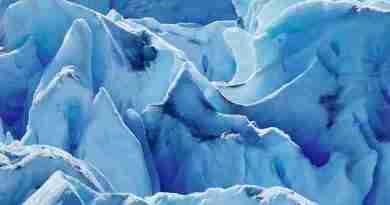
Forman’s hyper-real pastel drawings of glaciers and ice fields are emotionally charged documents of fragility. They translate climate data into intimacy, scale, texture, and loss you can feel.
Nils Udo
Udo creates temporary installations in nature using natural materials, often blending seamlessly into the site. His practice emphasizes interdependence and the poetic intelligence of ecosystems.
Chris Jordan
Jordan visualizes consumerism at scale—turning statistics into images that confront the hidden costs of daily life. The work is persuasive because it makes “numbers” become bodies, landscapes, and evidence.
Christo and Jeanne-Claude
By wrapping and temporarily transforming landscapes and infrastructures, Christo and Jeanne-Claude made visibility itself into a public event—revealing how environments are staged, owned, and regulated. Their practice sits at a boundary between spectacle and ecological attention.
Eco Art in Urban Landscapes
Eco art is not confined to remote sites. It can reconfigure cities and public habits. Joseph Beuys’ 7000 Oaks remains a key reference: a project that treated planting as social sculpture, expanding the idea of what an artwork can do in civic space.
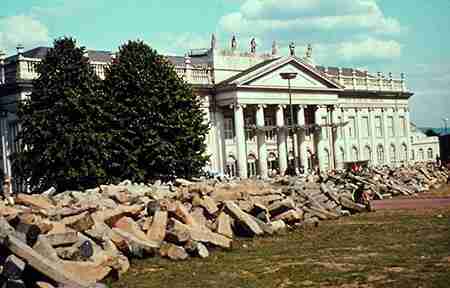
The legacy of these interventions is not just symbolic: it’s practical. Eco art can shift how public space is perceived, used, and cared for, especially when it creates long-duration change rather than one-off spectacle.
Interactive and Community-Based Projects
Eco art often moves beyond galleries through participatory formats that invite people into the work, not as viewers, but as co-responsible agents. This is where eco art becomes a method: workshops, local actions, “citizen” research, and community rituals that turn ecology into shared culture.
Mel Chin
Chin’s Revival Field explored phytoremediation, using plants to extract heavy metals from contaminated soil. It’s a landmark example of art that functions as a real ecological experiment, not just a representation.
Natalie Jeremijenko
Jeremijenko bridges art, technology, and activism through interactive projects that prescribe actions, small, feasible, specific—rather than vague awareness. Her work reframes “environmental health” as something communities can practice together.
Geographies of eco art: who faces what, where
Eco art is global, but environmental crisis is not evenly distributed. Different regions generate different artistic pressures—and different ethical questions about representation, extraction, and repair.
Europe and North America: institutions, infrastructure, and visibility
In many European and North American contexts, eco art often negotiates museums, public commissions, and the politics of infrastructure: what gets funded, what gets measured, and what counts as “impact.” Work that translates climate knowledge into public experience (like Eliasson) tends to circulate widely, while long-duration repair projects often struggle for visibility because their outcomes are slow and hard to brand.
Global South and decolonial ecologies: extraction, land rights, and environmental racism
Across many Global South contexts, eco art frequently intersects with extractivism, land sovereignty, water access, and environmental racism. Here “nature” is not a neutral landscape: it is contested territory. The artistic task becomes political by default—because pollution and dispossession are political realities.
Island and coastal realities: rising seas, tourism, and vulnerability
In island and coastal geographies, eco art often responds to sea-level rise, erosion, tourism economies, and fragile ecosystems. Artistic projects may operate as warning systems, public rituals of mourning, or community-driven repair. The question becomes: how do you represent a slow disaster without turning it into aestheticized ruin?
Next step for this hub: I will expand this section with dedicated regional reading paths (Latin America, Africa, South and Southeast Asia, and the Mediterranean), linking to specific artists and projects post by post.
Eco art and politics: climate justice, extractivism, law
Eco art becomes most urgent when it stops treating ecology as “background” and starts naming power: who profits from extraction, who pays the costs, and who gets erased from environmental narratives. That is why eco art often overlaps with climate justice movements and with forms of civic evidence.
- Climate justice: eco art can amplify unequal exposure to harm—heat, floods, toxic zones, displacement.
- Extractivism: artists address mining, oil, plantations, data extraction, and the aesthetics of consumption.
- Law and public accountability: in some cases, the artwork includes documentation, public testimony, and legal imagination—making harm contestable rather than merely visible.
If one boundary line defines eco art today, it is this: not “nature vs culture,” but repair vs spectacle. Eco art is strongest when it builds practices of attention, accountability, and long-term care.
Read next: The Stranglehold: Climate Crisis Between Cement and Fire
The Future of Eco Art
As climate instability accelerates, eco art continues to grow as a space where emotion, data, ethics, and imagination collide. It can challenge how we define progress, how we measure value, and how we narrate the future.
Through exhibitions, outdoor installations, social sculpture, and community projects, eco artists reshape public perception of what art can achieve: not only to represent a crisis, but to build practices of repair, attention, and accountability.
Related articles
- Eco Art category archive
- Sustainability in Contemporary Art: Artists Leading the Eco-Friendly Shift
- Environmental Art: A Contemporary Exploration of Nature
- Earth as Canvas: Exploring the Transformative World of Land Art
- The Stranglehold: Climate Crisis Between Cement and Fire
- Blue Rocks: The Beginning of My Journey to Change
- Christo and Jeanne-Claude: Transforming the Landscape Through Environmental Installations