Street Art AND The Vibrant World of Graffiti: A Celebration of Creativity and Community
Street art does not simply place images outdoors. It turns the city into a contested surface where visibility, ownership, memory and power are continuously negotiated.
Street art has moved from railway yards, subway tunnels and unauthorised walls into museums, auctions, festivals and global visual culture. Yet its importance does not depend only on scale, colour or public accessibility. Its real force comes from the unstable relationship it creates between an image and the place in which that image appears.
A mural can restore a suppressed history, transform the identity of a neighbourhood or become an instrument of urban branding. A stencil can challenge political authority, then be removed from its wall and sold. A work created illegally can be erased as vandalism, protected as cultural heritage or absorbed by the market.
This guide explores the artists, techniques and contradictions that shaped street art, from Banksy, Keith Haring and Jean-Michel Basquiat to JR, Swoon, Os Gemeos, Invader, Vhils, Shepard Fairey, Eduardo Kobra and Hanna Lucatelli.
Browse the wider Street Art archive for more artists, murals and critical essays, or explore the relationship between cities and cultural space in the Public Art archive.
What makes street art different from art placed outdoors?
Street art is not defined simply by location. A sculpture commissioned for a civic square, an advertising mural and an unauthorised stencil may all occupy public space, but they do not have the same relationship with permission, ownership or audience.
The street artist works with surfaces that already possess a social history. Walls divide private property from common space. Monuments establish official memory. Advertising purchases public attention. Graffiti and street art enter this visual environment without necessarily accepting its rules.
This is why context matters. The same image painted in a gallery and on a politically charged wall does not produce the same meaning. In the street, architecture, neighbourhood, weather, censorship and public reaction become part of the artwork.
The distinction between street art and graffiti is equally complicated. Graffiti developed around writing, tagging, crews and the transformation of letters into style. Street art is a broader category that often includes stencils, figurative murals, wheatpaste, mosaics, stickers, photography and sculptural interventions. The two histories overlap, but they should not be treated as interchangeable.
For a broader introduction to this transformation, read The Urban Art Movement: From Street Art to a Global Phenomenon.
How did the city become an artistic medium?
The city is more than a support for an image. It determines how the work is encountered and who is able to see it. Unlike a museum, the street does not ask the viewer to enter a designated cultural space. The artwork interrupts an ordinary journey, appearing during a commute, a protest, a walk or a moment of distraction.
This accessibility is often described romantically, as if art in public automatically belonged to everyone. In reality, public space is heavily controlled. Municipal governments, property owners, police, advertisers, developers and cultural organisations all compete to decide what can remain visible.
Street art makes that struggle easier to see. Its central question is not only “Is this art?” It is also “Who has the right to speak here?”
Banksy and the contradiction of illegal visibility
Banksy became the most internationally recognisable street artist by combining accessible imagery, political satire and carefully controlled anonymity. His stencils address war, surveillance, migration, consumer culture and institutional hypocrisy through images that can be understood almost immediately.
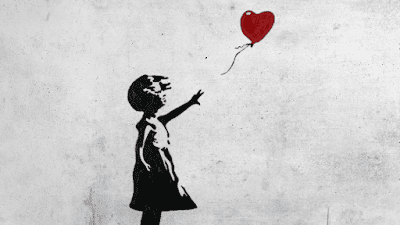
Girl with Balloon appears simple: a child reaches towards a heart-shaped balloon carried away by the wind. Its emotional openness has allowed it to circulate as an image of hope, loss, innocence and separation. That accessibility helped turn it into one of the most reproduced images associated with contemporary street art.

Banksy’s success also exposes street art’s central contradiction. A practice associated with unauthorised intervention has become a valuable global brand. Walls containing his works may be cut apart, protected behind transparent panels or removed for sale.
The conflict is not theoretical. As examined in They Spent £85,000 to Erase a Banksy. But Who Gets to Decide What Art Survives?, public authorities can classify an intervention as damage while the wider culture already considers it historically significant.
When a version of Girl with Balloon partially shredded itself immediately after being sold at Sotheby’s in 2018, the apparent attack on the market created an even more valuable artwork. The episode, explored in When Destruction Becomes Creation, demonstrated how efficiently the art market can transform rebellion into scarcity and spectacle.
Keith Haring: public drawing as social communication
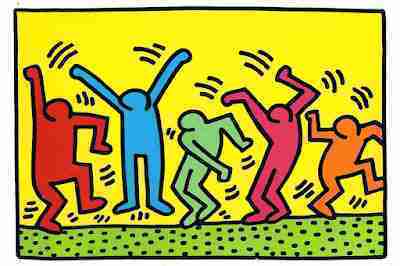
Keith Haring developed one of the most immediate visual languages of the twentieth century. His radiant babies, barking dogs and dancing bodies could communicate movement and emotional intensity without requiring specialist knowledge.
Haring’s early subway drawings were created on the empty black advertising panels of New York stations. These temporary works allowed him to engage commuters directly while developing a graphic language based on speed, repetition and public recognition.

The apparent simplicity of Haring’s work should not be mistaken for political innocence. He addressed AIDS, racism, apartheid, homophobia, nuclear anxiety and the vulnerability of children. His visual accessibility became a method of circulation, allowing urgent messages to travel beyond the institutional art world.
Haring understood that an image could be popular without becoming empty. His work remains a crucial example of how public art can combine pleasure, activism and formal discipline.
Jean-Michel Basquiat: from SAMO to the art market
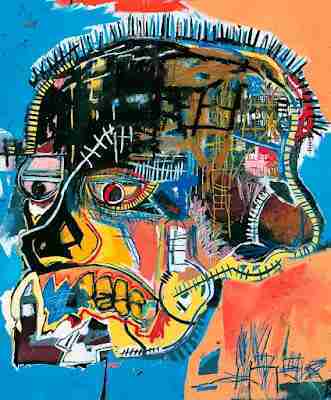
Jean-Michel Basquiat entered public attention through the cryptic SAMO texts he created with Al Diaz in Lower Manhattan. These interventions were closer to fragmented poetry and cultural criticism than to the figurative mural tradition commonly associated with street art.
Basquiat later moved rapidly into galleries, where his paintings combined anatomy, language, Black history, jazz, commodity symbols and references to European art. His work confronted how racial identity is represented, consumed and priced.

Calling Basquiat simply a street artist can obscure the complexity of his painting, but ignoring SAMO removes an essential part of his formation. His career demonstrates how quickly the art system can convert an artist associated with the street into a market mythology.
This tension between urban intervention, celebrity and institutional recognition is explored further in Jean-Michel Basquiat’s Artistic Odyssey in New York.
How did street art become a global language?
Street art did not simply spread outward from New York, London or Paris. Artists in different countries developed practices shaped by local histories, visual traditions and political conflicts. Its global expansion therefore produced multiple languages rather than a single international style.
Eduardo Kobra and monumental historical memory
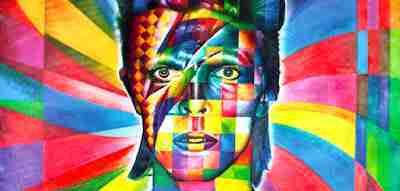
Brazilian muralist Eduardo Kobra is known for monumental portraits constructed through vivid geometric colour. His murals frequently depict cultural and political figures, turning recognisable faces into highly visible urban landmarks.

Kobra’s technique is immediately recognisable, but the scale of his work also raises a broader issue. Contemporary muralism often exists between public art, tourism, commemoration and urban regeneration. Visibility can produce collective memory, but it can also become part of a city’s marketing strategy.
JR and the politics of the photographic face
French artist JR uses monumental photographic portraits to make communities visible within the spaces they inhabit. His wheatpaste installations have appeared on buildings, rooftops, border structures and institutional façades.
JR’s work shifts attention away from the artist’s personal gesture and towards the photographed subject. Yet enlargement alone does not guarantee empowerment. His strongest projects ask who is normally represented in public space and whether temporary visibility can change the social conditions surrounding an image.
Os Gemeos and the visual culture of São Paulo
The Brazilian twins Otavio and Gustavo Pandolfo, known as Os Gemeos, developed a dreamlike universe of yellow figures, improvised machines, musical references and architectural transformations.
Their work grows from the visual density of São Paulo and from Brazilian popular culture, hip-hop and folklore. Rather than treating the wall as a neutral surface, Os Gemeos often make its windows, corners and dimensions part of the narrative.
Swoon and the vulnerability of paper
Swoon, born Caledonia Curry, is known for intricate wheatpaste portraits and hand-cut paper installations. Her figures often emerge from personal relationships, community histories and experiences of displacement or recovery.
Paper changes in public space. It tears, fades and absorbs the surface beneath it. This fragility gives Swoon’s work a different temporality from the monumental mural. The image is not designed to dominate the wall indefinitely. Its deterioration becomes part of its life.
Invader and the city as a playable network
French artist Invader installs ceramic mosaics inspired by early video-game graphics in cities around the world. By describing these dispersed works as “invasions,” he transforms urban geography into a connected system of discovery.
The project anticipated a central condition of contemporary street art: physical works are increasingly encountered through maps, photographs, apps and online documentation. The city becomes both a material location and a searchable interface.
Vhils and the image inside the wall
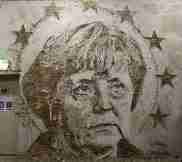
Portuguese artist Vhils, also known as Alexandre Farto, creates portraits by cutting, drilling and chiselling into walls. Instead of adding paint to a surface, he removes layers of plaster and construction material.
The technique makes the city’s physical history visible. Advertising, renovation, decay and demolition leave accumulated layers, and Vhils treats them as an urban archive. His portraits appear to emerge from the same structures that might eventually erase them.
When does street art become political art?
Street art is often called political simply because it appears outside museums. That assumption is too easy. A mural can be decorative, commercial, commemorative or openly propagandistic. Political meaning depends on subject, context, authorship and consequence.
Shepard Fairey: activism, propaganda and branding
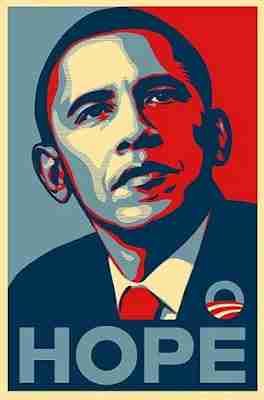
Shepard Fairey built a visual language based on repetition, graphic authority and the aesthetics of propaganda. His Obey Giant campaign placed an unexplained image into public circulation, while his 2008 Hope portrait of Barack Obama became one of the most recognisable political images of its era.

Fairey’s work is effective partly because it borrows the confidence of advertising and political propaganda. It also inhabits the contradiction between anti-authoritarian imagery and commercial production. This does not cancel its political significance, but it prevents easy claims of purity.
Hanna Lucatelli and the mural as historical correction
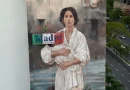
Street art can also intervene in collective memory. In Porto Alegre, Hanna Lucatelli’s monumental mural MADRE places a woman at the centre of the history of Italian emigration in Brazil.
The work does not treat the female figure as decoration or passive allegory. It makes visible the woman who crossed the ocean, transmitted language and memory, held families together and was frequently pushed to the margins of official narratives.
Read the full interview and analysis in Hanna Lucatelli and MADRE: The Mural Rewriting Italian Emigration.
The project demonstrates why murals still matter politically. A wall can become a place where the public image of history is not merely repeated, but corrected.
Chicano murals and public evidence
The relationship between muralism, identity and political visibility has a longer history. During the Chicano Movement, artists used murals to make Mexican-American culture present in neighbourhoods where official institutions often ignored or marginalised it.
These works were not designed only to beautify urban space. They operated as public evidence of community, history and political agency. Read more in Chicana Art: The Power of Murals in El Movimiento.
What techniques do street artists use?
Street art is not a single medium. Each technique produces a different relationship with speed, repetition, durability and risk.
- Spray paint allows rapid coverage, gradients, freehand drawing and large-scale lettering.
- Stencils make complex images repeatable and allow artists to work quickly in unauthorised locations.
- Wheatpaste transfers drawings, prints or photographs prepared in advance onto urban surfaces.
- Murals permit ambitious compositions but often require time, equipment and official permission.
- Stickers and posters distribute images through repetition and can function like alternative advertising.
- Mosaics create durable interventions that can become part of the architecture.
- Carving and removal use the physical layers of the wall rather than covering them.
- Temporary installations introduce objects, textiles, light or sculptural elements into public space.
Photography has also become essential. Many street works disappear quickly, but their images continue circulating online. Documentation can preserve an intervention, detach it from its original setting or transform a local work into a global media event.
What happens when street art enters festivals and museums?
Street art festivals can provide artists with legal walls, equipment, fees and access to large audiences. They can also create dialogue with local communities and turn neglected surfaces into significant cultural sites.
At the same time, commissioned mural districts can make rebellion feel safe and predictable. Areas such as Wynwood in Miami or Shoreditch in London demonstrate how street art can become connected to tourism, real-estate development and urban branding.
The movement from street to museum creates a related problem. Institutions can preserve important work and provide historical context, but removing street art from its environment can neutralise the conditions that gave it meaning.
The central issue is not whether street art belongs inside museums. It is what changes when an image created through exposure, illegality or site-specific tension becomes a protected cultural object.
Who owns an artwork painted on someone else’s wall?
Street art produces conflicts between several forms of ownership. The artist may claim moral authorship, while the building owner controls the physical wall. The local community may consider the work part of its cultural environment, and the market may assign it a financial value never anticipated when it was created.
Removal creates further complications. Once a section of wall is cut out and sold, the image survives but its relationship with place is destroyed. What appeared to be public art becomes private property.
Erasure can be equally significant. Street artworks disappear through weather, redevelopment, censorship and painting-over. That impermanence is not always a failure. It can be part of a practice built around intervention rather than possession.
Why street art remains essential to contemporary culture
Street art matters because it reveals that public space is never neutral. Every wall carries decisions about property, memory, advertising, access and control. Artists who intervene in those spaces make the politics of visibility difficult to ignore.
The strongest street art does more than brighten a neighbourhood or produce a photographable landmark. It changes how a place can be read. It may recover a suppressed history, interrupt an official narrative or make a familiar street suddenly feel unstable.
Street art has become part of the global art system, but it has not completely lost its capacity for disruption. Its contradictions are now part of its meaning. It can resist authority and support urban branding, speak for a community and become a private asset, disappear overnight and circulate online for decades.
Its future will depend not only on new images, but on the unresolved question at the centre of the movement: who has the power to occupy public space and leave a visible trace?
Recommended reading: a global map of street art
The World Atlas of Street Art offers a wider geographical perspective on the artists, cities and local cultures that have shaped street art around the world. It is a useful companion for readers who want to move beyond a history dominated by a small number of internationally famous names.
The World Atlas of Street Art
View the book on Amazon
Affiliate disclosure: As an Amazon Associate, I earn from qualifying purchases. The price paid by the reader remains unchanged.
Related articles
- Street Art: Artists, Murals and Urban Visual Culture
- The Urban Art Movement: From Street Art to a Global Phenomenon
- Hanna Lucatelli and MADRE: The Mural Rewriting Italian Emigration
- Banksy: The Enigmatic Street Artist Who Changed the Art Market
- JR: Transforming Public Space Through Photography
- Shepard Fairey: Between Activism, Propaganda and Art
- Swoon: The Intricate Storyteller of Urban Art
- Os Gemeos: Street Art, Fantasy and Brazilian Culture
- Vhils: Carving Identity into the City
- Pipe Yanguas: When an Insect Becomes a Cosmology