Contemporary Art 1950s
1950s Art Movements: How Post-War Art Changed the Centre of Modernism
The 1950s are often remembered as the decade when New York replaced Paris at the centre of modern art. That happened, but it is only half the story. While Abstract Expressionism became internationally dominant, artists in Europe, Japan, Mexico and elsewhere were already dismantling the idea that post-war art could have only one centre.
Contemporary art in the 1950s developed in the shadow of World War II and under the political pressure of the Cold War. Reconstruction, nuclear anxiety, consumer expansion, decolonisation and new mass media transformed the cultural environment in which artists worked. The decade produced monumental painting, but it also generated radical experiments with matter, movement, the everyday object and the relationship between art and life.
Abstract Expressionism became the most internationally visible post-war movement. Jackson Pollock, Willem de Kooning, Mark Rothko, Barnett Newman, Lee Krasner, Franz Kline and others helped shift the symbolic centre of the Western art world toward New York. Yet even within the New York School, the idea of one shared style is misleading. Pollock’s physical gesture and Rothko’s suspended fields of colour produced radically different kinds of experience.
Elsewhere, the decade was equally experimental. Lucio Fontana cut and punctured the traditional surface of painting in Italy. Art Informel and Tachisme transformed gesture and matter across Europe. Gutai artists in Japan used bodies, mud, paper and public action to reinvent artistic freedom after war. Jean Dubuffet’s interest in Art Brut questioned who had the authority to decide what counted as culture at all.
By the end of the decade, the next rupture was already visible. Robert Rauschenberg and Jasper Johns were bringing flags, beds, photographs and ordinary things back into art. Richard Hamilton and the Independent Group were analysing advertising and consumer imagery in Britain. ZERO sought a new beginning through light and movement, while the Situationist International attacked the increasingly spectacular organisation of everyday life.
The 1950s did not simply make New York the new centre of art. They made the idea of a single centre increasingly unstable.
This guide explores the major 1950s art movements, key artists and post-war debates that created the transition from heroic modernism toward the radically expanded art of the 1960s.
For a wider chronological view, visit the Contemporary Art Index.
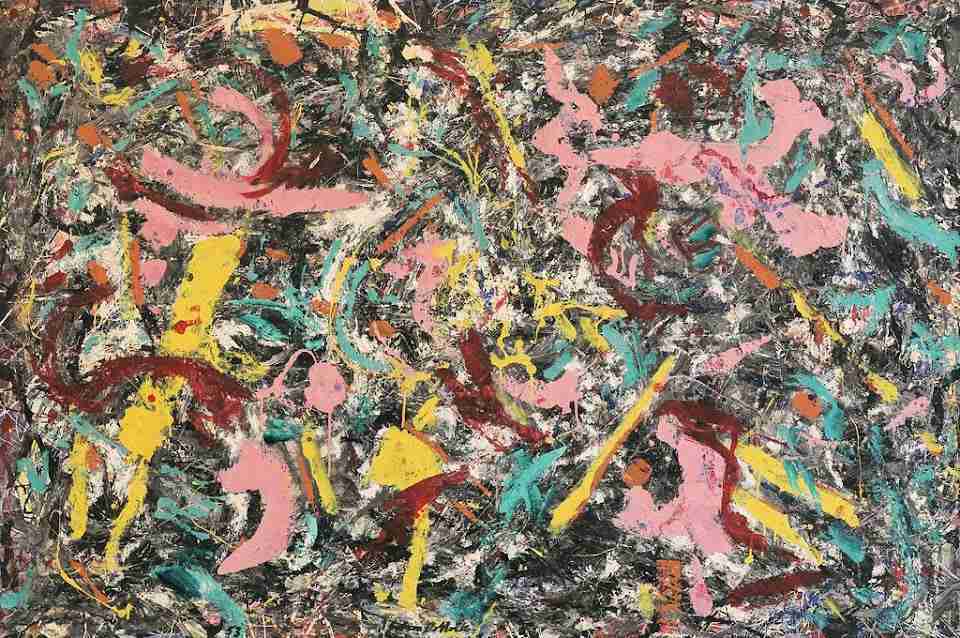
Jackson Pollock in the 1950s. The scale, physicality and all-over structure of Abstract Expressionism became symbols of a new post-war artistic confidence, but also of the mythology surrounding the autonomous modern artist.
Explore Art Movements and Trends of the 1950s
Open a section to explore the major movements, artists and ideas that transformed post-war art during the decade.
- Abstract Expressionism and the New York School
- Color Field Painting and the Sublime
- Spatialism and Post-War Italian Abstraction
- Art Informel, Tachisme and Lyrical Abstraction
- CO.BR.A. and Art Brut
- Gutai: Action, Matter and the Body
- Neo-Dada and the Return of the Everyday Object
- Early Pop Art and the Consumer Image
- Post-War Figuration and the Human Body
- ZERO, Light and the Search for a New Beginning
- Situationist International, City and Spectacle
Abstract Expressionism and the New York School
Gesture, scale and emotional intensity helped move the centre of the Western art world from Paris to New York.
Abstract Expressionism was the dominant American art movement of the early 1950s and one of the most influential developments in post-war art. Its artists did not share one recognisable style. What connected them was a new ambition for abstraction and scale, together with the belief that painting could become an event rather than simply an image.
Jackson Pollock made this transformation physical. Working with canvases placed on the floor, he dripped, poured and moved paint across enormous surfaces. The resulting paintings recorded movement without functioning as simple records of spontaneous emotion. Works such as One: Number 31, 1950 depended on an intense balance between accident and control.
Willem de Kooning developed a different language in which figuration and abstraction violently collided. His Woman paintings refused the idea that advanced painting needed to abandon the body. Franz Kline pushed black and white gesture toward monumental graphic structure, while Lee Krasner and Joan Mitchell demonstrated how incomplete the traditional male-centred history of Abstract Expressionism had been.
The movement’s cultural position also carried political meaning. During the Cold War, Abstract Expressionism was frequently associated with American freedom and individualism. This interpretation helped construct the mythology of the independent artist while concealing the more complicated political and institutional systems through which American culture was being promoted internationally.
The New York School extended beyond painting to poetry, music, dance and criticism. Its significance therefore lies not only in a group of canvases but in the cultural infrastructure that allowed New York to become an international centre of modern art.
Color Field Painting and the Sublime
Not all Abstract Expressionism was gestural. Large fields of colour turned painting into an environment for slow looking and psychological intensity.
Color Field Painting developed from Abstract Expressionism but moved away from the visible drama of action painting. Mark Rothko, Barnett Newman and Clyfford Still used large expanses of colour to create images whose intensity depended less on gesture than on scale, atmosphere and sustained attention.
Rothko’s mature language emerged around the beginning of the decade through luminous rectangular fields whose edges appear to breathe into one another. Rather than illustrating a specific subject, the paintings construct an emotional environment. The viewer does not simply inspect the composition but stands physically in relation to it.
Barnett Newman reduced the image even further. His vertical “zips” divide expanses of colour without functioning like conventional drawing. In paintings such as Vir Heroicus Sublimis, scale creates an encounter that is simultaneously minimal and monumental.
Helen Frankenthaler opened another route with her soak-stain technique. In Mountains and Sea of 1952, diluted paint entered the fibres of unprimed canvas rather than sitting heavily on its surface. The method would influence Morris Louis, Kenneth Noland and the generation associated with Post-Painterly Abstraction.
Color Field Painting therefore complicates the familiar image of 1950s art as aggressive gestural expression. The decade also produced paintings in which intensity emerged from restraint, duration and colour itself.
Spatialism and Post-War Italian Abstraction
In Italy, the surface of painting was no longer sufficient. Space, matter and the physical support itself became fields of experimentation.
The history of 1950s art becomes seriously distorted if it is narrated only through New York. Italy produced some of the decade’s most radical challenges to traditional painting, particularly through Spatialism and the material experiments surrounding post-war abstraction.
Lucio Fontana had begun developing Spatialism during the late 1940s, but the 1950s were decisive. His Buchi punctured the canvas, turning the surface into an actual opening rather than an illusion of depth. From 1958 his celebrated Tagli pushed the operation further through controlled cuts.
The importance of Fontana’s gesture is easy to lose because the slash later became an instantly recognisable image. Its radical proposition was not simply visual. The canvas ceased to function as an inviolable surface separating representation from real space. A physical void entered painting.
Post-war Italian abstraction developed along several other routes. The artists associated with Forma 1, founded in Rome in 1947, attempted to reconcile formal abstraction with politically engaged identities. Carla Accardi, Piero Dorazio, Achille Perilli, Pietro Consagra, Giulio Turcato and others developed increasingly distinct languages during the following decade.
Alberto Burri pursued another fundamental challenge through sacks, burns, plastics and damaged materials. Together with Fontana, his work demonstrated that the crisis of painting could be addressed not by abandoning the medium but by physically changing what a painted surface could be.
Italian art of the 1950s therefore belongs at the centre, rather than the margins, of the transition from modern painting toward the expanded artistic practices of the 1960s.
Art Informel, Tachisme and Lyrical Abstraction
European abstraction after the war turned gesture, stain and matter into languages of uncertainty rather than heroic certainty.
Art Informel became an important umbrella term for several forms of European abstraction that rejected precise geometric organisation. Matter, spontaneous gesture, texture and irregular marks offered artists ways to address a continent still processing the physical and psychological destruction of war.
Tachisme, from the French word tache, meaning stain, became particularly associated with gestural abstraction in France during the 1950s. Artists such as Georges Mathieu, Pierre Soulages, Hans Hartung and Wols developed radically different practices, but all challenged the expectation that abstract painting required predetermined geometric structure.
The visual similarities with Abstract Expressionism are obvious, yet simply treating European Informel as a weaker version of the New York School misses the historical conditions from which it emerged. Gesture had different meanings in societies confronting war damage, occupation, collaboration and political reconstruction.
Lyrical Abstraction overlapped with this larger field, emphasising atmospheric and gestural forms of abstraction without establishing one rigid style. The terminology itself is unstable because critics in different countries used competing labels to describe related but not identical practices.
That instability is historically useful. The post-war international art world was becoming connected, but it had not yet collapsed into one common vocabulary.
CO.BR.A. and Art Brut
Post-war artists challenged cultural refinement itself, searching for forms that appeared less controlled by academic taste and official institutions.
CO.BR.A. was founded in 1948 and existed formally only until 1951, but its final years belong directly to the cultural landscape from which the 1950s developed. The name combined Copenhagen, Brussels and Amsterdam, reflecting the international origins of artists including Asger Jorn, Karel Appel, Constant, Corneille and Christian Dotremont.
CO.BR.A. rejected polished artistic respectability through intensely coloured figures, spontaneous marks, collective experiments and an interest in children’s drawings, folk traditions and mythology. Its apparently primitive visual language was not a retreat from modernity. It was an attack on the cultural order that had accompanied European catastrophe.
Art Brut raised an even more difficult question. Jean Dubuffet championed work made outside conventional artistic institutions, including art by psychiatric patients, prisoners and self-taught creators. For Dubuffet, cultural sophistication itself could become a form of conformity.
The category remains ethically complicated. Celebrating art made outside institutions can challenge the canon, but it can also allow an established artist or curator to decide which outsiders become culturally valuable.
Art Brut therefore reaches beyond stylistic history. It asks who possesses the authority to call something art, a question that remains unresolved throughout contemporary culture.
Gutai: Action, Matter and the Body
In post-war Japan, artists made matter collide with bodies, weather, public space and action.
The Gutai Art Association was founded by Jirō Yoshihara in 1954 near Osaka and became one of the most radical avant-garde groups of the post-war period. Gutai challenged assumptions about painting while refusing the idea that Japanese contemporary art should simply imitate European or American modernism.
Its artists explored direct encounters between body and material. Kazuo Shiraga painted with his feet while suspended above the canvas. Saburo Murakami broke through sheets of paper with his body. Atsuko Tanaka constructed Electric Dress from coloured lights and electrical wiring, transforming clothing into a dangerous technological environment.
Gutai exhibitions also moved outside conventional gallery space. Outdoor projects exposed works to wind, sunlight, water and changing environmental conditions, while participatory experiments weakened the distinction between artwork and event.
The group’s post-war context matters. Creative freedom carried particular force in a society emerging from militarism and devastating wartime destruction. Yoshihara’s insistence on doing what had never been done before was therefore aesthetic and ethical at the same time.
Gutai is now recognised internationally partly because it makes the traditional Western chronology of post-war art impossible to sustain. Performance, installation, participation and material experimentation were not innovations radiating outward from one centre. They were developing through different cultural histories simultaneously.
Neo-Dada and the Return of the Everyday Object
By the end of the decade, flags, beds, newspapers and ordinary things were already dismantling the heroic purity of Abstract Expressionism.
The term Neo-Dada is commonly associated with artists including Robert Rauschenberg and Jasper Johns, whose work in the 1950s helped create the transition from Abstract Expressionism toward Pop Art, Conceptual Art and new forms of assemblage.
Rauschenberg’s Combines brought painting into direct contact with the material world. Quilts, photographs, newspaper, clothing and found objects could coexist with painted gesture. Bed of 1955, for example, converted bedding into a vertical painted surface while deliberately confusing intimate object and art object.
Jasper Johns turned familiar signs such as flags, targets and numbers into paintings. His American flag was already an image before he painted it. The work therefore destabilised the distinction between representing something and presenting a sign whose meaning the viewer already carries.
The two artists changed the direction of American art precisely because they refused a simple choice between abstraction and representation. The everyday world could enter the artwork without returning to traditional realism.
This was the beginning of a crucial shift. The heroic artist had dominated early post-war painting. By the late 1950s, cultural signs, found materials and repetition were beginning to compete with the expressive self.
Early Pop Art and the Consumer Image
Before Warhol’s soup cans, British artists were already asking what advertising, television and consumer desire were doing to visual culture.
Pop Art became an internationally dominant phenomenon during the 1960s, so treating it as a fully developed 1950s movement would be historically misleading. Its foundations, however, belong firmly to this decade.
In Britain, artists and critics associated with the Independent Group examined advertising, science fiction, Hollywood, magazines, domestic technology and the rapidly expanding consumer economy. Richard Hamilton became one of its central figures.
Hamilton’s 1956 collage Just what is it that makes today’s homes so different, so appealing? condensed the new world into a single interior packed with consumer goods, entertainment, idealised bodies and commercial signs. The work is frequently treated as one of the foundational images of British Pop.
The historical importance of early Pop lies in recognising that mass culture was not merely a lower cultural form against which fine art could define itself. Advertising and entertainment were increasingly constructing the visual environment in which everyone lived.
Across the Atlantic, Johns and Rauschenberg were producing a different bridge toward Pop by introducing recognisable signs and everyday materials into American painting. Warhol, Lichtenstein and Rosenquist would make the transformation unmistakable during the following decade.
The 1950s therefore did not yet belong to Pop Art. They produced the conditions that made Pop inevitable.
Post-War Figuration and the Human Body
The triumph of abstraction did not make the figure disappear. It made the painted body more unstable.
The dominance of Abstract Expressionism can give the false impression that serious post-war painting had abandoned representation. In reality, several important figurative practices developed alongside abstraction during the 1950s.
In California, the Bay Area Figurative Movement emerged when painters including David Park, Richard Diebenkorn and Elmer Bischoff returned to the figure while retaining the scale, colour and energetic handling associated with Abstract Expressionism.
The return was not academic. Figures, interiors and landscapes remained unstable within fields of paint. Abstraction had changed figuration permanently, even when recognisable bodies returned.
Related tensions existed in New York through what has been described as New York Figurative Expressionism. Artists maintained relationships with gestural painting while resisting the demand that advanced art become completely non-objective.
Francis Bacon pursued another form of post-war figuration in Britain. Distorted bodies, enclosed spaces and screaming faces transformed the human figure into evidence of psychological and historical instability. His paintings belonged to neither American AbEx nor conventional realism.
Post-war figuration therefore matters because it breaks the neat textbook opposition between abstraction and representation. The body survived, but after war it could no longer appear entirely secure.
ZERO, Light and the Search for a New Beginning
By the late 1950s, some European artists wanted not another expressive style but a symbolic reset.
ZERO was founded in Düsseldorf in 1957 by Heinz Mack and Otto Piene, with Günther Uecker later becoming a central figure. The name suggested a point of departure, an attempt to move beyond the heavily subjective languages of post-war Informel and Expressionism.
Light, movement, repetition, monochrome surfaces and reflective materials became central. Instead of treating the canvas as an arena for emotional gesture, ZERO artists explored changing optical and environmental conditions.
The movement connected with a much wider European network. Artists working around groups such as Nul and related tendencies exchanged exhibitions and ideas across national borders. Yves Klein, Lucio Fontana and Piero Manzoni intersected with parts of this expanded field without simply becoming members of one uniform movement.
ZERO is important because it anticipates several developments associated with the 1960s: Kinetic Art, Op Art, Light and Space, Minimalism and increasingly environmental approaches to perception.
The post-war artwork was moving away from the expression of an individual psychological interior toward systems of light, material and perception that existed between the object and its viewer.
Situationist International, City and Spectacle
The most radical artistic question of the late decade may have been whether making more art objects was enough.
The Situationist International was founded in 1957 through the convergence of avant-garde groups concerned with art, politics, architecture and everyday life. Guy Debord became its best-known theorist, but the Situationists resisted behaving like a conventional artistic movement.
Their criticism targeted a society increasingly structured through commodities, mass media and passive consumption. What Debord would later describe as the “spectacle” was not simply entertainment. It was a social condition in which lived relationships increasingly appeared through representations and commodities.
Practices such as the dérive encouraged drifting through cities outside predetermined routes, while détournement involved redirecting existing images and messages toward new meanings. Both strategies attempted to interfere with habitual forms of perception.
The Situationists became especially influential through the political culture of the following decade, but their foundation in 1957 matters to the history of art because they radically challenged the idea that cultural opposition could be contained inside museums.
Rather than asking how art could represent everyday life, they asked how everyday life itself might be transformed.
Other Important Post-War Art Currents of the 1950s
The movements above describe the decade’s strongest structural changes, but the post-war art world was already much larger than the familiar axis connecting Paris and New York.
Generación de la Ruptura and Mexican Modernity
In Mexico, younger artists increasingly resisted the expectation that national artistic identity had to remain defined by the monumental mural tradition of Rivera, Orozco and Siqueiros. The artists later grouped under the term Generación de la Ruptura pursued abstraction, new forms of figuration and wider international dialogue.
The label describes a diverse field rather than a single unified aesthetic movement. Its historical importance lies in demonstrating that post-war modernity in Mexico developed through arguments about local tradition and international experimentation rather than by simply importing American or European styles.
Explore Generación de la Ruptura: Breaking Boundaries in Mexican Art.
Australia, New Zealand and the Problem of Imported Canons
Artists in Australia and New Zealand also negotiated difficult relationships between international modernism, landscape and local histories. Sidney Nolan and Colin McCahon developed radically different approaches to place, narrative and identity, while the Antipodeans would formally articulate their defence of figurative painting in Melbourne at the end of the decade.
These histories matter because the term “post-war art” often disguises its own geography. The cultural problems experienced in New York, Paris, Tokyo, Mexico City or Melbourne were not interchangeable.
Explore Antipodean Art: Australia and New Zealand After the War.
Plasticien Painting and Canadian Abstraction
In Montreal, the Plasticiens developed a disciplined geometric abstraction during the mid-1950s that rejected both traditional representation and the more gestural approaches associated with Automatism. Their work demonstrates how regional modernisms generated different answers to the same international argument over gesture, structure and artistic autonomy.
Photography and the Global Human Image
Photography played an enormous role in post-war visual culture even when it did not operate under one dominant movement. Photojournalism, magazines and exhibitions expanded the circulation of images across national boundaries. MoMA’s 1955 exhibition The Family of Man, despite later criticism of its universalising humanism, demonstrated the cultural authority photography could acquire as a language of shared experience.
The contradiction would become increasingly important: photography could make distant lives visible while simultaneously reducing political and historical differences to images consumed elsewhere.
Unofficial Art Under State Control
The history of 1950s art also cannot be limited to cultural systems where artists possessed relative freedom of exhibition. Under Soviet and other authoritarian contexts, official expectations restricted artistic production and visibility. The practices later grouped as Soviet Nonconformist Art became more visible in the following decades, but their conditions were being formed within the political tensions of the post-Stalin period.
What Defined Art in the 1950s?
The 1950s are often described as the triumph of Abstract Expressionism, and there is good reason for that interpretation. The movement helped make New York the new centre of international modern art, while Pollock, Rothko and de Kooning became symbols of an extraordinarily ambitious form of painting.
But stopping there produces a distorted history.
Fontana was physically opening the canvas in Italy. European Informel was turning post-war instability into matter and gesture. Gutai artists were using bodies and materials in Japan. Dubuffet was challenging institutional definitions of cultural value. Johns and Rauschenberg were bringing familiar signs and ordinary objects back into art.
At the same time, the first languages of Pop were emerging from consumer culture, ZERO was searching for a post-expressionist beginning through light and movement, and the Situationists were already arguing that images, cities and commodities were transforming everyday experience itself.
None of these developments completely replaced the others. That coexistence is precisely what makes the decade important.
The 1950s did not end modernism. They broke its monopoly on the future.
The heroic painter continued to exist, but no longer represented the only credible direction for advanced art. Matter could compete with gesture. An ordinary object could compete with abstraction. A hole could compete with an image. An action could compete with a permanent object.
The decade also revealed that the apparent relocation of art’s centre from Paris to New York was taking place at exactly the moment when the idea of one centre was becoming increasingly difficult to defend. Gutai, Spatialism, Mexican abstraction and other international practices were not peripheral footnotes to an American story. They were evidence that post-war art was already becoming structurally plural.
This is the real bridge to the 1960s. The 1950s destabilised the authority of the dominant post-war language. The next decade would turn that instability into Pop Art, Minimalism, Conceptual Art, Fluxus, Arte Povera, Video Art and an unprecedented expansion of what an artwork could become.
Related Articles
- The New York School: Defining Abstract Expressionism
- Color Field Painting: Power, Color and Scale
- Lucio Fontana: Spatialism and the Space Beyond Painting
- Tachism: Post-War French Abstraction
- Jean Dubuffet and Art Brut
- Gutai: Art, Matter and Creative Freedom
- Neo-Dada: Rauschenberg, Johns and the Everyday Object
- Pop Art: Consumer Culture and Visual Power
- Bay Area Figurative Movement: Bringing the Figure Back
- Situationism: Art, Revolution and Spectacle