Contemporary Art 1980s
1980s Art Movements: Money, Media, Identity and the Image Wars
The 1980s turned the image into a battleground. Painting returned with enormous force, graffiti entered galleries, advertising became artistic material and the art market expanded spectacularly. At the same time, AIDS, feminism, queer activism and institutional critique exposed how violently bodies, images and cultural value were being controlled.
Contemporary art in the 1980s cannot be explained as a simple return to painting after the Conceptual Art of the previous decade. Painting certainly returned, through Neo-Expressionism, Transavanguardia and other international tendencies, but so did an intense suspicion of images themselves.
Cindy Sherman, Sherrie Levine, Richard Prince, Barbara Kruger and other artists associated with the Pictures Generation questioned originality, authorship, gender and the power of mass media. Jean-Michel Basquiat and Keith Haring carried languages developed in downtown New York and public space into an increasingly powerful gallery system. Jeff Koons and Peter Halley turned consumer objects, geometric abstraction and the visual language of capitalism back onto the culture that produced them.
Politics also entered the decade with extraordinary urgency. The AIDS epidemic devastated communities while governments and institutions often responded with silence or hostility. Artists, collectives and activists transformed grief, sexuality, statistics, posters, bodies and public space into tools of resistance. The Guerrilla Girls attacked sexism and racism inside museums, while the NAMES Project AIDS Memorial Quilt transformed thousands of individual losses into an overwhelming collective image.
Technology was changing artistic language at the same time. Video, electronic sound, projection and digital systems expanded beyond experimental niches. Laurie Anderson, Nam June Paik and Bill Viola demonstrated that moving images and electronic media could produce forms of experience impossible within painting or sculpture alone.
The defining contradiction of 1980s art was that criticism and commerce expanded together. Art attacked advertising while learning its visual language. Artists criticised the market while becoming global celebrities. Museums were challenged for their exclusions at the same moment that contemporary art acquired unprecedented cultural and financial visibility.
This guide explores the major 1980s art movements, artists and cultural conflicts that made the decade one of the decisive turning points in contemporary art.
For a wider chronological view, visit the Contemporary Art Index.
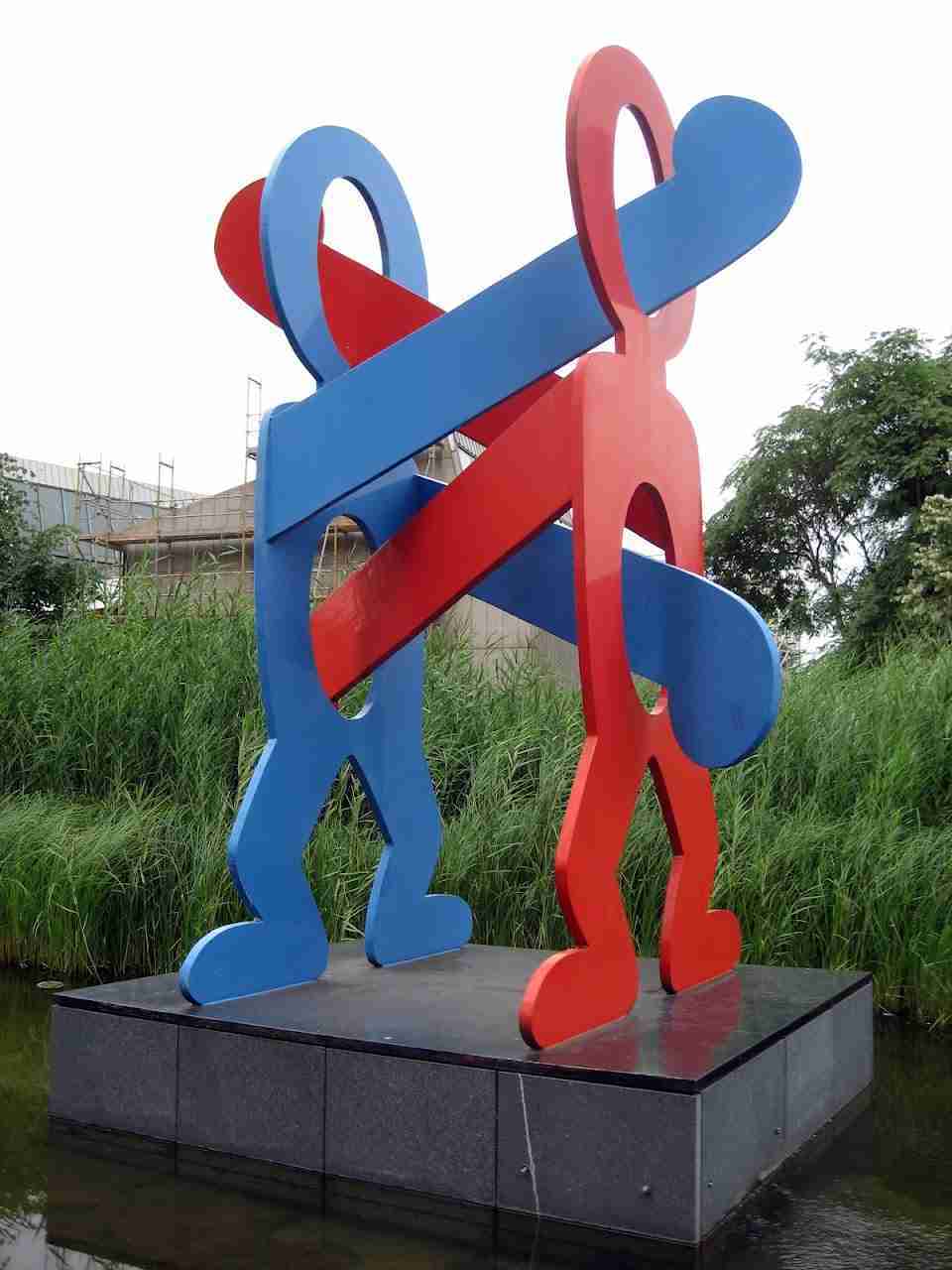
Keith Haring, Berlin Tiergarten. Haring transformed the speed and accessibility of public drawing into one of the most recognisable artistic languages of the 1980s, connecting street culture, sexuality, activism and mass communication.
Explore Art Movements and Trends of the 1980s
Open a section to explore the major movements, artists and cultural conflicts that shaped contemporary art during the decade.
- Postmodernism, Pictures Generation and Appropriation Art
- Neo-Expressionism, Transavanguardia and the Return to Painting
- Graffiti, Street Art and Downtown New York
- Neo-Geo, Neo-Pop and Commodity Culture
- AIDS, Queer Art and Activism
- Feminist Art and the Politics of the Image
- Institutional Critique and Museum Power
- Video Art, Electronic Art and Performance
- Global, Indigenous and Eastern European Practices
- Environmental Art and Ecological Awareness
- Culture Jamming and Media Activism
Postmodernism, Pictures Generation and Appropriation Art
Originality itself became suspicious as artists turned advertising, cinema, photography and existing artworks into material.
Postmodernism was not one visual style. In the 1980s it described a broader collapse of confidence in originality, artistic purity and the idea that history progressed neatly from one avant-garde to the next. Artists quoted the past, borrowed existing images and treated mass culture as something that could no longer be kept outside serious art.
The Pictures Generation became central to this transformation. Cindy Sherman constructed fictional female identities through photography. Sherrie Levine photographed existing photographs, deliberately destabilising ideas of authorship and originality. Richard Prince rephotographed advertisements. Louise Lawler photographed artworks inside the homes, museums and collections that gave them economic and cultural value.
Barbara Kruger took another route. Her combinations of photographs and commanding text adopted the visual authority of advertising in order to expose how advertising, politics and ideology speak to the viewer. The image did not simply represent power. It became one of the places where power operated.
Appropriation Art therefore posed a deceptively simple question: if contemporary culture is already saturated with images, why pretend that the artist begins with an empty surface?
The consequences extended far beyond the 1980s. Remix culture, sampling, internet memes and generative systems would later make the distinction between original and borrowed material even more unstable.
Neo-Expressionism, Transavanguardia and the Return to Painting
Painting returned with bodies, myths, violence, colour and historical memory, but there was no single international style.
The early 1980s witnessed a powerful revival of figurative and expressive painting. After years in which Minimalism and Conceptual Art had repeatedly challenged the authority of the painted object, large canvases, visible gesture, mythology and emotionally charged imagery returned to international galleries.
Neo-Expressionism became the broad label most associated with this revival. In the United States, Julian Schnabel used broken plates and aggressively material surfaces. Jean-Michel Basquiat combined anatomy, language, race, history, jazz and graffiti-derived energy. In Germany, Georg Baselitz and Anselm Kiefer confronted national memory and the unresolved weight of twentieth-century history.
Italy developed a distinctive response through the Transavanguardia, a term introduced by Achille Bonito Oliva. Sandro Chia, Francesco Clemente, Enzo Cucchi, Mimmo Paladino and Nicola De Maria rejected the idea that artistic progress required a constant rejection of history. Myth, symbolism, colour and older visual languages could be reused without pretending that they remained untouched by the present.
Related movements and scenes appeared elsewhere, including Germany’s Neue Wilde and France’s Figuration Libre. They should not be collapsed into one international Neo-Expressionist style. What they shared was a renewed willingness to use painting without apologising for its historical baggage.
The return of painting was also a market event. Large, recognisable canvases fitted extremely well into a rapidly expanding gallery and auction system. Formal revival and financial revival became difficult to separate.
Graffiti, Street Art and Downtown New York
A language developed on trains, subway walls and streets entered galleries without leaving behind the politics of public visibility.
Graffiti culture had developed before the 1980s, but the decade transformed its relationship with contemporary art. New York became a particularly important laboratory as artists, graffiti writers, musicians, clubs, galleries and alternative spaces crossed paths within the same downtown culture.
Keith Haring understood public space as a communication system. His subway drawings used simple graphic forms that could be understood immediately by commuters while addressing sexuality, nuclear fear, racism, apartheid and eventually AIDS.
Jean-Michel Basquiat’s relationship with graffiti was more complicated. His early SAMO texts belonged to the street, but his mature painting rapidly entered galleries and cannot be reduced to graffiti. He combined art history, anatomy, Black history, language and popular culture into dense surfaces in which visibility itself became a struggle.
This transition created a contradiction that still defines street art. Work born through unauthorised use of public space could acquire extraordinary commercial value once translated into an object, photograph or artistic signature.
The street did not simply enter the museum. The museum learned how to turn the cultural energy of the street into value.
Neo-Geo, Neo-Pop and Commodity Culture
Consumer capitalism did not remain outside the artwork. Its objects, surfaces, logos and systems became artistic material.
The 1980s were marked by expanding financial markets, luxury consumption, corporate branding and an increasingly powerful commercial art system. Several artistic tendencies responded not by rejecting these surfaces but by imitating them so closely that criticism and fascination became difficult to distinguish.
Neo-Geo, short for Neo-Geometric Conceptualism, included artists such as Peter Halley, Ashley Bickerton, Haim Steinbach and Jeff Koons in discussions around geometry, systems, commodities and simulation. Halley’s fluorescent cells and conduits transformed geometric abstraction into diagrams of technological and social confinement.
Jeff Koons made the ambiguity even more extreme. Vacuum cleaners, basketballs and consumer objects appeared with extraordinary visual perfection. The work could be read simultaneously as celebration, parody and forensic examination of desire.
Neo-Pop revisited the lessons of Pop Art in a culture where consumer imagery had become even more pervasive. The difference was historical. Warhol had confronted a rapidly expanding post-war consumer society. Artists of the 1980s were already living inside a world in which branding had become part of personal identity.
The key question was increasingly uncomfortable: if capitalism can absorb almost every criticism directed against it, how can an artwork use commercial language without simply becoming another luxury product?
AIDS, Queer Art and Activism
The AIDS crisis made visibility a matter of life, death, memory and political survival.
No account of art in the 1980s is complete without the AIDS epidemic. The crisis devastated gay communities and other vulnerable populations while stigma, governmental neglect and homophobia shaped public responses to illness and death.
Artists responded in radically different ways. David Wojnarowicz turned rage, sexuality and political accusation into a direct attack on systems that treated certain deaths as acceptable. Nan Goldin photographed communities from inside relationships of friendship, intimacy and loss rather than from the supposedly neutral position of the outside observer.
Keith Haring used a graphic language capable of moving between galleries, posters and public campaigns. Activist organisations such as ACT UP and Gran Fury understood that design and public communication could become political weapons.
The NAMES Project AIDS Memorial Quilt provided one of the most powerful collective responses. Individual textile panels transformed statistics into names and names into physical presence. When the Quilt was displayed on the National Mall in 1987, grief became impossible to contain within private mourning.
AIDS changed not only the subject matter of art but the ethics of visibility. To show a body, a lover or a death could become an act against erasure.
Feminist Art and the Politics of the Image
Feminist artists moved beyond representation and began attacking the systems deciding who could represent whom.
Feminist art entered a new phase during the 1980s. Earlier feminist practices had exposed domestic labour, bodily politics and exclusion from art history. The new media environment made advertising, photography, statistics and institutional visibility increasingly important battlegrounds.
Barbara Kruger turned the grammar of advertising against itself. Her works speak with the commanding tone of commercial persuasion while exposing gender, desire and power. Cindy Sherman’s constructed photographic identities destabilised the apparent naturalness of feminine stereotypes and revealed identity as something repeatedly performed through images.
The Guerrilla Girls, formed in New York in 1985, shifted attention from individual representation toward institutional evidence. Posters and statistics made museum inequality visible in a language that was fast, funny and difficult to ignore.
Their importance lies partly in method. Instead of asking whether museums personally supported women artists, they asked what museums actually collected, exhibited and rewarded. Institutional claims could be compared with measurable behaviour.
Feminist art therefore became increasingly inseparable from a wider question about cultural infrastructure: it was not enough for women to appear in images if the systems assigning artistic value remained unchanged.
Institutional Critique and Museum Power
Artists stopped treating the museum as a neutral room and began examining the money, architecture and authority behind its walls.
Institutional Critique originated before the 1980s, but the decade made its questions increasingly urgent. As the market expanded and museums became more powerful cultural institutions, artists examined how galleries and collections produced value rather than merely recognising it.
Hans Haacke investigated financial relationships, political connections and sponsorship. Michael Asher altered exhibition architecture in ways that forced viewers to notice conditions normally designed to disappear. Louise Lawler photographed artworks inside collections and private interiors, shifting attention from the art object toward the structures through which ownership creates meaning.
The Guerrilla Girls attacked the same institutional system from another direction, exposing discrimination through statistics. Feminism, institutional critique and media activism therefore frequently overlapped.
The central question remains unresolved: can a museum exhibit criticism of institutional power without converting that criticism into another source of institutional prestige?
Video Art, Electronic Art and Performance
Screens, electronic sound and time-based media expanded what an artwork could do to the body and to perception.
Video art had emerged earlier, but technological developments during the 1980s expanded its possibilities. Electronic images increasingly entered installations and performance while artists explored relationships between television, technology, time and bodily presence.
Nam June Paik continued to transform television from a communication appliance into sculptural and cultural material. Bill Viola developed increasingly complex video environments concerned with perception, consciousness and the experience of time.
Laurie Anderson crossed boundaries between performance, music, storytelling and electronic technology. Her work demonstrated that electronic media did not have to remain visually futuristic. Technology could become part of voice, memory and narrative.
Performance also remained vital because the live body provided something electronic culture could not completely replace. Artists inherited the radical body practices of the previous decades while responding to gender, sexuality, endurance and the increasingly mediated conditions of public life.
This period is important because technology ceased to function merely as a specialised experimental tool. Electronic media were gradually becoming part of the normal vocabulary of contemporary art.
Global, Indigenous and Eastern European Practices
The Western art world began to widen its geography, although recognition continued to depend heavily on Western institutions.
The language of a fully “global contemporary art world” belongs more clearly to the 1990s and 2000s, but important transformations were already visible during the 1980s. Artists outside the established Western centres increasingly entered international exhibitions while challenging the assumption that modernity had one geographical origin.
Contemporary Indigenous Australian art became increasingly visible internationally. These practices connected land, memory, cultural sovereignty and highly sophisticated systems of visual knowledge. Describing them simply as a new “movement” would reproduce the very misunderstanding that greater recognition was beginning to challenge.
In socialist Yugoslavia, Neue Slowenische Kunst, founded in 1984, developed a radically different response to politics and representation. Through groups including Laibach and IRWIN, NSK appropriated ideological symbols and the visual languages of state authority until the distinction between imitation and criticism became deliberately unstable.
Similar questions appeared in different forms across Latin America, Eastern Europe, Asia and regions shaped by dictatorship, postcolonial politics or Cold War division. Art could no longer be narrated convincingly as though New York and Western Europe constituted the entire contemporary world.
The decisive global turn was still coming. The 1980s helped make its necessity impossible to ignore.
Environmental Art and Ecological Awareness
Nature increasingly appeared not only as landscape but as a political system affected by industrial production and human intervention.
Environmental Art did not originate in the 1980s. Land Art, ecological practices and site-specific interventions already had important histories. During the decade, however, environmental awareness expanded as pollution, nuclear anxiety and industrial damage became increasingly visible cultural concerns.
Artists continued to work with landscape, restoration, organic materials and site-specific processes. The strongest practices moved away from the idea of nature as untouched scenery and toward a more difficult understanding of environments as systems shaped by economics, technology and human decisions.
This also created an ethical problem. An artwork claiming to celebrate nature could itself transform or damage the environment in which it appeared. Environmental practice therefore increasingly required artists to consider not only what a work represented but what physical consequences its production created.
These questions would grow dramatically during the 1990s and eventually become central to the climate art and ecological practices of the twenty-first century.
Culture Jamming and Media Activism
Advertising became both target and weapon as artists learned to interrupt mass-media messages from inside their own visual language.
The term culture jamming became associated with strategies that altered advertising, billboards and commercial communication in order to expose the ideological assumptions inside them. Its roots stretch further back, but the increasingly media-saturated culture of the 1980s gave these tactics new relevance.
The logic was simple: rather than creating an alternative image elsewhere, interfere with the message where people already encounter it. Change a billboard, imitate a corporate logo, distort a familiar slogan or reproduce advertising language until its manipulative structure becomes visible.
Culture jamming overlapped with feminist activism, street art and later tactical media. The Guerrilla Girls demonstrated how posters could turn institutional statistics into public embarrassment, while artists such as Barbara Kruger showed how the commanding language of advertising could be reused against itself.
The approach anticipated much of contemporary online culture. Memes, parody accounts and digital remix now perform similar acts of symbolic hijacking, although the scale and speed of circulation are radically different.
Other Forces That Shaped Art in the 1980s
Postmodern Architecture and Design
Postmodernism transformed architecture and design as well as visual art. Historical references, ornament, colour and irony challenged the austere universalism associated with much modernist design. Buildings and objects increasingly behaved like signs, quoting cultural histories rather than pretending to begin from zero.
Explore Postmodernism: Art, Architecture and Philosophy.
The 1980s Art Market Boom
The decade dramatically expanded the financial visibility of contemporary art. Galleries, collectors, auction houses and media coverage helped turn individual artists into cultural celebrities. Large paintings were especially compatible with this economy because they were unique objects that could be exhibited, collected and resold easily.
This does not mean that the decade’s painting revival was merely a market invention. It means that aesthetic and economic forces reinforced each other. Basquiat, Schnabel, Koons and many others became artists and public names inside a system increasingly capable of translating recognition into enormous financial value.
Personal Computing, Fractals and the Demoscene
Computer-generated images remained marginal compared with painting, photography or video, but the 1980s were crucial to the development of digital visual culture. Personal computers made algorithmic image-making increasingly accessible, while fractal imagery demonstrated how mathematics could generate apparently organic complexity.
The demoscene developed through programmers and digital communities pushing limited hardware to produce increasingly sophisticated audiovisual effects. These practices did not carry the same institutional weight as Neo-Expressionism or Appropriation Art, but they helped create the technical and cultural foundations of later digital art.
What Defined Contemporary Art in the 1980s?
The 1980s are sometimes remembered simply as the decade when painting returned and the art market exploded. Both statements are true, but neither explains what made the decade historically important.
The deeper transformation concerned images and power. Advertising, television, photography and consumer culture surrounded everyday life with unprecedented visual persuasion. Artists responded by borrowing those images, attacking them, imitating them or moving outside galleries into streets and public communication.
At the same time, bodies became political battlegrounds. Feminism challenged the supposedly neutral standards of museums. AIDS exposed the deadly consequences of silence and stigma. Queer artists transformed intimacy and grief into public evidence. The Guerrilla Girls demonstrated that statistics could become artistic material when institutions refused to acknowledge structural discrimination.
The market complicated everything. Critics of consumer culture became expensive commodities. Street languages entered galleries. Artists examining desire became brands themselves. Even institutional criticism could eventually be collected by the institution being criticised.
The central contradiction of 1980s art is that resistance and commodification learned to use many of the same images.
This is why the decade leads so directly into contemporary culture. Appropriation anticipated remix. Neo-Geo anticipated the architecture of networks and consumer systems. Culture jamming anticipated memes. Guerrilla Girls anticipated data-driven activism. The AIDS crisis made the politics of visibility impossible to treat as abstract theory.
The 1980s did not simply produce another group of art movements. They changed the relationship between art, media, identity, institutions and money. The 1990s would inherit that conflict and make it global.
Related Articles
- Postmodernism: Art, Architecture and Philosophy
- Neo-Expressionism: History and Key Artists
- Transavanguardia: Italian Postmodern Art
- Cindy Sherman: Identity as Costume
- Barbara Kruger: Media, Power and Identity
- Keith Haring: Art and Social Activism
- Jean-Michel Basquiat: From SAMO to Global Icon
- The NAMES Project AIDS Memorial Quilt
- Institutional Critique: Challenging Museum Power
- Video Art: How Moving Images Rewired Contemporary Art