Contemporary Art 2000s
Contemporary Art in the 2000s: When Art Went Global
The 2000s promised a connected art world. The internet became ordinary, museums grew spectacular, biennials multiplied and artists crossed borders more rapidly than ever before. Yet connection did not eliminate inequality. It created new networks of visibility, mobility and value, and revealed who had the power to control them.
Contemporary art in the 2000s cannot be reduced to one dominant movement. Digital art expanded as broadband internet, affordable software and digital cameras entered everyday life. Large-scale installation transformed museums into environments. Street art moved from walls into galleries and auction houses, while Superflat collapsed distinctions between painting, anime, design and merchandise.
At the same time, painting remained extraordinarily active. Photography and moving image responded to a world saturated with digital images. Relational aesthetics and socially engaged practices questioned whether encounters themselves could become artworks, while artists confronting 9/11, the wars in Afghanistan and Iraq, surveillance, migration and global inequality brought documentary and political strategies back to the centre of contemporary art.
The decade was also decisive for the globalisation of the art system. China became increasingly important to international contemporary art. Biennials and art fairs proliferated, new museums competed through spectacular architecture and the contemporary art market expanded dramatically before the financial crisis of 2008 exposed its dependence on speculation and wealth.
The defining tension of art in the 2000s was therefore not simply old media versus new technology. It was connection versus control. More artists, images and cultures could circulate globally, but access to institutions, markets, technology and physical mobility remained profoundly unequal.
This guide explores the major 2000s art movements, artistic practices, technologies and structural changes that shaped contemporary art at the beginning of the twenty-first century.
For a wider chronological view, visit the Contemporary Art Index.
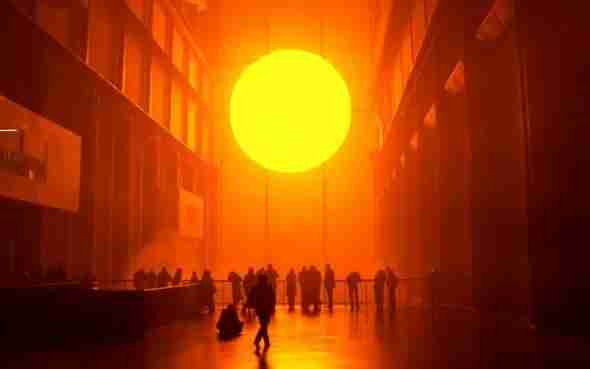
Olafur Eliasson, The Weather Project, 2003. An artificial sun transformed Tate Modern’s Turbine Hall into a collective environment while leaving the machinery of spectacle visible.
Explore Art Movements and Trends of the 2000s
Open a section to explore the movements, artists, media and cultural changes that defined contemporary art in the 2000s.
- Globalisation, Biennials and Altermodern
- Digital, Internet and New Media Art
- Relational Aesthetics and Social Art
- Installation, Immersion and Spectacle
- Painting, Figuration and Neo-Pop
- Photography, Video and Documentary Art
- Street Art and Public Space
- Superflat and Japanese Contemporary Art
- Political Art, War, Surveillance and Migration
- Eco Art, Site-Specific Art and Environment
- Art Markets, Museums, Fairs and Global Spectacle
Globalisation, Biennials and Altermodern
Contemporary art became increasingly global, but the ability to travel, exhibit and define cultural meaning remained unequally distributed.
The 2000s accelerated the transformation of contemporary art from a system dominated by a handful of Western centres into a much wider international network. Biennials, art fairs, residencies, galleries and museums brought artists from different regions into unprecedented contact, while cheaper air travel and digital communication increased the speed at which ideas and images circulated.
China became particularly important. Artists including Ai Weiwei, Cai Guo-Qiang, Yang Fudong and Cao Fei entered an increasingly international conversation at the same time that China’s economic and geopolitical position was changing dramatically. Similar shifts expanded attention toward contemporary practices from Africa, Latin America, the Middle East and South Asia.
Yet the idea of a borderless global art world was always misleading. Artists did not circulate under equal conditions. Passports, language, funding, residency programmes, galleries and institutional networks continued to determine who could move freely and who was primarily invited to represent migration, nationality or political conflict.
Near the end of the decade, Nicolas Bourriaud proposed Altermodern as a way of describing artistic practices based on translation, journeys, networks and cultural hybridity. The term captured an important characteristic of the period, even if it never became a stable movement in the traditional sense.
The 2000s did not eliminate the centre of the art world. They multiplied centres while preserving many of the inequalities that connected them.
Digital, Internet and New Media Art
The computer stopped being an exotic artistic tool and became part of ordinary visual culture.
Digital and new media art expanded rapidly during the 2000s. Broadband internet, increasingly powerful personal computers, digital cameras, projection technology and affordable editing software changed how images could be produced and distributed.
Artists worked with websites, animation, databases, virtual worlds, interactive interfaces, digital video, gaming and software. Cory Arcangel manipulated games and obsolete technologies. Rafael Lozano-Hemmer created interactive environments responding to bodies and data. Cao Fei explored virtual worlds and changing urban identities, while artists such as Rafaël Rozendaal treated the web browser itself as an artistic space.
The important change was not simply technological. By the middle of the decade, digital media were no longer necessarily presented as a separate avant-garde. They were becoming part of mainstream artistic production. An artwork could combine physical installation, projection, software, sound and interaction without requiring the artist to identify with one stable medium.
Interactivity also produced its own cliché. Asking a visitor to press a button or trigger an image did not automatically redistribute authorship. The strongest new media works made technology necessary to the meaning of the work rather than using novelty as a substitute for an idea.
The 2000s therefore prepared the conditions for post-internet art in the following decade. The internet first became an artistic medium and then became something more pervasive: an environment that increasingly shaped all images, including those made offline.
Installation, Immersion and Spectacle
The museum increasingly became an environment to enter rather than simply a building filled with objects.
Large-scale installation became one of the defining exhibition forms of contemporary art in the 2000s. Artists used architecture, light, sound, projection, mirrors, weather effects and monumental objects to reorganise the viewer’s physical relationship with the museum.
Olafur Eliasson’s The Weather Project at Tate Modern in 2003 became one of the decade’s most memorable examples. An artificial sun, mist and mirrored ceiling transformed the Turbine Hall into a collective environment in which thousands of visitors became part of the visual field.
Artists such as Anish Kapoor, Carsten Höller, Doris Salcedo and Ai Weiwei also worked at scales capable of transforming architecture into artistic material. The viewer no longer confronted only a discrete artwork but moved through situations constructed by the institution.
This transformation created an unresolved problem. Large-scale experience could produce genuine perceptual and emotional intensity, but it could also turn museums into cultural theme parks. Spectacle increased audiences and media attention while making monumental scale itself appear like evidence of importance.
The 2000s therefore anticipated the immersive exhibition economy that would expand dramatically during the following decade. Experience became increasingly valuable, but not every experience became more meaningful because it was larger.
Painting, Figuration and Neo-Pop
Painting survived every announcement of its death and absorbed the very image culture that was supposedly replacing it.
Any history of 2000s contemporary art focused only on new media produces a distorted picture of the decade. Painting remained central to museums, galleries and the art market, but there was no single dominant return to the medium.
Artists including Peter Doig, Marlene Dumas and Luc Tuymans demonstrated the continuing power of figurative painting, often working through memory, photographs and ambiguous narrative. Neo Rauch connected figuration to the strange historical afterlife of East Germany, while Kehinde Wiley used the conventions of European portraiture to reconsider race, power and representation.
Julie Mehretu developed another direction through large-scale abstraction built from architectural plans, maps, movement and layered systems of information. Her work made painting capable of addressing globalisation and urban complexity without returning to conventional representation.
Neo-Pop and commercial visual culture also remained important. Artists drew from advertising, fashion, comics, consumer objects and entertainment, while the distinction between fine art and branded culture became increasingly unstable.
The persistence of painting during a period of technological expansion is significant. Digital culture did not replace the painted image. It gave painting a new environment against which its materiality, slowness and physical presence could be understood.
Photography, Video and Documentary Art
The abundance of digital images made photography and moving image more politically important, not less.
Photography entered the 2000s at a moment when the distinction between professional and everyday image-making was beginning to collapse. Digital cameras became widespread, camera phones appeared and photographs could circulate online without passing through print publication.
Contemporary photographers continued to use large-scale staged imagery, portraiture and documentary strategies. Wolfgang Tillmans moved fluidly between intimate observation, abstraction and political culture. Rineke Dijkstra continued to explore the vulnerability of portraiture, while Jeff Wall’s meticulously constructed photographs maintained an unstable relationship between documentary appearance and cinematic staging.
Moving-image art expanded simultaneously. Steve McQueen, Isaac Julien, Harun Farocki, Omer Fast and others used film, video and multi-screen installation to address history, conflict, labour, surveillance and the construction of documentary truth.
The political conditions of the decade gave documentary art renewed urgency. 9/11, Afghanistan, Iraq and the expanding “war on terror” generated an enormous visual archive produced by television, military technologies, journalists and ordinary people. Artists increasingly worked not simply by creating new images, but by asking how existing images acquire authority.
The problem was becoming clear: greater documentation does not necessarily produce greater understanding.
Street Art and Public Space
Street art became globally recognisable at the same moment that its rebellion became increasingly valuable to galleries, cities and brands.
The 2000s were decisive for the international expansion of street art. Banksy, JR, Invader, Shepard Fairey, Swoon, Os Gêmeos and other artists developed visual languages that travelled from walls to photographs, books, websites, exhibitions and commercial markets.
The internet was crucial to this expansion. A temporary intervention could survive through digital documentation and circulate far beyond the city in which it appeared. Street art therefore became simultaneously local and global.
Banksy’s rise made the contradictions particularly visible. An anonymous practice associated with unauthorised public intervention became one of the most recognisable artistic brands in the world. The market could detach the image from the conditions in which it had originally appeared.
Cities discovered the same possibility. Street art could be used to encourage tourism, improve the cultural image of neighbourhoods and support redevelopment. A visual language associated with resistance could therefore become part of urban branding.
The important question was no longer simply whether street art belonged in a museum. It was what happened to public intervention once visibility became valuable.
Superflat and Japanese Contemporary Art
Anime, manga, consumerism and historical trauma collapsed the hierarchy between fine art and commercial culture.
Takashi Murakami introduced the term Superflat at the beginning of the decade, creating one of the few recognisable art movements closely associated with the 2000s. Its visual language connected the flatness of Japanese pictorial traditions with manga, anime, advertising and consumer culture.
But Superflat was never simply a celebration of colourful popular imagery. Murakami used the idea of flatness to question boundaries between high and low culture and to address Japanese society after the Second World War. Commercial desire, cuteness, sexuality and historical trauma could occupy the same apparently frictionless surface.
Artists associated with the wider Superflat context included Chiho Aoshima and Aya Takano, while Yoshitomo Nara developed an independent but related international language in which apparently childlike figures carried alienation, aggression and emotional resistance.
Murakami’s collaborations with fashion and luxury brands made the most difficult contradiction explicit. Art and merchandise did not have to occupy opposite worlds. The same image could exist as museum artwork, commercial product and corporate collaboration.
Superflat understood a defining condition of the decade: global culture was increasingly organised through brands, and contemporary art was not outside that economy.
Political Art, War, Surveillance and Migration
The decade produced more images of conflict than ever before, while making the politics of who produced and controlled those images increasingly visible.
The attacks of September 11, 2001 and the subsequent wars in Afghanistan and Iraq transformed the political atmosphere of the decade. Surveillance expanded, migration controls intensified and the language of security entered everyday life.
Artists responded through documentary images, archives, maps, performance and public intervention. Walid Raad explored the unstable relationship between archive, fiction and the history of conflict. Emily Jacir addressed displacement, Palestinian mobility and the politics of borders, while Ai Weiwei increasingly connected artistic production with censorship and political power.
Thomas Hirschhorn used deliberately precarious materials and overloaded visual environments to confront violence, political images and the unequal distribution of cultural value. Alfredo Jaar continued to question how images of suffering circulate and what responsibility remains after an event has become visible.
The decade made one contradiction increasingly difficult to ignore: contemporary culture had access to an unprecedented quantity of evidence, yet visibility alone did not guarantee political consequence.
That problem would become central to activist art in the 2010s and even more urgent in the following decade.
Eco Art, Site-Specific Art and Environment
Landscape increasingly appeared not as scenery but as infrastructure, ownership, extraction and ecological vulnerability.
Environmental concerns became increasingly prominent during the 2000s as climate change entered mainstream political debate. Contemporary artists expanded earlier traditions of environmental and land art through research into industrial landscapes, energy, waste, water, ecological systems and the politics of place.
Site-specific art also became more attentive to the histories hidden inside locations. A site could contain colonial memory, industrial labour, environmental damage, political borders or contested ownership. Place was no longer simply where an artwork happened; it could become the subject and material of the work.
Olafur Eliasson’s practice repeatedly connected perception with environmental conditions, while artists working with ecological restoration, infrastructure and public space challenged the distinction between representation and intervention.
The strongest ecological works avoided simply illustrating catastrophe. They asked which economic and political systems produced the landscape being represented and whether artistic action could do anything beyond making damage visible.
Art Markets, Museums, Fairs and Global Spectacle
Contemporary art became more visible, more global and dramatically more valuable, while a small network of institutions and collectors gained enormous influence.
The 2000s transformed the infrastructure of contemporary art as dramatically as many of its artistic practices. Art fairs expanded, biennials multiplied and galleries became increasingly international. Museums competed for global cultural tourism through ambitious buildings, major commissions and large-scale installations.
Tate Modern, opened in 2000, became emblematic of this new museum culture. Its Turbine Hall provided a scale that encouraged artists to produce monumental projects and helped turn temporary commissions into mass cultural events.
The art market also expanded dramatically during the years before the 2008 financial crisis. Contemporary art became increasingly attractive as an investment category, and the prices of living artists became part of mainstream financial and cultural news.
Damien Hirst’s direct auction at Sotheby’s in September 2008, occurring at almost exactly the moment the global financial system was entering crisis, became an extraordinary symbol of the relationship between contemporary art, branding and speculative capital.
The growth of fairs and mega-galleries made the art world appear increasingly connected, yet cultural authority remained concentrated. Being globally visible did not mean that every artist entered the network under the same conditions.
This is where the contradictions of the decade converge. Technology expanded access, institutions expanded audiences and markets expanded value. At the same time, each system created new gatekeepers capable of deciding what would circulate.
Other Important Art Trends of the 2000s
Not every important development of the decade became a major movement. Several smaller currents and emerging practices nevertheless reveal how quickly the definition of contemporary art was expanding.
BioArt and Art-Science
Artists increasingly worked with genetics, living tissue, biotechnology and laboratory processes. Eduardo Kac and other pioneers had begun this research earlier, but the 2000s made BioArt an increasingly visible field. The central question was no longer only whether living material could become art, but who possessed the right to manipulate life and how biotechnology was changing definitions of the body.
Explore BioArt: Where Science and Creativity Converge.
Gaming, VJing and Live Digital Culture
Video games, clubs and electronic music provided artistic environments that did not always fit easily inside museums. Machinima, modified games, live digital projection and VJing combined image, sound and real-time performance. These practices helped establish the visual vocabulary from which later immersive and virtual environments developed.
Explore the Art and Impact of VJing.
Stuckism and the Argument Over Painting
Stuckism, founded in 1999, gained considerable publicity during the following decade by defending figurative painting and attacking what it saw as an increasingly empty institutional Conceptualism. Its importance lies less in establishing a dominant style than in reopening an old argument: whether artistic innovation necessarily requires abandoning traditional skills and media.
Explore Stuckism and its Call for Authenticity.
Chinese Contemporary Art and the New Global Market
Chinese contemporary art became one of the most visible examples of the changing geography of the art world. Artists working through painting, photography, installation, film and performance entered museums and markets at extraordinary speed. At the same time, terms such as “Chinese contemporary art” risked turning highly different practices into a category constructed partly for international consumption.
The same contradiction would later become visible around contemporary African art: global recognition can correct exclusion while simultaneously creating new market identities.
What Defined Contemporary Art in the 2000s?
The 2000s did not produce one dominant art style because the most important change occurred in the networks connecting artworks to the world. The internet moved from novelty to infrastructure. Biennials and art fairs connected cities and artists across continents. Museums became global destinations, and the market transformed contemporary art into a highly visible financial asset.
Yet older artistic media never disappeared. Painting absorbed photography and digital image culture. Sculpture expanded into installation. Film entered the museum. Street art moved between illegal intervention and commercial success. Social encounters became artworks, while Superflat deliberately collapsed the distinction between art object and consumer product.
The decade therefore cannot be explained as a transition from analogue art to digital art. The more important transformation was the construction of a system in which everything could potentially circulate together.
That system promised openness. It also produced new inequalities. The internet expanded access but created technological gatekeepers. Global exhibitions increased cultural exchange but depended on unequal mobility. The market gave unprecedented value to contemporary artists while concentrating power among galleries, collectors and institutions.
The art of the 2000s was defined by a paradox: connection expanded faster than equality.
This is what makes the decade the essential bridge between the globalisation of contemporary art in the late twentieth century and the platform culture of the 2010s. The 2000s built the network. The following decade would discover what happened when almost every artwork, artist and political image had to live inside it.
Related Articles
- Altermodern Art: Globalisation, Travel and Cultural Translation
- Digital Art and Video Game Art
- Relational Aesthetics: When Social Exchange Becomes Art
- Superflat: Pop Culture, Trauma and Consumer Desire
- The Rise of Street Art: From Graffiti to the Gallery
- Contemporary Painting: A Mirror to Modern Society
- Site-Specific Art: When Place Becomes Material
- BioArt: Where Science and Creativity Converge