The Sculpture That Became a Reef
How Jason deCaires Taylor Turned Art into an Underwater Ecosystem
When sculpture becomes reef-building: a collaboration between human form and marine life.
A Vision Beyond the Canvas
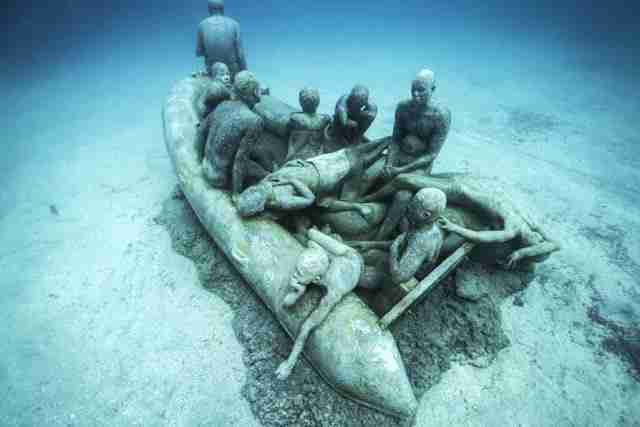
Jason deCaires Taylor is not your typical sculptor. Instead of galleries or museums, his works are found on the ocean floor, slowly becoming one with the sea. Taylor has redefined the boundaries of art by inviting nature itself to be a collaborator. His underwater sculptures are not just installations; they are living ecosystems that grow and change over time. Thus, they transform static human figures into thriving marine habitats.
Art Meets Ecology: The Silent Evolution
One of Taylor’s most iconic projects, The Silent Evolution (2010), placed over 400 life-sized human figures in the waters off Cancún, Mexico. This was part of MUSA (Museo Subacuático de Arte). But these statues were never meant to function as inert monuments. Made from pH-neutral cement, they were designed to attract coral and foster marine life. In this way, they turn art into an ecological sanctuary.

Each figure was shaped with grooves, hollows, and textured surfaces that encourage coral growth and provide shelter for fish and other marine creatures. The intention was clear: offer alternative sites for coral colonization and reduce pressure on natural reefs damaged by pollution, climate change, and mass tourism.
The Natural Transformation
As the years passed, nature took over Taylor’s work. Coral began to bloom; fish moved into crevices; entire micro-communities formed around the bodies. The once pristine human forms slowly became encrusted with barnacles, algae, and living color—an evolving archive of marine resilience.
Taylor’s vision wasn’t only to create a new kind of sculpture; it was to blur the border between art and environment. Over time, his figures become something otherworldly: half human, half reef—ghostly and beautiful reminders. These show that repair can be designed, and that conservation can be visual, public, and emotionally direct.

Symbols of Resilience
More than an aesthetic gesture, Taylor’s practice becomes a symbol of resilience and renewal. It shows how nature can reclaim and redefine human-made structures—while also asking a harder question: can we design interventions that do not dominate ecosystems, but support them?
In a moment of escalating ecological collapse, these underwater sculptures offer a rare kind of hope. This hope is practical, measurable, and poetic. They suggest that collaboration between humanity and nature is not only possible, but necessary.
A Future in Balance
Taylor’s underwater installations are living experiments in coexistence. They remind us that human impact can be destructive, but it can also be regenerative when guided by responsibility and care. Whether encountered by divers or through photographs, these submerged museums are not only artworks: they are blueprints for a different relationship with the sea.
In the end, Taylor’s strongest gesture is time. He creates forms that only complete themselves through years of growth, erosion, and colonization—inviting us to think of art not as an object, but as a long collaboration with the planet.


