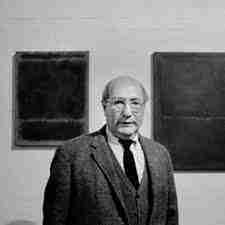
Mark Rothko: Color Fields, Silence and Emotional Depth
Mark Rothko: A Journey Through Color, Form, and Emotion
How abstract painting becomes an immersive space for introspection
Mark Rothko, a luminary of the Abstract Expressionist movement, revolutionized modern art through a profound use of color and form. His large, luminous fields of color are not just visually striking; they are built to carry emotional weight. They aim to slow the viewer down and trigger an inner response that words struggle to reach. Rothko’s work remains one of the strongest demonstrations that abstraction can hold human drama. Not by describing it, but by staging it as experience.
Mark Rothko
The evolution of Rothko’s artistic vision
Mark Rothko was born Marcus Rothkowitz in 1903 in Daugavpils, Latvia. His family emigrated to the United States when he was ten years old, settling in Portland, Oregon. Rothko’s early experience as an immigrant, together with his Jewish heritage, shaped his worldview. These experiences left a lasting imprint on the ethical and existential intensity of his art. He attended Yale University on scholarship, but left before completing his degree. He then moved to New York City to pursue painting.
Rothko’s early work was figurative and carried the influence of Expressionism and Surrealism. By the 1940s, however, he began moving away from representation, searching for a more universal language. Through this, painting could address the fundamentals of human experience. Myth, philosophy, and psychology fed this shift. Ideas associated with Friedrich Nietzsche and Carl Jung helped him. They framed painting as a site for archetypal emotion, spiritual tension, and the drama of existence.
The language of color and form
Rothko’s signature vocabulary, developed in the late 1940s and early 1950s, is built from large, luminous fields of color that appear to hover and breathe on the canvas. These color blocks are often stacked in horizontal bands. They create a subtle spatial pressure: depth without perspective, atmosphere without scenery. Rothko’s color is never decorative. Rather, each tone is chosen for its emotional temperature. Each edge is engineered to vibrate between softness and intensity.
Scale is central to this language. Rothko’s canvases often envelop the viewer, refusing the casual glance. The paintings ask for proximity and time. They seek a slow, almost meditative encounter in which boundaries shift. Color seems to pulse, and memory or feeling can rise to the surface.

Mark Rothko, Untitled #18
The emotional and spiritual dimensions
At the heart of Rothko’s art is a commitment to emotion and spirituality. He viewed painting as a vehicle for fundamental states: tragedy, ecstasy, awe, grief, and the sublime. In this framework, color is not simply a visual element but a carrier of psychological force. His aim was direct contact with the viewer. He achieved this not through narrative, but through an atmosphere that can be felt.
Many Rothko paintings are described as contemplative because they structure attention. They encourage viewers to slow down and tune into subtle relationships of hue, density, and edge. This meditative charge intensifies in the Seagram Murals, created in the late 1950s for the Four Seasons Restaurant in New York’s Seagram Building. With their darker, brooding tones and architectural weight, these works establish an almost chapel-like gravity, where painting becomes a space for quiet confrontation with oneself.
The legacy of Mark Rothko
Rothko’s contribution to Abstract Expressionism and modern art is profound. He challenged inherited ideas of composition and representation. He opened a path for later artists to treat painting as environment, presence, and psychological event. His work remains proof that abstraction can hold spiritual and emotional meaning without illustration. Additionally, a painting can be less an image than a place.

Mark Rothko, Untitled
Reflecting on Rothko’s artistic journey
Rothko’s art invites an encounter with the elemental: color, scale, silence, and duration. It challenges viewers to look beyond surface. They are prompted to notice how perception becomes emotion. By stripping away representation, Rothko creates conditions for introspection. The paintings become thresholds where the viewer’s inner life is part of the work’s completion.
In conclusion, Rothko’s painting demonstrates the enduring power of Abstract Expressionism to transform how we experience art. His luminous fields of color create a language that does not explain; it resonates. And in that resonance, the viewer finds the possibility of the sublime; not as spectacle, but as a quiet, personal intensity.
Related articles


