
Bracha L. Ettinger: The Art of Healing Through Connection
Embracing Trauma, Memory, and the Feminine Gaze
Bracha L. Ettinger is an artist whose work moves beyond the boundaries of traditional painting. It is not just her methods but also her deep theoretical engagement with psychoanalysis, trauma, and the feminine that set her apart as a singular voice in contemporary art. Ettinger’s art embodies a space where trauma and beauty coexist, a space that she describes as the “matrixial”, a domain that challenges conventional ways of seeing and relating. Today, let’s explore how Ettinger’s work offers us a way to navigate the complexities of memory, connection, and shared experience.
The Matrixial Theory: A New Way of Relating
To understand Bracha L. Ettinger’s art, one must first delve into her theoretical contributions, particularly her concept of the “matrixial borderspace.” Informed by her background in psychoanalysis, Ettinger developed this theory as an alternative to Freudian and Lacanian ideas of subjectivity, which have often been centered on individuality and separation. Instead, the matrixial concept is about interconnectedness, about the relational spaces between people, where trauma, memory, and emotions are shared and transformed.
This idea of shared experience and interconnectedness is evident in her visual work. Her canvases are often layered with delicate, translucent colors, evoking a sense of emergence and becoming. The forms that appear are not clearly defined; they blend, overlap, and dissolve into each other, suggesting a permeability between the self and the other. This visual language creates a space where viewers can experience an empathetic connection, an invitation to engage not just with the work but with the emotions and experiences that it evokes.
Painting as Healing: The Aesthetic of Fragility
Ettinger’s paintings are often described as fragile, and it is in this fragility that their power lies. Her use of light, transparent layers of paint creates an almost ethereal quality, where images seem to float between presence and absence. This aesthetic of fragility mirrors the nature of trauma itself, something that is there, yet elusive; something that can be approached but not fully grasped.
Her work is deeply influenced by her own family history, as well as the collective trauma of the Holocaust. Born in Tel Aviv in 1948 to parents who survived the Holocaust, Ettinger carries a generational memory of that trauma, and her art becomes a way of processing and transforming these inherited experiences. The act of painting, for Ettinger, becomes a practice of repair, not as closure, but as the possibility of transforming pain into a shared field of meaning. Her work speaks to connection and empathy through the acknowledgment of suffering.
The Feminine Gaze: Challenging Conventional Representation
Bracha L. Ettinger’s work also challenges traditional ways in which the feminine is represented in art. Historically, the female body has been depicted through the lens of the male gaze, often objectified or idealized. Ettinger offers an alternative, a feminine gaze that is not about objectification but about connection and transformation. Her works do not present the body as an object to be consumed; instead, they evoke the experience of embodiment, of being in a body that feels, remembers, and relates.
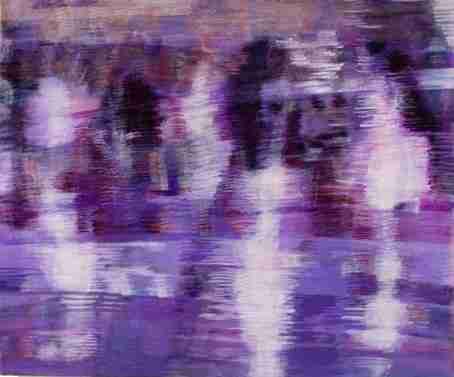
Her series titled “Eurydice” exemplifies this approach. Drawing on the myth of Orpheus and Eurydice, Ettinger reimagines the story from Eurydice’s perspective, focusing on loss, longing, and transformation. In these works, Eurydice is not merely a passive figure waiting to be rescued; she is an active presence, a subject with her own story. The blurred, overlapping forms suggest a liminal space between life and death, presence and absence, a space that Ettinger invites us to inhabit and explore.
The Art of the In-Between: Memory, Trauma, and Transformation
Ettinger’s work is profoundly concerned with in-between spaces, between self and other, between memory and forgetting, between trauma and healing. Her concept of the matrixial gaze is not about domination or control but about witnessing and sharing. It is about recognizing the other within oneself and understanding that our identities are formed not in isolation, but in relationship with others.
In “Pieta,” for example, Ettinger draws on the traditional Christian motif of Mary holding the body of Christ. However, her version is not about suffering in isolation; it is about shared pain, and the way grief and love can connect us across time and space. The forms are indistinct, merging into one another, suggesting that boundaries between self and other are fluid and permeable. This permeability is central to Ettinger’s work, an acknowledgment that pain and care circulate relationally.
Bracha L. Ettinger’s Legacy: Art as a Space of Encounter
Bracha L. Ettinger’s art and theory offer a challenge to the individualistic view of the self that dominates much of contemporary culture. Her work is a reminder that we are not isolated beings but are deeply interconnected, and that experiences, traumas, and memories are shared. By creating art that inhabits the space of the in-between, Ettinger invites us to embrace complexity, to find meaning in fragility, and to recognize the power of empathy.
Ettinger’s legacy is a call to see art as a space where healing can occur, where trauma can be transformed, and where we can encounter not just the other, but ourselves in a new way. In her matrixial spaces, we are invited to let go of rigid boundaries and to embrace the fluid, the uncertain, and the shared.


