Rafael Lozano-Hemmer: The Artist Who Makes Surveillance, Light, and Data Feel Human
Rafael Lozano-Hemmer: The Artist Who Turns Technology into a Human Pulse
Rafael Lozano-Hemmer does not make technology look futuristic. He makes it breathe, listen, remember, and expose what happens when bodies enter systems of light, data, surveillance, and connection.
In the dynamic world of contemporary art, few artists have blended technology, human interaction, public space, and emotional experience as powerfully as Rafael Lozano-Hemmer. A Mexican-Canadian artist born in Mexico City in 1967, he creates interactive installations where viewers are not passive spectators. They become the material of the work.
His practice belongs to the wider history of New Media Art, but it also goes beyond simple technological display. Lozano-Hemmer uses biometric data, voices, heartbeats, shadows, facial recognition, robotic lights, surveillance systems, and public participation to ask a deeper question: what happens when technology does not separate us, but makes our presence visible?
His works are technological, but their true subject is human vulnerability.
The Journey of an Innovator
Rafael Lozano-Hemmer was born in Mexico City and later studied Physical Chemistry at Concordia University in Montreal. That scientific background is essential to his art. His installations are not decorative uses of technology. They are carefully constructed systems, often based on measurement, response, programming, light, sound, and participation.
But the most important aspect of his work is not technical complexity. It is the way complexity becomes felt. A heartbeat becomes light. A voice becomes public memory. A shadow becomes architecture. A face becomes data. A border becomes a signal of possible encounter.
This is why Lozano-Hemmer is one of the key artists for understanding interactive art today. He does not ask viewers to admire technology from a distance. He asks them to enter it, activate it, and become responsible for what it reveals.
Relational Architecture: When Public Space Becomes Responsive
Lozano-Hemmer often uses the term relational architecture to describe how his works transform public space through technological systems. Buildings, plazas, museums, borders, and urban environments become responsive fields where bodies, signals, light, and memory interact.
This is different from simply projecting images onto buildings. In Lozano-Hemmer’s strongest works, the public is not just watching a spectacle. The public completes the work. The installation needs voices, movement, biometric data, proximity, or participation to exist fully.
In this sense, his work connects with Robotic Art and interactive installation, but it remains more political and bodily than many purely technological practices. The machine does not replace the human. It reveals the human condition through systems.

Pulse Room: The Heartbeat as Public Light
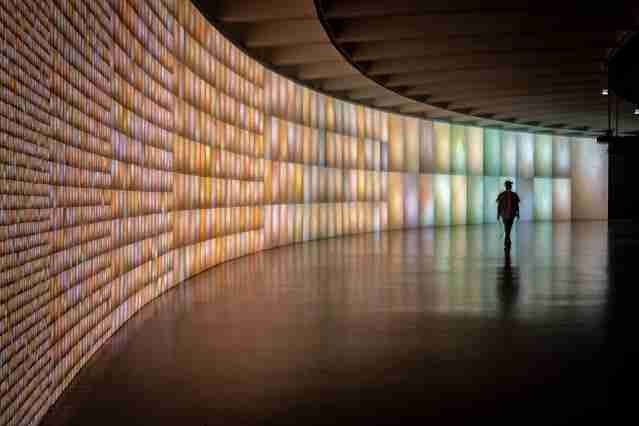
Pulse Room is one of Lozano-Hemmer’s most iconic works. Visitors place their hands on sensors, and their heartbeat is translated into flashing light bulbs. Each pulse enters the installation and joins the pulses of others, creating a luminous archive of human presence.
The work is simple to understand and difficult to forget. A private biological rhythm becomes public. The heart, usually hidden inside the body, becomes visible as light. The gallery becomes a chamber of shared mortality.
That is the force of Lozano-Hemmer’s art. He turns data into intimacy. He shows that measurement is never only measurement when what is being measured is a living body.
Microphones: Voice, Echo, and Memory
In works involving microphones, sound, and recorded voices, Lozano-Hemmer transforms speech into a fragile archive. A microphone is normally a tool for amplification, but in his installations it becomes something more unstable: a witness, a memory device, a ghost machine.
The participant speaks, but the work often returns another voice, another trace, another moment. Presence becomes layered with absence. The technology does not simply transmit the voice; it makes us aware that every act of speaking enters a field of recording, repetition, and disappearance.
This is why his work sits so strongly beside artists such as Lynn Hershman Leeson, who also explores identity, technology, surveillance, archives, and the self as a constructed interface. Both artists understand that technology is never neutral when it touches identity.
Voz Alta: Public Memory After Violence
Voz Alta is one of Lozano-Hemmer’s most politically charged works. Created for the 40th anniversary of the Tlatelolco massacre in Mexico City, the project invited participants to speak through a megaphone. Their voices activated powerful searchlights and were broadcast across the city and by radio.
The gesture is devastating because it transforms speaking into remembrance. A voice becomes light. Testimony becomes public space. Silence is interrupted by participation.
In this work, technology is not a cold instrument. It becomes civic memory. It gives form to the need to speak where history has been wounded.
Intersection Articulée: The City as a Field of Light
Lozano-Hemmer’s outdoor works often use light to change how people inhabit urban space. In projects such as Intersection articulée, beams of light cut through the city, creating temporary architectures that depend on movement, timing, and public perception.

The city is no longer just a fixed environment. It becomes responsive. Light makes invisible relations visible: between people, buildings, routes, signals, and the sky above them.
This connects Lozano-Hemmer to a broader tradition of artists who use media, architecture, and public space to rethink perception, from Nam June Paik and video art to contemporary digital and interactive practices. Yet Lozano-Hemmer’s specific power lies in the fact that his works are activated by human presence. Without the public, the system remains incomplete.
Identity, Surveillance, and the Body as Data
A recurring thread in Lozano-Hemmer’s work is the tension between connection and surveillance. His installations often use technologies associated with monitoring: fingerprints, facial recognition, biometric sensors, tracking systems, cameras, microphones, and data processing.
But he does not use these systems naively. He exposes their double nature. The same technology that connects us can also classify us. The same system that makes us visible can also control us. The same data that feels intimate can become a mechanism of power.
This is why his work is so contemporary. We live in a world where the body is constantly translated into information: face, voice, pulse, location, gesture, image, behaviour. Lozano-Hemmer makes that translation visible, poetic, and uncomfortable.
Border Tuner: Light Across the Border
Border Tuner is one of Lozano-Hemmer’s most moving public projects. Created along the U.S.–Mexico border, the work connected communities on both sides through interactive light and sound. Beams of light were activated only when participants on opposite sides collaborated.
The work matters because it refuses the border as only a line of separation. It turns the border into a temporary instrument of encounter. Connection requires participation from both sides. Dialogue becomes visible as light.
In a time of walls, migration politics, and militarized boundaries, Border Tuner offers a powerful counter-image: technology used not to separate bodies, but to let them hear and see one another across division.
The Audience as Co-Author
The central shift in Lozano-Hemmer’s work is that the audience becomes a co-author. The artwork is not complete before the viewer arrives. It is waiting for a pulse, a voice, a movement, a shadow, a face, a gesture.
This changes the ethics of viewing. The spectator is no longer outside the artwork, judging it from a safe distance. The spectator is implicated. The work responds to them, records them, amplifies them, or transforms them into light, sound, and data.
This is one reason Lozano-Hemmer’s work belongs at the centre of contemporary debates around interactive art, Digital Art, New Media Art, and participatory culture. His installations show that the future of art is not only about new images. It is about new relations.
Why Rafael Lozano-Hemmer Matters Now
Rafael Lozano-Hemmer matters now because he makes technology human without making it innocent.
He understands that technology can connect, illuminate, remember, and amplify. But he also understands that it can monitor, capture, classify, and expose. His art lives inside that tension.
In an age dominated by screens, interfaces, biometric systems, AI, and surveillance, his work reminds us that the most important question is not whether technology is advanced. The question is what kind of human relation it produces.
That is why his installations remain powerful. They are not only seen. They are entered, activated, felt, and completed by the people who encounter them.
Conclusion: Technology With a Heartbeat
Rafael Lozano-Hemmer has redefined interactive art by turning technology into a space of encounter. His works use light, sound, sensors, public space, surveillance systems, and biometric data, but they always return to the body.
A heartbeat becomes light. A voice becomes memory. A border becomes a conversation. A city becomes a responsive field. A viewer becomes part of the artwork’s system.
This is his essential lesson: technology is never just technology once a human body enters it.
In Lozano-Hemmer’s art, the machine does not erase the human. It reveals how fragile, exposed, and luminous human presence can be.
Related Articles
- The Evolution and Impact of New Media Art
- Nam June Paik: The Visionary Pioneer of Video Art
- When Art Becomes Responsibility: Interview with Artist Lynn Hershman Leeson
- Robotic Art: From Automata to Interactive Sculptures That Watch You Back
- Digital Art: Technology, Code, AI and Contemporary Images
- 1990s Contemporary Art: New Media, Interactivity and Global Criticality


