Contemporary Art 2020s
“`html
Contemporary Art in the 2020s: Art Under Pressure
Contemporary art in the 2020s has no dominant style. Painting, artificial intelligence, performance, sculpture, craft, moving image and immersive technologies coexist. What connects them is not how they look, but the pressure placed on art by climate crisis, war, algorithms, contested identities, technological acceleration and an art system increasingly organised around visibility.
The 2020s are still unfolding, so it would be premature to turn the decade into a clean sequence of movements. Many of its most important practices began much earlier. Feminist art, environmental art, digital art, Indigenous art, performance and institutional critique did not suddenly appear in 2020.
What changed was the intensity of the conditions surrounding them. The pandemic altered intimacy, labour and public space. Artificial intelligence accelerated image production. Climate crisis moved from prediction to lived experience. Wars, forced migration and censorship returned to the centre of cultural debate, while digital platforms became increasingly powerful in deciding which artists, images and conflicts become visible.
At the same time, older media did not disappear. Painting remains extraordinarily active. Sculpture has expanded through installation, architecture and found materials. Textiles and ceramics have moved from the margins of the hierarchy of “fine art” toward its centre. Photography and documentary practices remain crucial, while performance has become inseparable from debates around the body, identity and political action.
The defining characteristic of contemporary art in the 2020s is therefore coexistence under pressure. New technologies have not replaced traditional forms. They have forced every form to reconsider where it stands, how it circulates, what resources it consumes and what kind of consequence it can still produce.
This guide separates the decade into major artistic practices, media and structural conditions. The categories overlap because contemporary art does too.
For a wider historical view, visit the Contemporary Art Index.
Explore Contemporary Art of the 2020s
Open any section to explore the main practices, artists and critical questions shaping contemporary art today.
- AI and Algorithmic Art
- Eco Art and More-Than-Human Practices
- Post-Internet, Platforms and Surveillance
- Painting and the Persistence of the Image
- Sculpture, Installation and the Material Turn
- Performance, Participation and Social Practice
- Photography, Moving Image and Documentary
- Decolonial and Indigenous Practices
- Feminist, Queer and Trans Practices
- Political Art, War, Migration and Activism
- BioArt, Art and Science, Posthumanism
- Markets, Museums, Biennials and Visibility
AI and Algorithmic Art
Authorship meets computation, training data, automation and the hidden labour behind machine-generated culture.
Artificial intelligence is one of the most visible changes in contemporary art of the 2020s, but its significance goes far beyond the ability to generate an image in seconds. The deeper conflict concerns authorship, ownership, copyright, labour, cultural bias, environmental cost and the extraordinary concentration of technological power in a small number of companies.
Artists use machine learning, datasets, robotics, artificial vision and generative systems in very different ways. Refik Anadol transforms large datasets into immersive environments. Sofia Crespo works with artificial systems that reconstruct biological forms. Stephanie Dinkins examines race, memory and the politics embedded in machine intelligence, while Sougwen Chung explores collaboration between human gesture and robotic systems.
The weakest AI art treats the technology as spectacle: the machine produces something visually impressive and the artwork ends there. The stronger practices reverse the relationship. They make visible the systems behind the image and ask who supplied the data, who owns the model, who performed the labour and whose visual culture has been absorbed without consent.
AI has therefore intensified an older question rather than replacing it: does a new tool create a new form of art, or simply accelerate the production of existing images?
Eco Art, Climate Crisis and More-Than-Human Practices
Ecology becomes material, evidence, responsibility and a question of survival rather than a landscape to admire.
Environmental art has existed for decades, but the climate crisis has fundamentally altered its urgency. In the 2020s, ecological collapse is no longer an abstract future scenario. Fires, drought, floods, biodiversity loss, extraction and climate migration form part of the political and material conditions in which art is produced.
Artists increasingly work with climate data, contaminated soil, living organisms, water systems, plants, waste and scientific research. The artwork may function as testimony, archive, warning, ecological process or attempt at repair. More-than-human practices also question the assumption that human experience must remain at the centre of art.
This does not mean that every work using a plant automatically becomes ecological. The strongest eco art confronts systems: extraction, colonial land ownership, agriculture, fossil fuel economies, environmental racism and the long afterlife of industrial development.
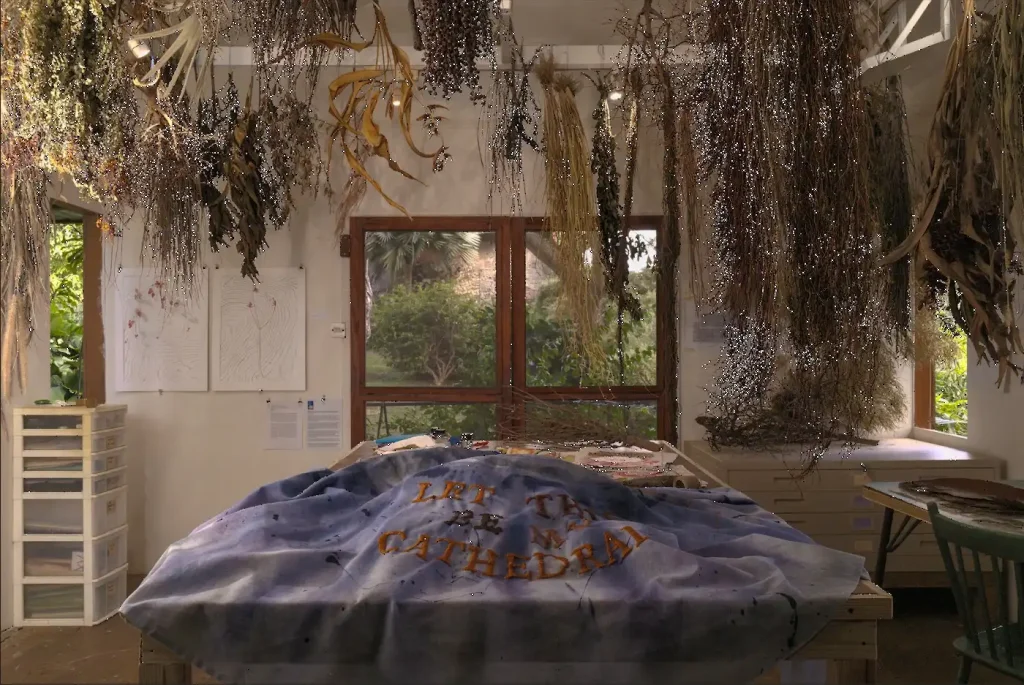
Annalee Davis, Let This Be My Cathedral. Ecology becomes colonial history, mourning, material memory and possible repair. Photo: RStudio.
Post-Internet, Platform and Surveillance Art
The internet is no longer a separate place. It is the infrastructure through which images, identities, attention and cultural value are organised.
Post-internet art emerged before the 2020s, but the condition it identified has become almost universal. Paintings, performances, exhibitions, protests and wars now reach much of their audience through screens, search engines and algorithmic feeds.
The important shift is that digital culture no longer describes a specialised artistic medium. It describes an environment. An oil painting photographed for Instagram participates in platform culture just as surely as a digital artwork does. The question is therefore not whether an artwork is online or offline, but what happens to it when visibility is mediated by platforms.
Artists working with facial recognition, avatars, deepfakes, digital archives, artificial identities, surveillance and data extraction investigate who is classified, tracked and made legible by technological systems. Ryoji Ikeda turns data itself into an overwhelming perceptual environment, while Juliana Huxtable uses the unstable boundary between body, image, avatar and identity as artistic material.
Visibility has consequently become ambiguous. To be visible can mean to be recognised, but also to be monitored, simplified, monetised or attacked.
Painting and the Persistence of the Image
Painting did not disappear in the digital age. Its slowness, materiality and historical weight may explain why it remains so persistent.
Any account of contemporary art in the 2020s that focuses only on AI and immersive technology misses an obvious fact: painting remains one of the most visible and commercially important artistic forms of the decade.
Figuration has remained particularly strong. Artists use portraiture, narrative painting, abstraction and hybrid techniques to address race, migration, gender, memory and personal history. Painters such as Julie Mehretu, Lynette Yiadom-Boakye, Njideka Akunyili Crosby, Salman Toor and Jadé Fadojutimi demonstrate how different contemporary painting can be while remaining materially connected to a medium with centuries of history.
The persistence of painting is not simply conservative. In a culture of rapid image production, the painted surface introduces resistance. It takes time to make and usually requires physical presence to experience fully. A painting circulates online, but the photograph of it is never completely the work.
This gives painting a paradoxical contemporary role. The oldest major medium in the art system may also be one of the forms best positioned to expose the difference between an image and an object.
Sculpture, Installation and the Material Turn
Objects, architecture, found materials and bodily scale have returned with force in a culture increasingly dominated by immaterial images.
Sculpture in the 2020s rarely means only a self-contained object on a pedestal. It can expand into architecture, installation, assemblage, landscape, sound and social space. Artists increasingly treat the exhibition itself as material, asking the viewer to move physically through relationships between objects rather than simply observe them from a fixed position.
Sarah Sze constructs dense environments from everyday objects, images and fragile systems of balance. Simone Leigh combines sculpture, architecture and histories of Black womanhood. Theaster Gates moves between objects, buildings, archives and urban transformation, while Thomas Hirschhorn deliberately uses inexpensive materials to resist the polished authority of monumental art.
The renewed importance of matter is significant in a decade obsessed with digital production. Ceramics, textiles, wood, earth, recycled objects and industrial materials insist that artworks still possess weight, texture, fragility and environmental cost.
Installation art also challenges the idea that an artwork has a single viewpoint. The viewer becomes a body inside the work, and space itself becomes part of its meaning.
Photography, Moving Image and Documentary Practices
In a decade saturated with images, photography and video are less concerned with producing more visibility than with asking what visibility can still prove.
Photography remains essential to contemporary art even as smartphones generate billions of images. The abundance of photographs has not made photography irrelevant. It has made questions of framing, evidence, manipulation and circulation more urgent.
Artists use photography to examine identity, family, landscape, sexuality and political memory. Catherine Opie continues to explore community, belonging and the politics of looking. Zanele Muholi uses portraiture as a form of self-representation and visual resistance, while many younger artists move freely between photography, text, archive and social media.
Moving-image art has become equally important. Video installations, essay films and documentary practices allow artists to work with testimony, history and duration outside the conventions of cinema. Tuan Andrew Nguyen, for example, combines historical research, oral memory and fiction to question the stability of official archives.
The documentary image has also become politically unstable. Deepfakes and generative AI weaken the old assumption that seeing is believing. This makes the construction and verification of evidence an artistic question in its own right.
Decolonial and Indigenous Practices
Museums, archives and nations are being forced to confront how their collections, categories and authority were constructed.
Decolonial art is not a unified style. It includes practices that challenge the political structures through which territories, objects, bodies and histories have been classified and represented.
Artists examine colonial archives, imposed borders, stolen artefacts, erased languages and ecological extraction. Kader Attia has made repair central to his practice, showing that a wound cannot simply be restored to an imaginary state of innocence. Tuan Andrew Nguyen works through the afterlives of colonial wars and displacement, while Indigenous artists increasingly refuse the expectation that contemporary work must appear as a static representation of tradition.
Restitution has therefore become part of contemporary artistic debate. Returning an object is not simply a logistical transaction. It requires museums to recognise that collecting, preservation, violence and ownership can belong to the same history.
The strongest decolonial practices do not replace one simplified narrative with another. They expose the systems that made some histories appear universal while others were treated as peripheral.
Feminist, Queer and Trans Practices
Visibility remains a struggle over who is allowed to appear, speak, desire and define the body.
Feminist, queer and trans art did not begin in the 2020s, but the decade has made clear how many of their conflicts remain unresolved. Reproductive control, gender violence, racialised representation, censorship, transphobia and institutional exclusion remain political realities rather than historical subjects.
At the same time, artists are increasingly suspicious of visibility itself. Representation can create recognition, but an image can also become content. Platforms reward simplification, outrage and immediate identification, while institutions can adopt the language of inclusion without changing how resources and authority are distributed.
Artists such as Cassils, Juliana Huxtable and Catherine Opie demonstrate very different approaches to gender, sexuality and the politics of looking. Their practices move across photography, performance, sculpture and digital culture, showing why feminist and queer art cannot be reduced to one medium.
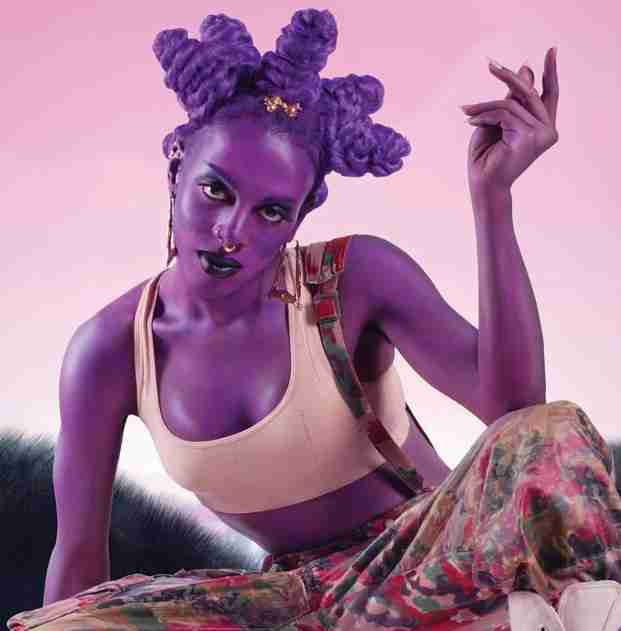
Juliana Huxtable, Untitled (Psychosocial Stuntin’). The body becomes image, avatar, performance and a refusal of fixed identity.
Political Art, War, Migration and Activism
The central problem is no longer whether art can make violence visible. Violence is already visible. The question is what happens after visibility.
War, occupation, forced migration, racial injustice, censorship and authoritarian power have returned political art to the centre of contemporary culture. Artists respond through archives, testimony, performance, documentary strategies, public intervention and institutional refusal.
Yet the conditions of political art have changed. Images of suffering can circulate globally within minutes and still produce almost no consequence. A photograph can be shared millions of times, absorbed into the same feed as advertising and entertainment, and disappear from attention almost immediately.
This changes the question artists face. Awareness is no longer automatically an achievement. In many cases, the audience already knows that violence exists. The difficult problem is whether art can change duration, memory, responsibility or the structures through which the event is understood.
Museums are part of this contradiction. They can exhibit protest while remaining connected to donors, corporations and governments. Political art in the 2020s therefore increasingly examines the institution displaying it as much as the event it represents.
BioArt, Art and Science, Posthumanism
Living organisms, biotechnology and artificial systems are destabilising the old distinction between nature, body and machine.
BioArt began well before the 2020s, but advances in biotechnology, genetic engineering and artificial intelligence have given its questions new urgency. Artists work with bacteria, cells, DNA, living tissues and scientific research while asking who has the right to modify life and how biological knowledge becomes economic power.
Posthumanist practices expand the discussion beyond laboratory biology. They challenge the idea of the autonomous human subject and examine bodies as systems connected to animals, machines, microbes, environments and networks.
Anicka Yi, Heather Dewey-Hagborg and other artists working between art and science explore smell, genetics, identity and biological classification. Sofia Crespo’s AI-generated organisms add another layer: even artificial nature can now be produced through systems trained on existing biological images.
The important issue is therefore not whether art can use science. It is whether art can expose the ethical and political structures hidden inside scientific innovation.
The Art System: Markets, Museums, Biennials and Visibility
The 2020s are not shaped only by what artists make. They are also shaped by who decides what becomes visible, valuable and historically important.
The contemporary art system has become increasingly concentrated around mega-galleries, international fairs, auction houses, private foundations, major museums and a small number of global cultural events. These structures do not simply distribute art after it has been created. They help determine which artists receive visibility, institutional legitimacy and market confidence.
The 2020s have also exposed the fragility of the middle of the market. Smaller and mid-sized galleries face rising costs and competition, while the most powerful galleries expand across cities and continents. Auction houses increasingly operate beyond traditional auctions, combining art, luxury goods, private sales and global brand culture.
Biennials and fairs remain crucial because they compress the art system into visible networks. Curators, collectors, journalists, galleries and institutions meet in the same temporary spaces. What appears to be an exhibition can also become a mechanism for producing reputations.
Digital visibility adds another layer. Social media can allow an artist to bypass traditional gatekeepers, but it can also create new ones. Algorithms reward what generates rapid attention, while artistic careers usually require something much slower: trust, critical context, institutional relationships and sustained work.
The central question of the 2020s may therefore be less “What is the new style?” than “Who controls the conditions under which art becomes visible?”
Other Forces Shaping Art in the 2020s
Not everything defining the decade is an artistic movement. Some developments are technologies, exhibition formats, renewed material practices or historical conditions. They nevertheless change what artists make and how audiences encounter it.
Immersive Art, VR and Digital World-Building
Virtual reality, augmented reality, game engines, spatial sound and responsive environments have expanded the exhibition into a constructed world. The strongest immersive works use scale and technology to investigate memory, data, ecology or perception. The weakest offer spectacle without resistance, replacing critical experience with the visual language of entertainment.
Explore Installation Art, or read Virtual Reality and Immersive Art: Beyond the Screen.
Craft, Textiles, Ceramics and Material Knowledge
Textiles, embroidery, weaving and ceramics have become increasingly visible within contemporary museums and galleries. Their return challenges the hierarchy that historically separated “major art” from practices associated with women, domestic labour, Indigenous cultures and non-Western traditions.
The significance is not simply nostalgic. Material knowledge offers another response to technological acceleration. When images can be generated instantly, the evidence of labour, touch, repetition and embodied knowledge acquires a different cultural weight.
NFTs and Crypto Art
NFTs are not a coherent art movement, but their spectacular rise and subsequent contraction made them one of the defining art-market stories of the early 2020s. They exposed unresolved questions around digital ownership, artificial scarcity, speculation and the difference between technological innovation and artistic value.
The collapse of much speculative enthusiasm did not make the experiment irrelevant. It demonstrated how quickly the art world can confuse a new mechanism for buying an artwork with a new form of art.
The Pandemic and the Altered Body
COVID-19 was not an art movement, but it transformed the conditions in which art was produced and experienced. Museums closed, screens became exhibition spaces and physical proximity became a political and medical problem.
The pandemic’s deeper artistic legacy concerns touch, care, illness, isolation, labour and inequality. It also accelerated digital forms of exhibition and communication that did not disappear when museums reopened.
Sound, Listening and the Expanded Exhibition
Sound has become increasingly important within installations, moving-image works and immersive environments. It can reorganise a space without producing another image, creating experiences based on duration, vibration and bodily presence.
This is particularly significant in an art culture saturated with visual information. Listening introduces another tempo. It asks the viewer to remain rather than simply recognise.
So What Defines Contemporary Art in the 2020s?
The 2020s have not settled into a dominant movement because contemporary culture no longer develops through a simple succession of avant-gardes. Painting did not disappear when digital art arrived. Sculpture did not disappear when installation expanded. Craft, performance, photography, AI and political art exist at the same time and frequently overlap within the same practice.
An artwork can be ecological and digital, feminist and performative, decolonial and archival, or generated through artificial intelligence while questioning the politics of biology. These categories intersect because the systems shaping contemporary life intersect as well.
This is why I would resist describing the decade primarily through novelty. The strongest tension of the 2020s is not old art versus new technology. It is the coexistence of radically different forms under the same pressures.
Every artwork now enters a network of questions that extends beyond appearance. Who made it? Who trained the system that produced it? What materials and resources did it consume? Which histories does it inherit? Where does it circulate? Which institution legitimises it? Who can see it, and who profits from that visibility?
Contemporary art in the 2020s is not defined by one look. It is defined by the increasing difficulty of pretending that an artwork exists outside the systems around it.
That may ultimately be the clearest difference between this decade and many that preceded it. The new has not replaced the old. Everything is still here. What has changed is the pressure.
Related Articles
- AI Art Explained: Artists, Tools, Ethics and the Crisis of Creativity
- Contemporary Painting: Why the Canvas Still Matters
- Eco Art: Artists, Methods and Climate Justice
- Ryoji Ikeda: When Data Stops Being Neutral
- Kader Attia: Repair Does Not Erase the Wound
- Feminism in Art: A Global History of Visibility, Power and Resistance
- Virtual Reality and Immersive Art: Beyond the Screen
- Art Trends 2026: Institutional Power, Market Realism and Cultural Value
← Back to Contemporary Art Index
```