Antipodean Art Explained: Australia, Aotearoa and the Politics of Land
From Country and Whenua to Modern Myth
Antipodean art is not a peripheral chapter of art history. It is one of the fields in which the relationship between image, land, memory, Indigenous knowledge, colonial violence and contemporary identity has been tested most intensely.
Across Australia and Aotearoa New Zealand, artists have transformed desert, harbour, coastline, volcanic terrain, language, ceremony and national mythology into visual structures. The landscape is rarely an innocent background. It can be Country, whenua, ancestral law, private obsession, contested property, colonial wound or ecological warning.
From Aboriginal Dreaming and Tjukurrpa to Māori carving and weaving, from Sidney Nolan’s black helmet to Colin McCahon’s painted words, from Ralph Hotere’s scorched materials to Tracey Moffatt’s staged photography, Antipodean art asks a difficult question: who has the authority to turn a place into an image?
This article uses the expression Antipodean art in its broad geographical sense, referring to visual culture from Australia and Aotearoa New Zealand. It should not be confused with The Antipodeans, the specific group of Australian figurative artists associated with the Antipodean Manifesto of 1959.
What Does Antipodean Art Mean?
The word Antipodean originally describes something situated on the opposite side of the world. Its cultural use carries an uncomfortable inheritance because the point of reference is usually Europe. Australia and New Zealand appear as distant places measured from an assumed centre.
Art from the region repeatedly overturns that logic. What had been presented as remote becomes intellectually central. Indigenous systems of knowledge, Māori understandings of ancestry and land, Australian national myths and contemporary ecological practices do not wait to be validated by Europe or the United States. They construct their own relations between place, image and responsibility.
For this reason, Antipodean art cannot be reduced to a regional style. It includes ceremonial and community-based practices, modern painting, photography, sculpture, installation, moving image, performance, textiles, carving and politically engaged conceptual art.
What connects these very different practices is not a single appearance. It is the pressure exerted by place. The land is not simply represented. It acts on the work, carries memory and determines what can be revealed, protected or contested.
Country, Tjukurrpa and Indigenous Australian Art
Indigenous Australian art does not begin with Western ideas of landscape painting. Its foundations lie in living systems of law, story, ceremony, ancestry, movement and responsibility.
In the early 1970s, artists associated with the Papunya Tula movement began transferring ancestral narratives and relationships to Country onto board and canvas. This translation helped make Western Desert painting visible to new audiences, but visibility was never a simple act of disclosure.
Dotting, repetition, circular structures and mapped pathways could communicate relationships to Country while also veiling knowledge that was not intended for outsiders. The surface therefore became both image and boundary. It offered access while establishing limits.
This distinction is essential. Works connected to Tjukurrpa do not merely depict the desert. They emerge from relationships involving land, kinship, ceremony, memory and obligation. To treat them as decorative abstraction is to remove precisely the structure that gives them meaning.
The work of artists such as Doreen Reid Nakamarra demonstrates how rhythm and apparent abstraction can carry a highly specific relationship to place. The repeated mark is not empty pattern. It can become movement, surface, distance, transmission and protected knowledge.

Contemporary Indigenous Australian artists have expanded this field through photography, installation, public art and institutional critique. Tracey Moffatt and Fiona Foley, among others, have confronted the narratives through which Aboriginal identity has been framed, photographed, collected and politically controlled.
Māori Art and Aotearoa New Zealand
In Aotearoa New Zealand, Māori visual culture connects form to whakapapa, community, ancestry and whenua. Carving, weaving, tā moko, architecture and taonga cannot be separated from the relationships they sustain.
These practices are not remains of a closed historical tradition. They continue to shape contemporary identity and the politics of cultural visibility. Their presence also challenges the museum to distinguish between possessing an object and accepting responsibility for the relationships carried by that object.
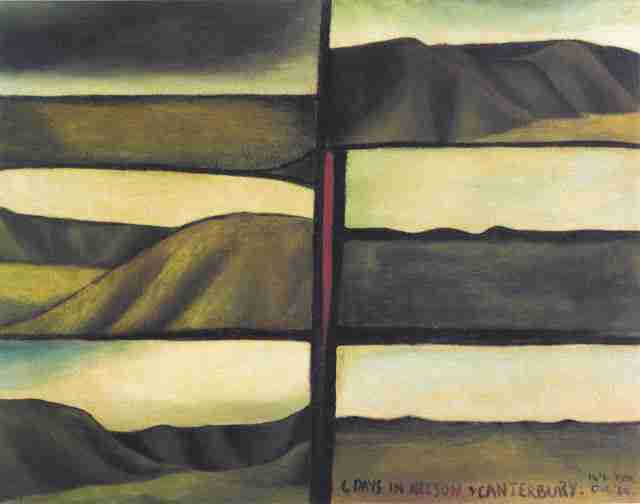
Modern New Zealand painting developed its own intense dialogue with language, landscape and belief. Colin McCahon inserted words, numbers and fragments of scripture into landscapes that seem to hesitate between revelation and doubt.
McCahon did not use text as an explanation placed beside the image. The words occupy the painting, interrupt vision and force reading to become a physical experience. Landscape becomes a space in which belief is tested rather than confirmed.
Ralph Hotere, who was of Te Aupōuri descent, pushed this relationship toward blackness, reflection, poetry and protest. His surfaces can appear almost silent, yet that silence is never neutral. It can contain nuclear anxiety, environmental conflict, collective mourning and Māori memory.
More recently, artists such as Fiona Pardington have used photography to examine taonga, extinction, archives and the unstable boundary between scientific classification and cultural memory.
The Antipodeans and the 1959 Manifesto
The broad expression “Antipodean art” must be distinguished from The Antipodeans, a specific Australian group formed in Melbourne in 1959.
The group brought together Charles Blackman, Arthur Boyd, David Boyd, John Brack, Robert Dickerson, John Perceval and Clifton Pugh, alongside art historian Bernard Smith. Their only group exhibition opened at the Victorian Artists’ Society in August 1959.
The accompanying Antipodean Manifesto defended the figurative image at a moment when abstraction appeared to be gaining cultural authority. The signatories did not share a single style, but they resisted the idea that the recognisable image had become intellectually obsolete.
Their position was defensive, combative and historically revealing. It exposed the anxiety surrounding Australia’s relationship with international modernism. Could Australian art enter global modernity without merely importing its dominant languages? Could the figure still carry national experience, myth and psychological conflict?
The National Gallery of Australia’s history of The Antipodeans clarifies that the group should be understood within the conflict between figuration and abstraction that shaped Australian art in the late 1950s and early 1960s.
The term therefore contains two different stories. One is a broad and contested geographical category. The other is a precise episode in Australian modernism. Confusing them makes both less legible.
Five Images That Changed Antipodean Art
1. Sidney Nolan’s Ned Kelly
In the Ned Kelly cycle, created chiefly in 1946 and 1947, Sidney Nolan reduced the Australian bushranger to a black geometric helmet with a narrow opening onto the landscape.
The helmet is simultaneously armour, mask, prison and empty screen. Kelly becomes visible by disappearing inside a sign. The surrounding Australian landscape is not passive scenery. It absorbs violence, pursuit, legend and national memory.
Nolan’s achievement was not simply to illustrate a famous outlaw. He created a visual structure through which Australia could recognise its own mythology while remaining uncertain whether it was looking at a rebel, a criminal, a victim or a national invention.

2. Brett Whiteley’s Sydney Harbour
Brett Whiteley transformed Sydney Harbour and Lavender Bay into psychological territory. Curving lines, luminous blues, interiors, bodies and windows turn the city into an extension of appetite and instability.
Where Nolan hardens national myth into a black rectangular mask, Whiteley liquefies place. The harbour becomes desire, escape, self-dramatisation and danger. Landscape is no longer outside the artist. It passes through his nervous system.
3. Colin McCahon’s Victory over Death 2
In Victory over Death 2, painted in 1970, Colin McCahon used monumental words, darkness and a flash of light to collapse the boundary between painting and proclamation.
The work does not simply communicate a religious statement. Its scale forces the viewer to stand inside the conflict between affirmation and doubt. Language becomes landscape, and landscape becomes a place where certainty repeatedly fails.
McCahon’s importance lies in this refusal to separate the local from the existential. The geography of Aotearoa and the vocabulary of spiritual crisis become part of the same unstable visual field.
4. Ralph Hotere’s Black Phoenix
Created between 1984 and 1988 from burnt wood and metal, Ralph Hotere’s Black Phoenix transforms the remains of a fishing boat into a monumental structure of destruction and return.
The work does not repair the damaged material or disguise its history. Fire remains visible. The fragments retain the memory of collapse. Yet their reassembly creates another form of presence, one that refuses the clean separation between mourning and regeneration.
Hotere’s blackness is therefore not an absence of meaning. It is a surface that concentrates memory, politics and spiritual attention.
5. Tracey Moffatt’s Something More
Tracey Moffatt’s 1989 photographic series Something More resembles fragments from a film whose complete story has been withheld. The staged images combine glamour, violence, rural space, race, ambition and escape.
The Australian landscape becomes a theatrical trap. It promises departure while repeatedly returning the protagonist to structures of power. Moffatt refuses the expectation that identity should be represented through documentary transparency. Instead, she uses artifice to expose how myths are manufactured.
The series also shifts the discussion of Antipodean art away from the solitary modern painter. Photography, costume, performance and cinematic sequencing become instruments for questioning who is allowed to occupy the image and who controls the narrative.
Sovereignty, Ecology and the Contemporary Field
Contemporary Antipodean art is increasingly shaped by questions of sovereignty, archive, climate crisis, migration and institutional power.
Artists do not simply inherit the older landscape tradition. They interrogate it. They ask who claimed the land, who named it, who photographed it, who removed cultural objects from it and who continues to benefit from its representation.
In this context, Indigenous knowledge challenges the Western idea of landscape as scenery or property. Land can be a living relation involving rights and obligations. The image is therefore never only aesthetic. It may carry legal, cultural, spiritual and ecological consequences.
Artists such as Tracey Moffatt, Fiona Foley, Fiona Pardington and Doreen Reid Nakamarra expand the field beyond the mythology of the isolated painter facing an empty territory. Their works insist that the territory was never empty. It was inhabited by stories, laws, communities and memories before it was transformed into a national image.
The climate crisis makes this distinction increasingly urgent. Fire, water, extraction, extinction and environmental damage cannot be separated from questions of sovereignty. Ecological visibility without historical responsibility risks becoming another form of spectacle.
Museums, Biennials and Global Visibility
The Biennale of Sydney, the National Gallery of Australia, the Art Gallery of New South Wales, Te Papa Tongarewa, Auckland Art Gallery and other institutions have helped bring Australian and Aotearoa New Zealand art to international audiences.
But institutional visibility is not the end of the story. Museums are themselves part of the conflict. They must confront colonial collections, repatriation, naming, provenance and the difference between displaying an object and understanding the network of relationships it carries.
This is especially important when Indigenous works and taonga enter collections built according to European categories. The museum may describe an object as art, artefact or cultural property, while the community from which it comes understands it through ancestry, ceremony and continuing responsibility.
The strongest institutions are therefore not those that merely add Indigenous artists to an existing narrative. They are those willing to question the structure of the narrative itself.
Why Antipodean Art Matters Today
Antipodean art matters because it disrupts the idea that modern and contemporary innovation always travels outward from Europe or the United States.
Australia and Aotearoa New Zealand are not distant recipients of international modernism. They are places where modernity, colonial history, Indigenous sovereignty, ecological crisis and national mythology collide with unusual intensity.
From Papunya Tula to Nolan’s Kelly, from Whiteley’s harbour to McCahon’s words, from Hotere’s burnt materials to Moffatt’s cinematic photographs, the most significant works do not merely represent a region. They question the conditions under which a region becomes visible.
The central issue is not whether land can be turned into art. It is what disappears when land is reduced to an image, and what becomes possible when the image begins to carry memory, conflict and responsibility.
Antipodean art is not peripheral. It is one of the places where the future relationship between art, land and consequence is being decided.
Further Reading on Australian and New Zealand Art
For a deeper exploration of Australian, Indigenous Australian and Aotearoa New Zealand art, this selected publication examines the artists, histories and relationships between visual culture, land and identity.
Recommended book:
New Zealand Art: From Cook to Contemporary
As an Amazon Associate, I earn from qualifying purchases. The price paid by the reader remains unchanged.