Mariuccia Secol’s Feminist Lesson: An Interview with a Pioneering Artist
At ninety-seven, Mariuccia Secol looks back on feminist art, psychiatric workshops, Gruppo Immagine, motherhood and the 1978 Venice Biennale.
Read MoreContemporary Art Criticism, Interviews, Essays and Visual Politics

Santa Nastro is an Italian art critic, journalist, author, and cultural communication specialist. Born in Naples in 1981, she studied Art History at the University of Bologna, where she wrote her thesis on the Italian art historian Francesco Arcangeli.
She is currently Deputy Director of Artribune, one of Italy’s leading publications devoted to contemporary art and visual culture. Her work moves between journalism, criticism, institutional communication, publishing, and direct conversations with artists and cultural professionals.
Rather than treating contemporary art as an enclosed professional field, Nastro examines the people, labour, economic structures, and personal conditions that make artistic production possible. Her writing pays attention not only to exhibitions and artworks, but also to the less visible systems that determine who can continue working, who receives institutional support, and whose practice eventually becomes visible.
At Artribune, Santa Nastro writes about artists, museums, exhibitions, cultural policy, publishing, and the changing structure of the Italian art system. She also conducts interviews with artists, curators, museum directors, cultural workers, and other figures operating across different parts of the sector.
Her journalism combines current information with a broader investigation into how culture is produced. An exhibition can become an opportunity to discuss public institutions, local communities, cultural employment, economic inequality, or the relationship between artists and the places in which they work.
Interviews are central to this approach. They are not treated simply as promotional conversations, but as spaces in which artists and cultural workers can describe their choices, difficulties, working methods, and responsibilities in their own words.
In 2022, Santa Nastro published Come vivono gli artisti? Vita, economia, rapporto con il settore e pratica with Castelvecchi.
The book begins with a question that art criticism often avoids: how do artists actually support themselves?
Art writing usually concentrates on ideas, techniques, exhibitions, and critical recognition. It less frequently examines income, unpaid labour, family support, teaching, commissions, illness, care responsibilities, or the unstable balance between artistic practice and other forms of employment.
Nastro addresses these issues through direct conversations with artists. The book questions both the romantic image of the poor but inspired bohemian and the more recent model of the artist as a permanently productive entrepreneur of the self.
The result is not a manual for professional success, but an investigation into the material conditions of artistic life. It asks who can afford to continue, who is gradually pushed out, and how economic inequality influences the art that eventually reaches galleries, museums, and public attention.
In 2025, Nastro extended this investigation with Mamme nell’arte. Artiste e operatrici culturali nella sfida della maternità, also published by Castelvecchi, with a preface by Caroline Corbetta.
The book examines the relationship between motherhood, creative practice, professional ambition, economic precarity, and care within the contemporary art system. Through essays and thirty interviews, Nastro brings together the experiences of artists, curators, journalists, communicators, teachers, museum professionals, and other women working in culture.
Mamme nell’arte moves beyond the representation of maternity as an art-historical subject. Its central concern is what happens when motherhood becomes part of the real working life of women whose careers depend on mobility, visibility, networking, continuous availability, and forms of employment that are often unstable or insufficiently protected.
The book asks how professional time is reorganised, how care is distributed, what forms of support exist, and which expectations continue to fall disproportionately on women. Motherhood is therefore not treated as a private interruption to an otherwise neutral career, but as a condition that reveals the structural organisation of cultural work.
Together, Come vivono gli artisti? and Mamme nell’arte form a connected investigation into what the art world tends to leave outside its official narratives: money, care, family, work, access, time, and the personal conditions required to sustain a cultural practice.
Alongside her editorial activity, Santa Nastro has worked in communication for major Italian art institutions. Since 2015, she has been responsible for communication at the Fondazione Museo Pino Pascali in Polignano a Mare.
Her work at the foundation connects exhibitions, public programmes, contemporary artistic research, and the legacy of Pino Pascali with wider national audiences. It also places her in direct contact with the practical activity of an institution, where research, communication, education, public engagement, and territorial relationships must operate together.
Until 2024, she was Head of Communication at FMAV, Fondazione Modena Arti Visive. She also collaborates with Pianoterra ETS and Fondazione Beta, organisations working through culture, education, and social projects to address inequality and support vulnerable communities.
A recurring concern in Santa Nastro’s work is the distance between the public image of art and the conditions under which it is produced. The contemporary art world often presents itself through exhibitions, openings, prizes, fairs, publications, and institutional success. Behind that surface, however, are fragile careers, unpaid labour, unequal access to opportunities, care responsibilities, and forms of economic dependence that remain largely invisible.
Her writing brings these questions into art journalism without treating them as external sociological problems. Economic conditions, motherhood, family structures, professional networks, and institutional policies directly influence who has the time and resources to work, whose career can develop, and whose practice enters the historical record.
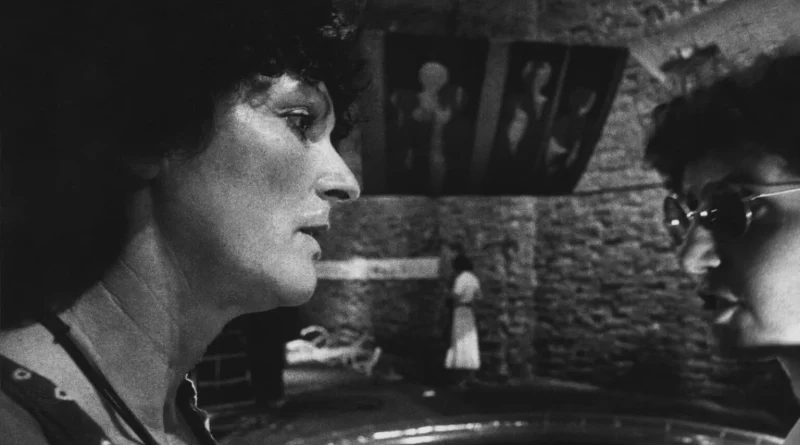 Mariuccia Secol at the Venice Biennale, 1978. Courtesy of Artribune.
 At ninety-seven, Mariuccia Secol looks back on feminist art, psychiatric workshops, Gruppo Immagine, motherhood and the 1978 Venice Biennale.
Read More The Glorious Mothers
 A collective born in Italy during the pandemic, facing the challenge of being both artists and mothers between creative practice,
Read More Santa Nastro
 Part of my Feminism hub: Feminism in Art Isn’t a Style: It’s a Battle Over Visibility. You can also browse
Read More