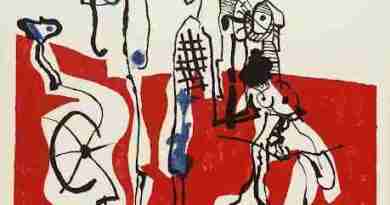
Georg Baselitz: The Rebel Who Turned Art Upside Down
Confrontation, Provocation, and the Power of Perspective
Georg Baselitz is an artist who refuses to play it safe. Throughout his career, he has embraced rebellion, both in his art and in his attitude toward the establishment. Known for a raw, expressive language and for the radical decision to turn his paintings upside down, Baselitz disrupts the viewer’s habits of looking and forces a confrontation with perspective itself. This post explores why his unapologetic approach continues to push the boundaries of contemporary art.
Post-war roots: a deeply influenced perspective
Baselitz was born Hans-Georg Kern in 1938 in Deutschbaselitz, Saxony, in what would soon become East Germany. Growing up in the shadow of World War II, his early life was steeped in the disarray of a shattered country. The destruction and trauma of war left a deep impression on him, driving him toward art as a way of making sense of a fractured world. This post-war pressure is visible in the rawness and aggression of his early imagery, where the human figure appears as damaged, exposed, and unresolved.
In 1958, Baselitz moved to West Berlin to study art, entering a climate radically different from the tightly controlled cultural environment of East Germany. German Expressionism and Abstract Expressionism were key reference points, but Baselitz’s urge was to produce something that could not be reduced to style. He rejected abstraction as a purely aesthetic solution and pursued figuration that would sabotage the norms of representation from within.

Upside-down figures: a revolutionary approach
Baselitz’s decision to turn his paintings upside down, beginning in 1969, remains one of his most iconic contributions to contemporary art. By inverting his subjects, he forces viewers to confront the act of seeing rather than the comfort of recognition. The question shifts from what the subject is to how perception works.
Inversion strips away familiar narrative cues and redirects attention to the formal mechanics of painting: composition, color, rhythm, and surface. It is both a philosophical and pictorial statement. Baselitz described this strategy as a way to liberate content from conventional associations, placing representation and abstraction in direct tension. The upside-down image becomes a form of independence: a refusal to let painting behave as illustration.
Heroes and rebels: the power of the outsider
Among Baselitz’s most significant early bodies of work is the “Heroes” series from the mid-1960s. These paintings depict monumental, battered figures, often resembling soldiers or warriors, who embody strength and vulnerability at once. They are not triumphant. They appear exhausted, scarred, and unstable, as if heroism itself has been damaged by history.

The “Heroes” works were controversial because they refused the polished narratives of recovery and national dignity. Baselitz’s figures are human, compromised, and far from idealized. Read against post-war Germany, they register the collapse of certainty and the discomfort of inheritance: a society struggling with its past and unsure how to inhabit the future.
Embracing the raw and the primitive
Baselitz has often drawn inspiration from what he considered “primitive” forms such as folk traditions and non-Western sculpture, pursuing a deliberate roughness that rejects academic polish. Thick brushwork, aggressive carving, and intentionally awkward forms foreground the physicality of making. For Baselitz, rawness is not an effect; it is a stance against the smoothness of cultural consensus.
His sculptures, developed more intensively from the 1980s onward, extend this position into three dimensions. Carved from wood with a chainsaw, they remain rough-hewn, as if the figure is still struggling to emerge from the material. The splintered surfaces operate as evidence: art as impact, not refinement.

A legacy of defiance and reinvention
Baselitz has always been an artist of defiance: defying expectations, political comfort, and even the conventions of his own practice. Across upside-down paintings, monumental anti-heroes, and aggressively carved sculpture, his work insists that art is not primarily about agreement. It is about friction, conflict, and a re-education of the eye.
In later years, Baselitz revisited earlier motifs, reworking themes with a new economy of gesture and a different kind of violence. This return is not nostalgia; it is a strategy of reinvention. For Baselitz, there is no definitive statement, only ongoing revision, where each new work argues with the last.
His influence on contemporary art remains decisive because he treats painting as a problem that must be kept alive. Baselitz reminds us that art is not comfort. It is confrontation, a way of pushing viewers out of complacency and forcing them to see from a different perspective.
Related articles
- The Resurgence of New European Painting
- Gerhard Richter: The Alchemist of Ambiguity
- Sigmar Polke: Trickster of Contemporary Art
- Anselm Kiefer: Confronting History with Ash, Lead, and Memory
- Luc Tuymans: Painting Shadows of Memory
- Marlene Dumas: Raw Humanity of Painted Emotion
- Art Under Attack: The Defiance of Miriam Cahn