Tilo Baumgärtel: The Dreamscapes of Modern Life
Surreal Narratives, Eerie Atmospheres, and the Mystery of the Everyday
Tilo Baumgärtel paints on the threshold between waking life and dream logic. Known for large-scale oil paintings that depict mysterious, often surreal situations, he is a master of atmosphere: the kind that pulls you in gently and then refuses to let you feel fully safe. His scenes look ordinary at first glance, yet they carry a quiet disturbance, as if reality has been slightly misaligned. In this post, I want to enter Baumgärtel’s world and understand why his work feels both enchanting and unsettling.
A New Leipzig visionary
Baumgärtel emerged from the Leipzig painting scene often grouped under the label New Leipzig School, which gained international attention in the early 2000s. He studied at the Hochschule für Grafik und Buchkunst in Leipzig, where a commitment to painting as craft and image-building remained strong even as other art scenes moved decisively toward installation and conceptual formats.
His connection to Leipzig matters because it frames the core tension in his work: a technically rigorous painting language used to stage ambiguity. Like others associated with Leipzig, he often works with nostalgia, irony, and a sense of historical afterimage. Yet his voice is distinct. Baumgärtel’s images tend to whisper rather than declare, producing unease through mood, spacing, and the psychology of the scene rather than through overt symbolism.
The mystery of the ordinary: surrealism in everyday life
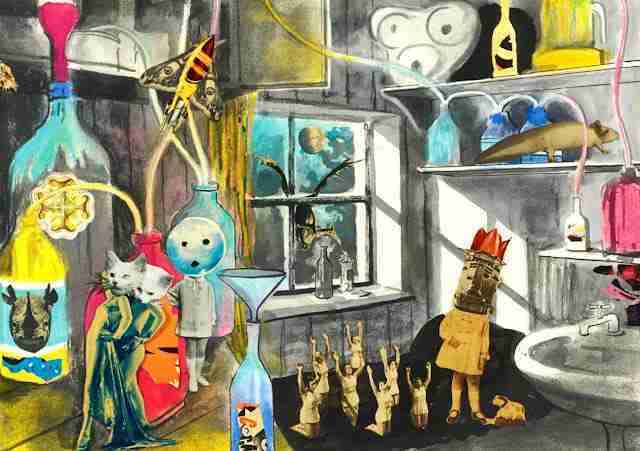
One of the most compelling aspects of Baumgärtel’s practice is how he turns the familiar into something strange. Many scenes begin in mundane territory: a park, a living room, an industrial edge-zone, a small gathering that could be a picnic or a pause in routine. Then a fracture appears. The light feels artificial. The figures seem detached, as if participating in a ritual only they understand. The room looks staged. The landscape reads like a set.

This is where Baumgärtel’s surrealism lives: not as spectacle, but as a low-frequency distortion. The paintings do not announce “the surreal.” They let it leak in. What remains is the feeling of a dream you can almost remember: coherent enough to hold, strange enough to keep shifting.
Time and stillness: a world out of joint
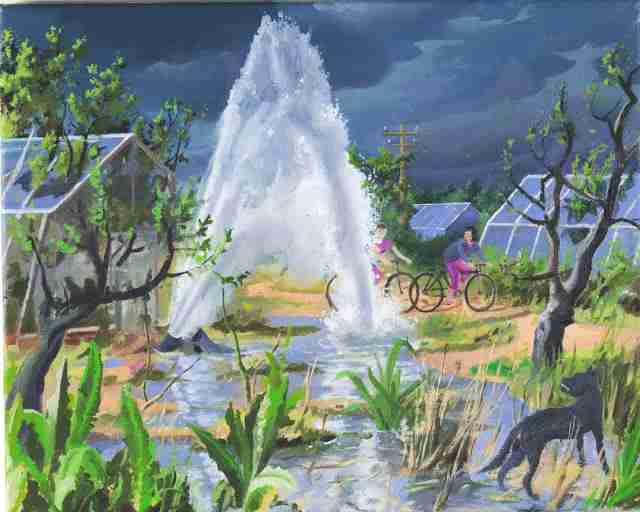
Baumgärtel’s paintings often feel suspended in time, as if the moment has been held open and will never resolve. This stillness is both beautiful and unsettling. It sharpens attention. You become hyper-aware of surfaces, fabric patterns, the temperature of the light, the expression on a face. The image invites lingering, as if looking longer might reveal the story underneath.
But the story never fully arrives. Baumgärtel refuses clear narrative closure. Instead, he creates conditions for interpretation. The paintings remain alive because they do not finish themselves; they keep renegotiating their meaning depending on who is looking.
The cinematic influence: painting as narrative
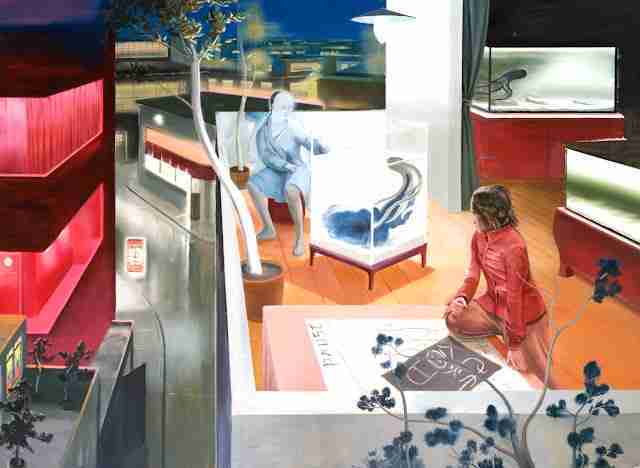
Another key to Baumgärtel’s impact is the cinematic sensation his images produce. Many works feel like frames extracted from a film you cannot access: a moment between scenes, an aftermath, a calm before an unknown disruption. The influence of film is present in composition and in his control of light and shadow, which operates less as illumination and more as mood engineering.
Suspense is central. Something seems about to happen, or has just happened, and the painting leaves you only with the evidence. The figures are often caught in introspection or strange interaction, and the space around them feels as active as they are, as if the environment is part of the plot.
The power of ambiguity: inviting the viewer to dream
Baumgärtel’s work resists easy interpretation. His images contain motifs that feel symbolic, yet the symbolism never locks into a single code. That refusal is the point. Ambiguity is what keeps the paintings open: viewers bring their own associations, fears, and memories, and the image rearranges itself around those inputs.
His world is one where reality and imagination blur, where the everyday becomes a carrier of mystery, and where every detail holds the potential for meaning. In a culture that demands clear answers and fast narratives, Baumgärtel offers another kind of experience: slow, unresolved, and strangely human. His paintings remind us that uncertainty is not a failure of meaning; it can be meaning’s deepest form.