Rosa Loy: The New Leipzig Painter of Dreams, Rituals and Women
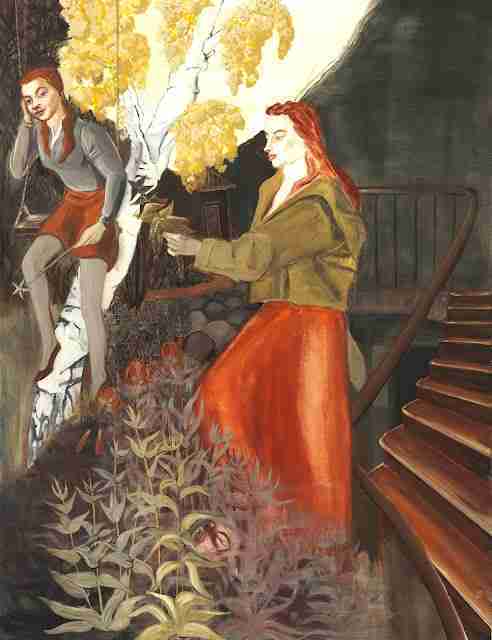
Rosa Loy paints as if the visible world were only the first layer of a deeper, stranger order. Her paintings are inhabited by women who garden, sew, listen, wait, perform rituals, exchange glances and occupy rooms where domestic life becomes myth. Nothing in her work is simply decorative. A flower can become a sign, a gesture can become a spell, and a familiar interior can suddenly open onto something dreamlike and unresolved.
Associated with the New Leipzig School, Loy stands apart for the way she turns figurative painting toward feminine psychology, symbolic narrative and quiet mystery. Her art does not shout. It attracts, withholds and unsettles. It asks the viewer to stay inside ambiguity long enough for meaning to begin moving.
Rosa Loy and the New Leipzig School
Rosa Loy was born in Zwickau, East Germany, in 1958. She studied at the Academy of Visual Arts in Leipzig, one of the most important centers for figurative painting in Germany. This context matters. The Leipzig tradition is marked by technical discipline, narrative density and a strong relationship between painting, history and memory.
But Loy does not simply repeat that tradition. She transforms it. Where Neo Rauch often stages the strange afterlife of ideology, labor and historical memory, Loy moves inward. Her paintings are less public and more psychic, less monumental and more intimate. They do not abandon history, but they translate it into symbols, rituals and relationships between women.
This makes her one of the most distinctive voices within the Leipzig constellation. Around her, artists such as Arno Rink, Matthias Weischer, Tilo Baumgärtel and Christiane Baumgartner show different ways in which German figurative art after reunification could become a field of memory, atmosphere and visual uncertainty.
Painting After East Germany
Loy’s early life in the German Democratic Republic left a quiet but important pressure on her work. Her paintings do not function as direct political documents, yet they often seem shaped by systems of enclosure: rooms, gardens, uniforms, rituals, repeated gestures and women who appear to know more than they reveal.
There is no simple opposition between public history and private imagination in her art. Instead, the two are braided together. The domestic space becomes charged. The garden becomes symbolic. Female companionship becomes a form of knowledge. In this sense, Loy’s paintings suggest that inner life is never separate from social history. It stores it, transforms it and sometimes resists it.
Casein Paint and the Surface of Mystery
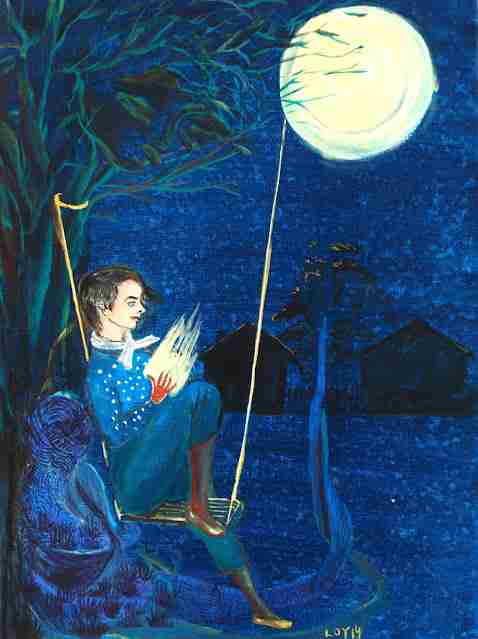
One of the most distinctive features of Rosa Loy’s painting is her use of casein, a medium made from milk protein. Casein gives her works a matte, velvety surface that feels neither fully contemporary nor entirely archaic. The result is a strange temporal effect: the paintings can look newly made and ancient at the same time.
This surface is crucial to her atmosphere. It softens the image without making it sentimental. It gives the figures a fresco-like stillness, as if they belonged to a ritual scene whose meaning has partly survived and partly been lost. The medium becomes part of the mystery. Loy’s paintings do not only represent dreamlike worlds; their very surface seems to slow vision down.
Women, Rituals and the Feminine Universe
The subjects of Loy’s paintings are often women, alone or in pairs, sometimes in groups, engaged in activities that look ordinary and mysterious at once. They garden, sew, converse, carry objects, touch plants, stand near thresholds or seem to take part in private ceremonies. The scenes are readable, but never fully explainable.
This is where Loy’s work becomes powerful. Her women are not passive figures arranged for the viewer’s pleasure. They act, prepare, gather, transmit and guard knowledge. Their gestures suggest a world of female agency that does not need to announce itself loudly in order to be strong.
For this reason, Loy’s work can be read in relation to the wider question of feminism in art, not because her paintings deliver direct slogans, but because they construct a visual universe where women are subjects of mystery, thought, desire, labor and transformation.
Symbols, Flowers and the Language of Transformation
Rosa Loy’s paintings are filled with symbolic forms: flowers, vines, tools, ladders, windows, textiles, vessels, plants and architectural fragments. These signs rarely function as fixed symbols with a single meaning. Instead, they create a symbolic climate. They suggest growth, secrecy, fertility, repair, passage and metamorphosis.
Nature is especially important. Plants in Loy’s work often seem to belong both to the external world and to the psyche. They grow around bodies, enter interiors, surround women or become part of the painting’s hidden logic. The boundary between human and vegetal life begins to blur.
This is why her paintings feel close to forms of magical or symbolic realism. Like Magical Neorealism, they do not abandon reality. They make reality porous. The everyday remains visible, but it opens toward something stranger.
Rosa Loy and Surrealism
Loy’s connection to Surrealism is clear, but it should not be reduced to imitation. Her paintings echo the worlds of Leonora Carrington and Remedios Varo, especially in their use of female figures, symbolic interiors, alchemical atmospheres and ritual-like scenes. But Loy’s work has a quieter, more restrained temperature.
Where much Surrealism stages rupture, shock or erotic disturbance, Loy often produces suspense through calm. Her figures rarely panic. They seem to know how to move inside the dream. This gives the paintings a particular authority: the women are not trapped in the irrational. They inhabit it.
In this sense, Loy belongs to a lineage of women artists who use dream, myth and symbolism not as escape, but as alternative knowledge. The irrational is not chaos. It is another structure of meaning.
The Power of Female Relationships
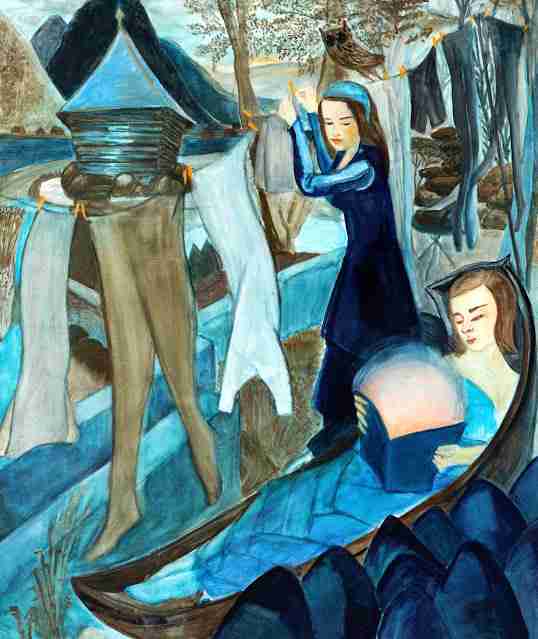
One of the most compelling aspects of Rosa Loy’s work is her depiction of relationships between women. Her paintings often show pairs or groups engaged in shared tasks. Sometimes they appear cooperative, sometimes secretive, sometimes ritualistic. Their relation is never reduced to friendship in a simple emotional sense. It is more complex: a form of alliance, recognition and mutual initiation.
There is often a utopian charge in these scenes, but it is not naïve. Loy’s female communities are not free of ambiguity. They can feel protective and unsettling at the same time. That ambiguity is precisely what makes them convincing. They do not offer an easy fantasy of sisterhood. They stage the feminine as a field of power, intimacy, secrecy and transformation.
Why Rosa Loy Matters Today
Rosa Loy matters because she refuses the false choice between technical painting and psychological depth. Her work is precise but not cold, symbolic but not obscure for its own sake, feminine but not illustrative. She gives painting the density of a dream without dissolving it into vagueness.
In a contemporary art world often divided between spectacle, theory and market recognizability, Loy’s paintings insist on another rhythm. They ask for slow looking. They create images that cannot be consumed immediately because their meaning remains partly hidden. That hiddenness is not a weakness. It is the condition of their power.
Her art speaks to a contemporary need for images that do not explain everything, images that preserve interiority, uncertainty and symbolic life. Rosa Loy shows that mystery is not the opposite of meaning. Sometimes it is the only way meaning survives.
Key Questions
Who is Rosa Loy?
Rosa Loy is a German painter associated with the New Leipzig School. She is known for dreamlike figurative paintings centered on women, symbolism, ritual, intimacy and the feminine imagination.
What is distinctive about Rosa Loy’s painting technique?
One distinctive aspect of Rosa Loy’s work is her use of casein paint, which creates a matte, velvety surface and gives her images a timeless, fresco-like atmosphere.
Why is Rosa Loy linked to the New Leipzig School?
Rosa Loy studied at the Academy of Visual Arts in Leipzig and is associated with the New Leipzig School, a context known for figurative painting, technical discipline and psychologically charged narratives.
Why is Rosa Loy connected to Surrealism?
Her paintings blur the boundaries between dream and reality through symbolic objects, ritual scenes and enigmatic female figures. This connects her to Surrealist artists such as Leonora Carrington and Remedios Varo, while her language remains strongly personal.
Why does Rosa Loy’s art matter today?
Rosa Loy’s art matters because it restores mystery, feminine agency and symbolic depth to contemporary figurative painting. Her work resists fast consumption and invites slow, attentive interpretation.