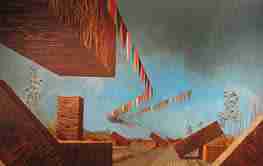
The Neue Leipziger Schule: Reviving the German Art Scene with Bold New Voices
Exploring the Neue Leipziger Schule: A Renaissance of Contemporary German Art
In the contemporary art world, few movements have sparked as much debate as the Neue Leipziger Schule (New Leipzig School). This group emerged from the Hochschule für Grafik und Buchkunst (Academy of Visual Arts) in Leipzig in the early 2000s. They helped revive and reposition German figurative painting on the international stage. Their work is often rooted in history and technical discipline. Yet it speaks in the unstable language of the present: irony, discontinuity, and images that feel like memories you can’t fully place.
Origins and influences
The term “Neue Leipziger Schule” can be misleading, because it suggests a neat continuation of the earlier “Leipziger Schule” associated with Leipzig in the 1970s. There are overlaps, especially a commitment to figuration and narrative density. Yet the younger generation diverges through a wider range of references and a more unstable relationship to time and ideology.
The fall of the Berlin Wall and the cultural shock of reunification form a crucial backdrop. For many Leipzig artists, painting became a way to process discontinuity: the collision of propaganda and consumer culture, the collapse of grand narratives, and the lingering afterimage of life in the former East.
The Academy’s role
The Leipzig Academy of Visual Arts was central to the movement’s formation. It transmitted a respect for craft and image-building. Moreover, it defended painting at a time when many art scenes were shifting decisively toward installation and conceptual practices. Teachers such as Arno Rink helped shape an environment where technical rigor could coexist with narrative experimentation.
Leipzig also became a site where the past was not “resolved.” Instead, it remained active material: a set of visual habits, political memories, and social textures that could be recombined, distorted, and tested through painting.

Key figures of the Neue Leipziger Schule
Neo Rauch is often described as the movement’s best-known figure. His large canvases merge echoes of Socialist Realism with Surrealism and Pop aesthetics. This produces narratives that feel both theatrical and unresolved. His scenes operate like historical weather: ideology, labor, and desire drifting through the same pictorial atmosphere.
Matthias Weischer is known for interiors that feel architectural and psychologically charged. Perspective, décor, and spatial compression become tools for staging the “ordinary” as something unstable. As a result, the viewer is invited to contemplate how spaces hold power, memory, and social scripts.
Tilo Baumgärtel often builds dreamlike scenes where the familiar slips into the eerie. His paintings blur reality and fiction, suggesting that contemporary life is haunted by images, fears, and narratives we inherit without fully choosing.
Artistic themes and styles
The artists associated with the New Leipzig School are not unified by a single style. What connects them is a shared commitment to figurative painting and to narrative as a structure of meaning. Their work frequently engages history, particularly the afterlife of the Cold War and the psychological residues of Eastern Europe’s transformation.
Importantly, this is not nostalgic painting. Many works use irony, dissonance, and surreal shifts as a way to speak about the absurdities of both past and present. In this sense, Leipzig painting often performs a double movement: it returns to craft while refusing to restore a stable worldview.
Impact and contemporary relevance
The influence of the Neue Leipziger Schule extends beyond Germany. International exhibitions and strong market interest helped re-legitimize figurative painting as a contemporary, critical language. At a moment when images are constantly produced and consumed, these artists insist on a slower image. This image is one built through labor, density, and ambiguity.
Ultimately, the New Leipzig School represents a revitalization of German painting grounded in technical mastery and historical awareness. Yet it is forward-looking in its thematic risk. As these artists continue to push narrative figuration into strange, hybrid territories, they invite viewers to reconsider the past. At the same time, they encourage the audience to sharpen their reading of the present and imagine how painting can still describe the human condition.