Caribbean Feminist Art: Jamaica, Cuba and the Politics of Diaspora
Caribbean Feminist Art and Counter-Archives: Ebony G. Patterson, Firelei Báez, and Belkis Ayón
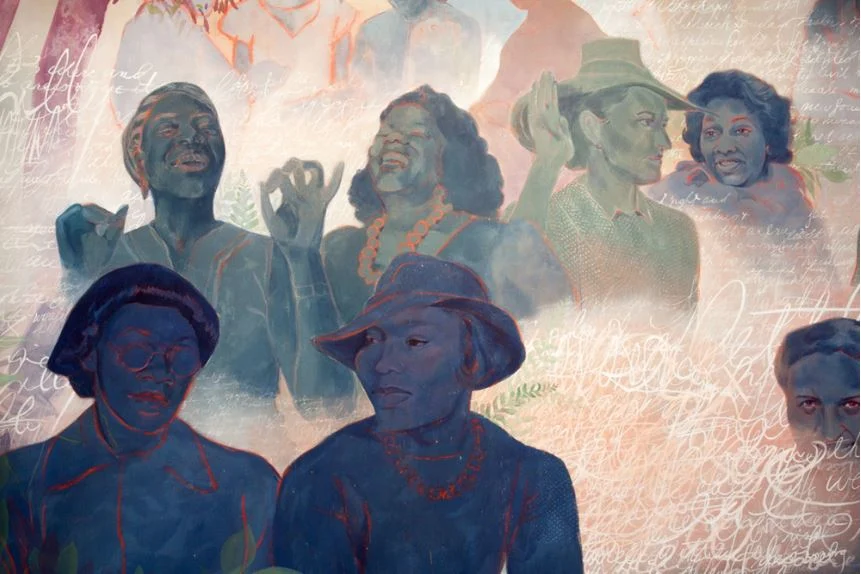
In the Caribbean and across Black and diasporic contexts, feminist art is inseparable from race, colorism, migration, and the politics of visibility inside postcolonial societies. Here, feminism does not function only as critique. It also functions as reconstruction: artists re-stage history, reclaim the image, and resist the museum’s habit of aestheticizing pain.
This article expands the diasporic thread from my larger hub essay on feminism in art:
Feminism in Art Isn’t a Style: It’s a Battle Over Visibility.
You can also browse the ongoing archive in my
Feminism category.
Why “postcolonial visibility” changes feminist art
Postcolonial societies do not distribute visibility evenly. They also do not distribute safety evenly. Feminist artists in Caribbean and diasporic worlds often work inside a brutal equation: visibility can bring recognition, yet it can also bring extraction. The gaze can turn a life into a spectacle. It can turn grief into an aesthetic. It can turn a body into a commodity.
For that reason, many artists build strategies that refuse a simple reveal. Instead of showing trauma directly, they translate it. They re-stage it. They encode it. They protect the subject while still forcing the viewer to confront the system.

What is a counter-archive, and why does figuration matter here?
A counter-archive is not only a collection of images. It is a new way of deciding what counts as history. In museums, archives often privilege official documents, colonial records, and the “clean” narratives that power prefers. By contrast, a counter-archive privileges what power neglects: intimacy, rumor, the body, ornament, refusal, and the fragments of everyday life.
That is why figuration becomes crucial. Figuration can hold contradiction without resolving it. It can stage pleasure and violence in the same frame. It can mix fantasy with history. It can also show how representation itself becomes a battleground.
Ebony G. Patterson: beauty as camouflage, mourning as structure
Ebony G. Patterson builds worlds that seduce before they accuse. Her lush gardens, tapestries, and immersive installations feel opulent: glitter, textile density, ornamental excess, and botanical abundance. Yet she uses that beauty as a trap. She pulls the viewer close, then forces a reckoning with the politics of who becomes visible, who disappears, and who gets mourned.
Importantly, Patterson refuses the most common trap in representing violence against Black bodies: the replay. She does not simply reproduce images of death and spectacle. Instead, she translates them through re-staging, fragmentation, and inference. As a result, she shifts the ethical burden back onto the viewer. The work does not offer shock. It offers responsibility.
Her “garden” becomes a memorial architecture. Each flourish becomes a marker for lives that the public sphere treats as disposable. At the same time, the work stays unstable: pleasure and grief coexist, and the viewer cannot separate them cleanly.
Firelei Báez: maps, myth, and the rewriting of power
Firelei Báez often starts from the archive that shaped the Atlantic world: maps, colonial diagrams, and the visual language of classification. Then she breaks it open. She paints figures across cartography, interrupts borders, and turns geography into a body. Because of that, she shifts history from a “neutral” record into a contested surface.
Her work also insists on hybridity as method. Diasporic identity rarely fits a single national script. Therefore, Báez often stages figures that carry multiple lineages at once, refusing purity as a colonial fantasy. She brings in mythic and folkloric presences as well, not as decoration, but as alternative knowledge systems that survive inside postcolonial life.
In series such as Bloodlines, she connects power to ornament, hair, textile, and gesture. Those details are not secondary. They operate as political symbols. They show how the body carries history even when history pretends to be finished.
Belkis Ayón: Sikán, silence, and the feminist re-reading of forbidden myth
Belkis Ayón built a singular counter-archive by entering a myth system that excluded her. Working in Cuba, she focused on Abakuá iconography, a secret society reserved for men. Rather than treating that exclusion as a wall, she used it as a lens. She returned again and again to Sikán, a mythical female figure within the Abakuá story, and she made Sikán’s position visible as both central and silenced.
Ayón’s preferred medium, collography, supports this tension. The prints often feel nocturnal, monochrome, and ritual-like. They do not present a clean narrative. Instead, they build an atmosphere where power looks like a code: symbols, masks, gazes, and repeating figures that behave like law. Consequently, the viewer reads silence as a political condition, not as absence.
Ayón’s work also clarifies a key point for feminist art history: exclusion does not only happen through censorship. It also happens through myth. It happens through “tradition.” It happens through stories that claim to explain origins while enforcing hierarchy in the present.

Intimacy and spectacle: the collision that refuses resolution
Across these practices, the tension between intimacy and spectacle becomes the engine. Patterson seduces with beauty, then exposes the ethics of looking. Báez rewrites colonial knowledge by painting over its maps and symbols. Ayón enters a forbidden mythology and turns its codes into a critique of gendered power.
None of them offer a neat moral closure. Instead, they build a counter-archive where history and fantasy collide, pleasure and violence sit together, and the viewer loses the comfort of distance. That discomfort is productive. It blocks the museum’s tendency to turn pain into a style.
What this Caribbean and diasporic thread adds to the feminism hub
- Feminism as reconstruction: not only critique, but the building of alternative historical memory.
- Visibility as risk: representation can protect, yet it can also extract, so artists design ethical strategies of translation.
- Figuration as counter-archive: the body holds what official records erase, especially across migration and colorism.
- Refusal of aestheticized pain: the work forces responsibility instead of offering spectacle.
Ultimately, Caribbean and diasporic feminist art expands the idea of feminism itself. It shows that gender politics never stand alone. They intersect with race, colonial history, migration, and the struggle over who gets to appear in public, and under what terms.
Related articles
- Feminism in Art Isn’t a Style: It’s a Battle Over Visibility
- Feminism: Power and Gender Politics
- Wangechi Mutu: Reimagining the Feminine Body and Postcolonial Identity
- Afrofuturism: The Artistic Blend of African Diaspora Culture and Science Fiction
- The Guerrilla Girls: The Unseen Heroes Challenging Art World Inequality
- Kehinde Wiley: Redefining Portraiture through Vibrant Celebrations of Black Identity
- Juliana Huxtable: Bodies, Identity, and the Poetry of Digital Mutations
- The Rise of Contemporary African Art: A New Era
- Annalee Davis at Biennale Arte 2026. Landscape as Mourning, Archive, and Resistance