The Prize Nobody Wants: Venice Biennale 2026 and the Collapse of Neutrality
At the Venice Biennale 2026, the scandal did not stay outside the exhibition. It entered the voting system, the pavilions, the protest letters, the withdrawals and the question nobody wanted to answer: can an institution still turn refusal into participation?
Venice 2026 did not simply host a political crisis. It revealed how contemporary art can absorb even dissent, unless refusal is allowed to remain refusal.
Before the Venice Biennale 2026 opened to the public, before the International Jury resigned, before the Visitors’ Lions transformed an institutional crisis into a public vote, I was contacted directly by people connected to the protest network around the Biennale.
I did not expect that contact. Until then, I had been following the Biennale as I usually do: through works, pavilions, artists, interviews and fragments that ask to be looked at before they become arguments.
I have always been wary of writing that enters art only to confirm a political sentence prepared in advance. There is already too much of that. Art deserves more patience, even when the world around it is burning.
In Venice, however, the frame cracked before the works could settle inside it.
After hearing from several people involved, after following the letters, the closures, the withdrawals, the legal warnings and the increasingly nervous institutional replies, I started asking myself a question I could not avoid. What if the chaos around the Biennale was not outside the exhibition? What if it had become one of its clearest forms?

That does not make every protest pure. Nor does it make every institutional decision cynical. Venice was more interesting, and more disturbing, because the fracture refused such clean divisions.
Art was no longer only what had been installed inside the pavilions. It was also the pressure around them: who represents a state, who refuses a prize, who remains visible after refusing, who speaks for the dead, who is invited to mourn, who stays outside the official map, and who gains symbolic capital once moral language begins to circulate.
Sometimes art is not the beautiful object inside the room. Sometimes it is the moment when the room shows the power that built it.
A Prize Born from a Resignation
On April 30, 2026, La Biennale di Venezia announced that it had received the resignation of the International Jury of the 61st International Art Exhibition, In Minor Keys, curated from Koyo Kouoh’s project.
The jury was composed of Solange Farkas, Zoe Butt, Elvira Dyangani Ose, Marta Kuzma and Giovanna Zapperi. On the same day, the Biennale announced the creation of two Visitors’ Lions: one for the Best Participant in the central exhibition and one for the Best National Participation.
From jury decision to public vote
The Awards Ceremony, originally expected at the opening, moved to November 22, the final day of the exhibition. Visitors who had seen both Giardini and Arsenale could vote. In the absence of the jury, the public became the judge.
At first glance, this could look like a democratic gesture. However, the timing made that reading almost impossible. Days earlier, Reuters reported that the jury would not consider entries from Russia and Israel for awards, citing international criminal proceedings and human rights concerns.
The two cases were not legally identical, and they should not be made identical for rhetorical convenience. Vladimir Putin is subject to an ICC arrest warrant for alleged war crimes involving the unlawful deportation and transfer of Ukrainian children. Benjamin Netanyahu is subject to an ICC arrest warrant for alleged war crimes and crimes against humanity in the situation in Palestine.
Precision matters here. Without it, the argument becomes noise.
The jury’s position entered a field already loaded with government pressure, legal threats, accusations of discrimination, criticism of Russia’s return and anger over Israel’s presence. Then the jury resigned. The Biennale did not cancel the awards. It changed the mechanism.
Judgment became voting.

The Public Vote Did Not Solve the Crisis
The Visitors’ Lions used calm institutional language: openness, participation, a place of truce, the freedom of art. Yet the new award system did not remove the conflict. It formatted it.
On the first public day of the exhibition, Hyperallergic reported that artists and national pavilion teams had withdrawn from awards consideration in solidarity with the jury.
The Art Newspaper also reported the withdrawal of more than 70 artists from the awards process. Later reports described more than 100 participants objecting to their inclusion in the public ballot.
When refusal remains visible
The Biennale’s reply made the contradiction sharper. According to these reports, the Foundation said that all names would remain visible on the ballot to preserve visitors’ freedom of expression, but votes cast for artists who had withdrawn would not be counted.
That sentence is almost too perfect.
If the vote cannot count, why ask the visitor to cast it? If the artist refuses the prize, why preserve the image of eligibility? When a name remains visible while the institution declares the vote invalid, what exactly is being protected?
The answer is uncomfortable. The procedure protects the visitor’s freedom, but it also protects the institution’s need to keep the mechanism intact.
No exaggeration is needed. The facts already do the work.
The Visitors’ Lions became a device for absorbing crisis. A collapsed jury became public participation. A political fracture became an interface. Refusal became something the institution could still display, neutralize and manage.
The institution as machine of absorption
This is why the episode matters beyond the mechanics of a prize. Contemporary art institutions have learned how to host trauma, protest, feminism, ecology, colonial memory, queerness, war, migration and grief.
They can give these words walls, captions, catalogues, talks and opening speeches. Refusal is harder. It does not ask to be represented. It asks not to be used.
Venice Never Was Neutral
The Biennale often speaks of openness and artistic freedom. Its official statement around the Visitors’ Lions described La Biennale as a place of truce in the name of art, culture and freedom.
The phrase is beautiful. In 2026, however, it is also almost impossible to believe without discomfort.
A national pavilion is never neutral. Nor is a flag. State presence already carries power, diplomacy and symbolic violence. After the resignation of a jury over Russia and Israel, even a prize cannot pretend to be neutral. Moreover, inclusion itself changes meaning when artists ask not to be included.
The collapse of innocence
Venice did not become political because activists arrived. It was political already. The Giardini are a map of power. The national pavilion system carries diplomacy, colonial history, cultural branding and soft power inside its architecture.
Some countries occupy permanent symbolic homes. Others rent, borrow, improvise or remain outside the national structure altogether.
Therefore, the real change in 2026 was not the presence of politics. What collapsed was the performance of innocence.
For years, major art institutions have survived by turning conflict into discourse. A war becomes a panel. Colonial violence becomes an archival installation. A destroyed culture becomes a moving exhibition. A boycott becomes a debate on artistic freedom.
Much of this can be necessary. None of it is automatically false. Still, at a certain point, the format itself becomes part of the problem.
When an institution believes every fracture can become programming, it stops listening to the fracture. Instead, it listens to its own ability to metabolize it.

Russia, Israel and the Uneven Grammar of Outrage
One of the clearest tensions around Venice 2026 concerns the difference between how European institutions speak about Russia and how they speak about Israel.
Condemning Putin’s Russia has become institutionally clear in Europe. After the full-scale invasion of Ukraine, the vocabulary was direct: aggression, occupation, war crimes, imperial violence, repression.
That vocabulary is necessary. It should not be softened. I have written about it through Russian dissident art, Skrepetsky, Pussy Riot and Pavlensky, and through the Ukrainian Pavilion’s brutal question of security guarantees.
A different language for Israel
With Israel, the language becomes more guarded. Every word is weighed before it is allowed to exist. Every accusation immediately meets another accusation.
The demand to exclude Israel from the Biennale, first pushed forcefully by Art Not Genocide Alliance in 2024 and renewed for the 2026 edition, exposed this asymmetry.
The point is not that Russia and Israel are the same case. They are not. Making them identical would weaken the argument.
More precisely, Western institutions often recognize some forms of state violence immediately, while they treat others as too sensitive, too strategic or too politically dangerous to name with the same clarity.
The double standard made visible
Reuters reported that the European Commission moved to suspend or terminate a 2 million euro grant after Russia was allowed to return to the Biennale. The Italian government also increased pressure around Russia’s presence.
Against Israel, however, the pressure came largely from artists, curators and activist networks, not from the same official European machinery.
That difference matters. Whether one supports or rejects a cultural boycott, the discrepancy reveals something the art world prefers not to say aloud.
Contemporary art does not operate inside a universal moral language. It operates inside alliances, risks, reputations, diplomatic fears and selective taboos.
The Biennale did not create the double standard. It made it visible.

Palestine Was Present, But Not as a State
Palestine does not have a national pavilion at the Venice Biennale. Italy does not recognize Palestine as a sovereign state. That fact alone should make any discussion about equal participation more careful.
In 2026, Palestine entered the official Biennale structure through a collateral event, not through the national pavilion system.
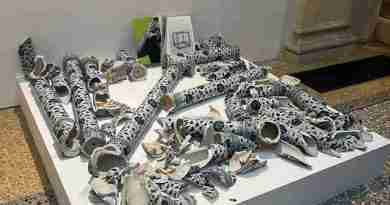
Faisal Saleh’s Gaza – No Words – See the Exhibit, presented by the Palestine Museum US at Palazzo Mora, brought the Gaza Genocide Tapestry to Venice: 100 embroidered panels made through tatreez, a Palestinian practice of stitching memory, identity and belonging across generations.
One side entered through state representation. The other entered through testimony, diaspora, mourning and cultural survival.

The architecture of recognition
That imbalance is not a curatorial detail. It is the architecture of recognition.
The word genocide should never be used lazily. It should not become rhetorical decoration. In this case, however, it does not float in a vacuum.
South Africa’s case against Israel is before the International Court of Justice, which has issued provisional measures under the Genocide Convention. The ICJ has not issued a final ruling on genocide. That distinction is essential.
At the same time, the existence of the case, the provisional measures and the ICC warrants against Israeli leaders mean that the language around Gaza is not simply activist noise.
Who speaks for Palestine?
In my interview with Faisal Saleh, one detail stayed with me. He told me he had contacted ANGA, Art Not Genocide Alliance, but had not been involved.
I do not use this as a weapon against ANGA. Their campaign changed the public debate around the Biennale. It forced questions that the institution would have preferred to keep manageable.
Nevertheless, that detail matters because it opens a harder question. When a movement speaks in the name of Palestine, who is actually heard inside that movement? Who becomes central? Who becomes symbolic?
The art world is skilled at amplifying a cause. It is less skilled at checking whether the people most directly tied to that cause have received more than moral usefulness.

Lubaina Himid and the Cost of a Name
This is where Lubaina Himid’s position becomes important.
Himid represents Britain at the 2026 Biennale with Predicting History: Testing Translation, a pavilion rooted in belonging, migration, Black British history, work, making and the uneasy possibility of changing a space from within.
In a Guardian interview, she speaks from a long history of exclusion, from the Black Art Movement of the 1980s to the delayed recognition that brought her to the Turner Prize and now to Venice.
Signing and risking
Himid also signed the ANGA letter calling for the cancellation of the Israeli pavilion. Her reason was direct: one cannot be neutral in front of bombing and killing.
In the same interview, however, she expressed unease about ANGA remaining anonymous while named artists such as her and Alfredo Jaar carried the consequences of signing.
This is not a contradiction to hide. It is one of the most honest points in the whole debate.
Himid does not retreat into neutrality. She signs. She risks. At the same time, she asks who is visible, who remains protected, who carries the public consequences, and who can operate through an anonymous collective identity.
That question is not anti-activist. It is necessary if activism wants to remain more than performance.
Protest and cultural capital
In the art world, visibility has an economy. Protest has one too. A signature, a closed pavilion, a refusal, a flag, a slogan, a photo of a locked door, a sentence on Instagram: each can be an act of courage.
However, each gesture can also become a unit of reputation.
The problem is not that protest enters art. It must. The problem is that the art system can turn protest into another form of cultural capital with frightening speed.

The Gap Between Gesture and Structure
The May 8 strike against Israel’s inclusion made that tension visible. ANGA announced a broad mobilization against the Israeli pavilion.
Some pavilions closed. Others reduced access, reopened later, or acted through statements rather than full closure. The exact geometry of participation was uneven, and that unevenness is part of the story.
This does not invalidate the protest. It makes it readable.
When the image replaces the cost
There is always a gap between the force of a statement and the institutional reality that follows it. That gap is not hypocrisy by itself. It becomes dangerous when the image of commitment replaces the cost of commitment.
Contemporary art loves the visible sign of political urgency. A closed door photographs well, while a statement circulates quickly. A boycott, meanwhile, produces immediate drama. However, the image of urgency can easily become a substitute for its cost.
These gestures can matter, but they are not enough. The harder question is what remains when the image has traveled and the structure has not moved.
That is also why the Visitors’ Lions became so revealing. The institution and the protest both fought over visibility.
Several pressures, one fracture
The Biennale wanted the names to remain visible on the ballot. The withdrawing artists wanted refusal to have consequence. ANGA wanted the Israeli pavilion made impossible.
Meanwhile, Himid wanted to sign but also questioned the anonymity behind the campaign. Saleh brought Gaza into Venice through embroidery and testimony, but the main protest machine did not absorb him as one might have expected.
Each position exposes a different kind of pressure. None of this is clean. That is why it is worth writing about.
The African Silence in the Minor Key
Another fracture runs inside this story. The European art press has seen it less clearly, but it becomes impossible to ignore if we are serious about geopolitics. It concerns Africa, especially the Sahel.
Venice 2026 was full of outrage around conflicts Europe recognizes as close to itself: Ukraine, Russia, Israel, Gaza. These are urgent. They deserve attention.
Yet the same art system that speaks fluently about colonial memory often becomes quieter when postcolonial power is not a historical theme but a living structure.
France, the Sahel and the present tense of colonial power
France’s relationship with its former colonies in West Africa offers one clear example. Burkina Faso ended French military operations on its soil in 2023. Niger forced out the last French troops later that year. Senegal ended France’s permanent troop presence in 2025.
In June 2026, Reuters reported that Burkina Faso had broken off diplomatic relations with France, accusing Paris of interference and violating principles of mutual respect.
None of this makes the military juntas of the Sahel innocent. They have their own violence, authoritarianism and failures. Easy campism would be useless here.
The point is not to romanticize every anti-French rupture. Rather, the point is to recognize that European power did not disappear when colonial flags came down. It changed instruments, vocabulary and forms of dependency.
If Venice claims to be global, it cannot treat postcolonial power as a historical subject while ignoring it as a current structure.
In that sense, In Minor Keys is more than a title. The minor key is where the world is heard when it is not allowed to dominate the score.

Images That Escaped the Frame
Some of the strongest images of this Biennale did not come from the places designed to produce them.
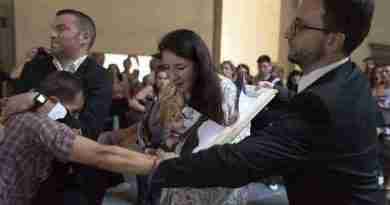
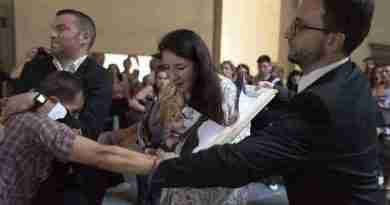
When Pussy Riot and FEMEN protested in front of the Russian Pavilion, they did not only attack a national presence. They exposed the pavilion as recognition.
The same question runs through my interview with Nadya Tolokonnikova, where the separation between official culture and state violence became impossible to maintain.
Ukraine, Iran and the broken promise
The Ukrainian Pavilion worked differently. Through Security Guarantees, Ukraine did not ask Europe simply to look at suffering. It placed Europe in front of a broken promise.
Iran added another layer. In my article on Iran at the Venice Biennale 2026, the issue was the gap between announcement, war, bureaucracy and the fragile status of cultural representation.
Two seagulls against the national pavilion
Even the two seagulls nesting near the Polish Pavilion became, absurdly, part of the argument.
In The Pavilion of Nature, I wrote about them because their presence cut through the human noise.
While states argued about legitimacy, two birds shared care, defended a nest, and made the national pavilion system look briefly ridiculous.
Sometimes the image that matters is not selected by the institution. It interrupts it.

The Prize Nobody Wants
The Biennale is not only an exhibition. It is a machine of inclusion.
To be there means to be seen, photographed, archived, translated, circulated and historicized. Exclusion matters, of course. But inclusion matters too. Being included can be an honor. It can also be a trap.
The Visitors’ Lions controversy shows this with almost cruel clarity. Once an artist enters the Biennale, the institution can continue producing meaning around that presence even when the artist resists.
The name remains on the ballot. Visitors still vote. Then the institution says those votes will not count. Meanwhile, the press reports the conflict, refusal circulates, and the machine goes on.
Visibility is not enough
At that point, the artist is not only refusing a prize. The artist is testing whether refusal can still exist inside an institution built to convert everything into visibility.
This is the larger crisis of contemporary art. We still behave as if visibility were the answer.
Give visibility to Gaza, certainly. Ukraine also needs visibility. Dissidents, colonial wounds, women, queer lives, Black histories, Indigenous memory, ecological collapse, migration and grief need it too. However, visibility cannot remain the final answer.
Visibility matters. Without it, power prefers silence. However, visibility without consequence becomes consumption. It allows us to feel morally awake while remaining structurally unchanged.
Seeing Gaza in embroidery and then leaving the political architecture untouched is not enough. Admiring Ukrainian resilience while Europe’s promises remain broken is not enough either. Nor is it enough to applaud Russian dissidents while an official state pavilion returns to the same symbolic stage.
To vote for artists who have refused the game is not enough either.
Refusal as the real event
The Visitors’ Lions may eventually be remembered less for who wins them than for who refused them.
That refusal is not a side story. It is the real event. A prize normally converts artistic value into recognition. In Venice 2026, the prize exposed the violence that recognition can contain.
It showed that institutions do not only exclude. They also include too much, too quickly, too insistently, even when inclusion becomes a form of capture.
The Biennale did not fall into crisis because politics entered art. Politics was already there. The national pavilion carried politics. Funding did too. So did the passport, the map and the queue outside a pavilion.
Even the silence around some conflicts and the noise around others were political.
The alibi collapsed
What collapsed was the alibi.
Together, the resignation of the jury, the creation of the Visitors’ Lions, the artists’ withdrawals, the legal threats, ANGA’s campaign, Faisal Saleh’s Palestinian project, Russia’s return, Ukraine’s accusation, Iran’s uncertainty, Africa’s unresolved postcolonial fractures and the strange spectacle of protest itself all point to the same thing.
By then, the Biennale was no longer simply representing the crisis of the world. It had become one of the places where that crisis performs itself.
Maybe the prize nobody wants is the most honest artwork of this Biennale.
Not because it is beautiful, and not because it solves anything. It does not bring justice either. Instead, it exposes the mechanism.
It shows an institution trying to turn refusal into participation, protest into programming, fracture into public engagement, and political collapse into a voting interface.
At that point, the real question is no longer who deserves the Lion.
The question is whether contemporary art still knows how to let refusal remain refusal.
And whether we, as viewers, writers, curators, artists and citizens, still have enough courage to recognize when participation has stopped being freedom and has started to look like obedience.
Related Articles
- Faisal Saleh on Gaza, Tatreez and the Venice Biennale 2026
- Pussy Riot at the Venice Biennale: “Russia’s art today is blood”
- Pussy Riot and FEMEN Protest at the Russian Pavilion
- Russian Dissident Art: Skrepetsky, Pussy Riot, Pavlensky
- Ukrainian Pavilion Venice Biennale 2026: Security Guarantees
- Iran at the Venice Biennale 2026: Withdrawal or Delayed Return?
- The Pavilion of Nature at the Venice Biennale