The Ukrainian Pavilion at the 2026 Venice Biennale Exposes the Failure of Politics. An Interview with the Curator
A sculpture against diplomatic illusions.
With Security Guarantees, the Ukrainian Pavilion at the 2026 Venice Biennale does not seek to offer a reassuring representation of the country. Instead, it transforms a sculpture evacuated from the front line into a political question addressed to Europe, the West, and the very system of national pavilions.
Link to the Italian version on Artribune
At the Biennale there are pavilions that merely occupy space. Ukraine’s, by contrast, accuses.
Security Guarantees does not simply present an artwork, but exposes the collapse of a political order that for years called “guarantees” what, once tested by reality, turned out to be little more than diplomatic scrap paper.
At the center of the project is The Origami Deer by Zhanna Kadyrova, a sculpture created in place of a Soviet jet capable of carrying nuclear weapons. After its evacuation from Pokrovsk and arrival in Venice, the work ceases to function merely as an artwork and becomes a brutally sharp question addressed to international politics.
The Value of the Ukrainian Pavilion Project
The issue is not only Ukraine. The issue is everything Europe and the West once defined as security, only to discover that the word itself protected no one.
In this sense, the Ukrainian Pavilion does something many others avoid: it does not use art to soften reality, but to expose its contradictions. The deer folded like origami, suspended in Venice and accompanied by documentation of its displacement, does not ask for compassion. It asks viewers to confront a betrayed promise.
In a Biennale where national pavilions often continue to perform the idea of the nation, Security Guarantees instead works through fracture: between peace and illusion, between disarmament and vulnerability, between artistic image and political failure. It does not seek a reassuring image of Ukraine. It seeks an image strong enough to prevent the viewer from remaining comfortably distant.

Interview with Ksenia Malykh, Curator of the Ukrainian Pavilion
Why choose art to strike at a political failure, rather than denouncing it head-on?
Direct political denunciation speaks the language of declarations, which unfortunately has become all too familiar to the international community and often turns into just another “piece of paper.” Contemporary art possesses a completely different toolkit. It is capable of materializing emptiness and absurdity.
Our project does not soften reality, it exposes its contradictions. We take a concrete, three-dimensional story that began with Ukraine’s nuclear disarmament and, through the physical presence of an evacuated object, demonstrate how global security promises have disintegrated into diplomatic scrap paper.
Art here is not a screen or an embellishment. It becomes the language capable of piercing the deafness of the political establishment.

Is The Origami Deer still an artwork, or has it become something that exceeds art and directly implicates the language of international politics?
The Origami Deer remains a work of contemporary art, but the context of war has endowed it with a new, monumental agency.
When Zhanna Kadyrova created it in 2019 in Pokrovsk, it was a humanistic gesture aimed at reimagining space: a transition from a Soviet Su-15 jet interceptor to a symbol of peace. However, its evacuation in August 2024 and its subsequent 6,000-kilometer journey across Europe fundamentally altered its nature.
Outwardly durable like concrete, it turned out to be as defenseless as a sheet of paper, exactly like the Budapest Memorandum.
Today, the Deer has outgrown the boundaries of pure aesthetics. It has become physical evidence and a brutally sharp political question addressed directly to the global security architecture.

Does bringing to Venice a sculpture evacuated from the front line mean representing Ukraine, or putting Europe itself under accusation?
This project certainly does not seek to offer a reassuring or comfortable representation of Ukraine.
We have brought to Venice not merely an artistic image, but a traumatized and displaced fragment of our public space. Therefore, yes, our pavilion accuses. It targets the very illusion of security in which the Western world has grown accustomed to living, pretending that paper guarantees protect anyone.
Art evacuated from Pokrovsk forces the European viewer out of the role of detached observer and compels them to confront a betrayed promise. It becomes a mirror for Europe, reflecting the deep crisis of its own political institutions.

In a Biennale that tends to absorb everything into aesthetics, how do you prevent a project like this from being neutralized, admired, and then emptied out?
The risk of the art system attempting to “consume” and aestheticize tragedy is always high. This is precisely why we operate through fracture, through a radical rupture.
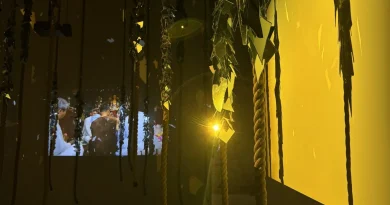
Alongside The Origami Deer, we meticulously present its entire journey: video documentation of the evacuation, footage from Pokrovsk, and the chronicle of its transit through European capitals on the open platform of a truck.
The viewer cannot simply admire the form of the concrete, because the documentary context strikes directly at the core. We strip the audience of the ability to maintain a comfortable distance.
When you see that this deer made of concrete is moving across the world only because its home is being destroyed at this very moment, aesthetic admiration instantly collapses, transforming into either solidarity or profound discomfort.

To present a pavilion that denounces the failure of international politics within a Biennale that also hosts state representations now burdened with conflict and responsibility: is this, for you, a gesture of political affirmation, or a way of showing how historically and morally insufficient the very format of national pavilions has become?
Both statements are true.
On one hand, for Ukraine this is a powerful political affirmation of its agency and its right to speak the truth from the world’s primary cultural forum.
On the other, Security Guarantees clearly demonstrates the moral obsolescence of the traditional national pavilion format. In times of global tectonic shifts and total wars, nations cannot continue merely to “perform” their status or showcase detached artistic achievements.
When the system of national pavilions turns into an exclusive club that ignores the reality outside the walls of the Giardini, it becomes historically and morally bankrupt.
Our pavilion shatters this conventional tranquility.

The protest by many artists against certain national pavilions shows that the Biennale format itself is now under pressure. Do you feel that your project also works within this fracture, showing that it is no longer enough to exhibit, but that one must take a position?
Absolutely.
The era of decorative or neutral art is over, especially when it comes to representing countries in a state of war or profound crisis.
Artist protests worldwide prove that the creative community is no longer willing to serve as a tool for a cultural diplomacy that whitewashes political failures or crimes.
Our project exists precisely within this fracture. We deliberately refuse to provide an “appealing image.” Security Guarantees is not just an exhibition; it is an uncompromising stance.
We assert that if artistic institutions and creators are incapable of taking a clear position and raising their voices against the dismantling of the global order today, then their very presence in Venice loses all meaning.

Final question for the artist, Zhanna Kadyrova
When you created The Origami Deer, did you already think of it as a work capable of unsettling an entire idea of security, or was it the war that transformed it into something harsher than your original intention?
When I created The Origami Deer in 2019, I wasn’t thinking about security guarantees or geopolitics. I was interested in replacing a symbol of military power with something fragile and peaceful. The work was conceived as a permanent sculpture for Pokrovsk, and I never imagined it would have to leave its place.
The war changed that.
When the deer was evacuated from a city that is now almost completely destroyed, it acquired meanings that I could not have anticipated. What was meant to stay became displaced.
In that sense, the war transformed the sculpture into something harsher and more urgent than my original intention.
Today, it speaks not only about the place where it was created, but also about the experience of millions of Ukrainians who have been forced to leave their homes.
Venice // Through November 22, 2026
Security Guarantees. Ukrainian Pavilion
Arsenale
Related Articles
- More from Biennale Arte 2026
- Pussy Riot and FEMEN Protest at the Russian Pavilion at the Venice Biennale
- The Pavilion of Nature at the Venice Biennale
- Nick Cave at the 2026 Biennale. Seven works of loss, memory, and protest
- Annalee Davis at Biennale Arte 2026. Landscape as Mourning, Archive, and Resistance
- Kader Attia: Repair Does Not Erase the Wound
- The Polish Pavilion: Language Beyond the Human in Liquid Tongues
- Danish Pavilion Venice Biennale 2026 Who Brought Porn Stars into the Exhibition