Contemporary Art 1960s
1960s Art Movements: When Art Broke Out of the Frame
The 1960s did not produce one new style. They dismantled the idea that art needed one. A soup can could become a painting, an industrial box could become sculpture, an instruction could become an artwork, a television could become a medium and an audience could become part of the event. The decade changed not only what art looked like, but what art was allowed to be.
Contemporary art in the 1960s developed inside a culture transformed by consumerism, television, the Cold War, civil-rights struggles, anti-war protest, the space race and a rapidly expanding youth culture. Artists responded by attacking many of the assumptions inherited from post-war modernism.
Pop Art replaced the heroic gesture of Abstract Expressionism with advertising, celebrities, comics and supermarket products. Minimalism moved in almost the opposite visual direction, reducing sculpture and painting to geometry, repetition and industrial fabrication. Yet the two movements shared an important idea: both rejected the myth of the unique expressive gesture.
Conceptual Art pushed that rejection further by arguing that an idea could matter more than the object used to communicate it. Fluxus and Happenings blurred art with ordinary life, while Op Art and Kinetic Art turned perception and movement into artistic material. Video, electronic systems, land interventions and new forms of sculpture increasingly challenged the boundaries between traditional media.
The geography of art was also changing. Nouveau Réalisme developed in France, Arte Povera emerged in Italy, ZERO connected artists across Europe, Mono-ha appeared in Japan and political movements in the United States transformed the relationship between art, race, gender and public space.
The defining transformation of 1960s art was therefore expansion. Art absorbed mass culture while escaping the canvas, entered the street while questioning the museum, embraced industrial technology while rediscovering ordinary materials, and turned both the viewer and the idea into possible components of the artwork.
This guide explores the major 1960s art movements, artists and cultural conflicts that created many of the conditions we now associate with contemporary art.
For a wider chronological view, visit the Contemporary Art Index.
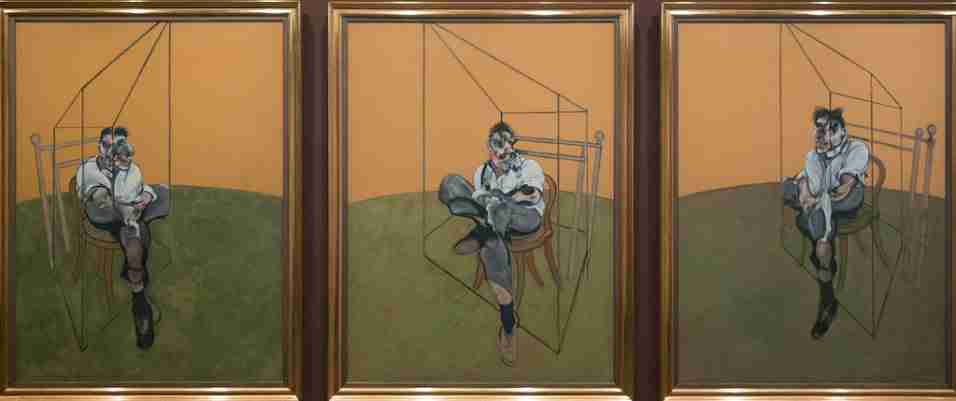
Francis Bacon, painting detail. Even as the 1960s pushed art beyond traditional painting, Bacon demonstrated that figuration could remain psychologically violent, contemporary and resistant to the cool languages developing around Pop and Minimalism.
Explore Art Movements and Trends of the 1960s
Open a section to explore the major movements, artists and ideas that transformed contemporary art during the decade.
- Pop Art and the Mass-Media Image
- Minimalism and Industrial Form
- Conceptual Art and Art & Language
- Fluxus, Happenings and Participation
- Op Art, Kinetic Art and Perception
- Nouveau Réalisme, ZERO and the European Object
- Arte Povera, Anti-Form and Soft Sculpture
- Land Art, Systems Art and the Expanded Site
- Video Art and Electronic Media
- Protest, Chicano Art and Counterculture
- Painting After Abstract Expressionism
Pop Art and the Mass-Media Image
Advertising, celebrities, comics and consumer products entered fine art just as mass culture was becoming impossible to escape.
Pop Art became one of the defining art movements of the 1960s. Its origins reached back into Britain during the 1950s, but the movement acquired extraordinary visibility in the United States through artists including Andy Warhol, Roy Lichtenstein, Claes Oldenburg, James Rosenquist and Tom Wesselmann.
Pop rejected the assumption that serious art required elevated subject matter. Soup cans, Coca-Cola bottles, comic strips, movie stars, advertisements and household objects could occupy the same cultural territory previously reserved for mythology, history or abstraction.
Andy Warhol understood this new image economy particularly clearly. His silkscreens repeated Marilyn Monroe, Elvis Presley, electric chairs and consumer products through a technique associated with commercial reproduction. Repetition made the image immediately recognisable while simultaneously weakening the distinction between artwork, advertisement and commodity.
Roy Lichtenstein performed a related operation with comic-book imagery. His enlarged Ben-Day dots imitated mechanical printing while turning disposable images into monumental paintings. What appeared superficially simple raised a difficult question about originality: if modern culture already speaks through reproduced images, what exactly does it mean for an artist to create an image?
Pop Art was therefore not simply colourful or accessible. It recognised that visual culture was being reorganised by mass reproduction, television, celebrity and consumer desire. The artwork could no longer pretend to exist outside that system.
Minimalism and Industrial Form
The artist’s expressive gesture disappeared behind geometry, serial repetition, industrial materials and physical space.
Minimalism emerged as another fundamental movement of the 1960s, but its visual language appeared almost opposite to Pop Art. Donald Judd, Dan Flavin, Carl Andre, Robert Morris and Sol LeWitt developed works based on simple forms, repetition and manufactured materials.
The reduction was not merely aesthetic. Minimalism questioned assumptions about artistic authorship and craftsmanship. Donald Judd increasingly relied on industrial fabrication rather than personally constructing every object. The artist could specify dimensions, materials and relationships while allowing production to occur elsewhere.
This weakened the romantic image of the artist leaving an emotional trace through the hand. A metal box did not have to reveal the artist’s personality. Its dimensions, position, repetition and relationship with the surrounding architecture could be enough.
Minimalism also changed the viewer’s role. A sculpture could no longer be understood completely from one privileged viewpoint. Walking around a work by Judd, Andre or Flavin meant becoming aware of one’s own body, the floor, the walls and the distance between objects.
The apparently impersonal object therefore produced a highly physical experience. Minimalism removed expression from the surface only to relocate meaning into space.
Conceptual Art and Art & Language
Once an idea could become an artwork, the physical object lost its monopoly over artistic meaning.
Conceptual Art emerged during the 1960s from several overlapping experiments in language, instructions, systems, documentation and dematerialisation. Joseph Kosuth, Sol LeWitt, Lawrence Weiner and others questioned whether an artwork needed to exist primarily as a visually distinctive object.
Kosuth’s One and Three Chairs of 1965 placed an actual chair beside its photograph and dictionary definition. The work does not ask which representation is most beautiful. It asks where meaning resides: in the object, the image, the word or the system connecting all three.
Sol LeWitt developed a different solution. His instructions allowed other people to execute works according to predetermined rules. The artist’s role could therefore shift from manufacturing an object toward designing the intellectual conditions through which an object appeared.
Art & Language, formed in Britain toward the end of the decade, made discourse itself part of artistic production. Writing, analysis, propositions and debate were no longer simply commentary surrounding the artwork. They could constitute the practice.
Conceptual Art’s deeper achievement was not the disappearance of objects. Objects continued to exist. What changed was the hierarchy: the object could now serve an idea rather than automatically being the artwork’s final purpose.
Fluxus, Happenings and Participation
The artwork could become an event, an instruction, a joke, a meal or something that happened only because an audience participated.
Fluxus developed during the early 1960s as an international network rather than a conventional movement organised around one visual style. George Maciunas, Yoko Ono, Nam June Paik, George Brecht, Alison Knowles and others worked across music, objects, actions, publications and performance.
Fluxus scores could consist of extremely simple instructions. An ordinary action might be performed according to a rule, shifting attention from the production of precious objects toward time, behaviour and everyday experience. Affordable editions and multiples also challenged the economic exclusivity traditionally attached to unique artworks.
Yoko Ono’s Cut Piece of 1964 made participation ethically uncomfortable. Audience members were invited to cut pieces from her clothing while she remained seated. Participation was no longer automatically playful or democratic. The spectator became responsible for an action performed upon another person’s body.
Happenings developed from related experiments but often emphasised temporary environments and events. Allan Kaprow’s work deliberately weakened the separation between art and ordinary life. Viewers could move, act and make decisions rather than remain outside the work.
This was a fundamental change. Once the audience could become part of the artwork, spectatorship itself became material that artists could organise, manipulate and question.
Op Art, Kinetic Art and Perception
Instead of representing movement, artists began making vision itself unstable.
Op Art became internationally visible during the 1960s through artists including Bridget Riley, Victor Vasarely and Richard Anuszkiewicz. Geometric structures, repeated lines and colour relationships created apparent vibration, movement and instability.
The viewer was not simply looking at an optical effect from a safe distance. Vision became part of the work. The image could appear to move even though nothing physically changed, demonstrating that perception is constructed rather than passive.
Kinetic Art made movement literal. Jean Tinguely created machines that moved, malfunctioned or even destroyed themselves. Jesús Rafael Soto and Carlos Cruz-Diez investigated relationships between movement, colour and physical position, while Alexander Calder’s mobiles continued to transform sculpture through balance and changing conditions.
These practices shared an important refusal of the static artwork. Whether movement occurred physically or inside perception, the work could change through time and through the viewer’s position.
The consequences are still visible in interactive installations, immersive environments and digital art. Before electronic interactivity became ordinary, Op and Kinetic artists had already demonstrated that an artwork could behave differently because the viewer moved.
Nouveau Réalisme, ZERO and the European Object
European artists found different ways of dismantling traditional painting through objects, urban materials, light, destruction and accumulation.
The transformation of 1960s art was never exclusively American. Nouveau Réalisme, formally identified in France in 1960 around critic Pierre Restany, brought the materials and residues of contemporary urban life directly into artistic practice.
Arman accumulated objects. César compressed automobiles and industrial materials. Daniel Spoerri fixed the remains of meals. Yves Klein used monochrome painting, performance and immaterial propositions, while Jean Tinguely constructed machines whose useless activity mocked technological efficiency.
The movement shared Pop Art’s interest in everyday culture, but its approach was different. Rather than reproducing consumer imagery, many Nouveau Réalistes physically appropriated the objects and waste produced by consumer society.
ZERO, associated particularly with Heinz Mack, Otto Piene and Günther Uecker, pursued another route through light, repetition, motion and the idea of beginning again after the destruction of war. Artists connected with the broader ZERO network investigated optical experience and materials rather than returning to conventional expression.
These European practices demonstrate why the 1960s cannot be reduced to a neat confrontation between American Pop Art and Minimalism. The dismantling of traditional artistic form was happening through several interconnected centres.
Arte Povera, Anti-Form and Soft Sculpture
Materials stopped behaving obediently. Earth, fabric, latex, plants and industrial fragments acquired their own agency.
Arte Povera emerged in Italy in 1967, when Germano Celant used the term to describe a loose constellation including Michelangelo Pistoletto, Jannis Kounellis, Mario Merz, Alighiero Boetti, Luciano Fabro, Giulio Paolini, Giovanni Anselmo and others.
The movement’s “poverty” referred to strategy rather than deprivation. Earth, stone, clothing, plants, glass, fire and industrial remnants could undermine the expectation that an artwork needed precious materials or polished permanence.
Related experiments challenged fixed sculptural form elsewhere. Anti-Form allowed gravity, process and unstable materials to determine how a work appeared. Robert Morris and Eva Hesse explored materials that folded, sagged or resisted rigid geometry.
Soft Sculpture destabilised another inherited assumption: sculpture did not have to be hard, permanent or monumental. Claes Oldenburg enlarged ordinary objects through fabric, while Yayoi Kusama and Eva Hesse used repetition and flexible materials to make sculpture feel bodily, unstable or obsessive.
What connected these very different practices was a transfer of authority from predetermined form toward material behaviour. Instead of forcing matter to illustrate an idea, the artist could allow matter to participate in determining the result.
Land Art, Systems Art and the Expanded Site
Artists began treating landscapes, information, processes and invisible relationships as parts of the artwork.
By the late 1960s, several artists were abandoning the gallery as the unquestioned location of art. Land Art developed through experiments by Robert Smithson, Michael Heizer, Walter De Maria and others who treated geology, scale, distance and entropy as artistic problems.
Several of the movement’s canonical works belong to the early 1970s, including Smithson’s Spiral Jetty, but the intellectual and practical shift had already occurred during the previous decade. The landscape could become material rather than simply subject matter.
Systems Art expanded the definition differently. Instead of concentrating on an individual object, artists examined relationships, information, feedback, environments and processes. A system could generate the visible result without the artwork being reducible to that result.
This logic intersected with Conceptual Art and emerging technological practices. Instructions, diagrams and data increasingly allowed artists to describe invisible structures that traditional painting could not easily contain.
The expanded site and the system share a crucial insight: an artwork does not necessarily end at its physical edge. The forces producing it may exist far beyond the object we can see.
Video Art and Electronic Media
Television was becoming the dominant image machine of everyday life, so artists began taking the machine apart.
Video Art emerged during the 1960s from experiments with television, electronic signals, performance and portable recording technologies. Nam June Paik and Wolf Vostell were among the artists who recognised that television was not simply a device through which culture arrived. It could itself become artistic material.
Paik manipulated television images, incorporated monitors into sculptural environments and connected electronic technology with music and performance. His relationship with Fluxus was crucial because technology did not appear in isolation. It became another method for questioning conventional boundaries between media.
The arrival of portable video equipment expanded these possibilities. Artists could increasingly produce moving images without depending on the infrastructure of cinema or broadcast television. Recording could become immediate, inexpensive and connected to performance.
This represented more than the birth of another artistic medium. Television had become one of the twentieth century’s most powerful systems for distributing images. Video Art allowed artists to work inside the same technological language while resisting its normal commercial and narrative structures.
The significance becomes clearer from the present: today’s art exists inside screens, feeds and digital circulation. The first attempts to turn electronic images against their own medium began decades before the internet.
Protest, Chicano Art and Counterculture
Civil rights, anti-war protest, feminism and counterculture made the idea of politically neutral art increasingly difficult to defend.
The 1960s unfolded through the civil-rights movement, anti-colonial struggles, the Vietnam War, student protest, feminist organising and major conflicts over race and political authority. Not every artist responded through an identifiable political movement, but the social conditions of artistic production changed dramatically.
The Black Arts Movement, associated with the broader Black Power era, challenged cultural institutions and demanded forms capable of speaking directly to Black political and social experience. Groups such as AfriCOBRA, founded in Chicago in 1968, developed a collective visual language grounded in Black identity, community and self-determination.
The Chicano Art Movement emerged from El Movimiento and struggles around labour, civil rights and cultural identity. Murals and public imagery became especially important because art could address communities outside conventional museum structures.
Feminism was also moving toward a decisive artistic rupture. Many of the practices most clearly identified as Feminist Art belong to the 1970s, but the Women’s Liberation Movement and the work of artists such as Yoko Ono, Yayoi Kusama, Carolee Schneemann and others had already made sexuality, the body and unequal visibility impossible to treat as marginal concerns.
Psychedelic Art emerged from another part of the counterculture. Concert posters, album graphics, radical typography and saturated colour created a highly recognisable visual language associated with music, altered consciousness and resistance to conventional social order.
The decade therefore changed the politics of artistic visibility. The question was no longer simply whether art could discuss politics. It was who had access to cultural representation and which audiences art was prepared to address.
Painting After Abstract Expressionism
Painting did not disappear when Pop, Minimalism and Conceptual Art emerged. It fragmented into increasingly incompatible possibilities.
Abstract Expressionism remained enormously influential at the beginning of the 1960s, but younger artists increasingly resisted its mythology of individual gesture and heroic subjectivity. Painting responded through several distinct strategies rather than one unified successor movement.
Post-Painterly Abstraction, a term associated with critic Clement Greenberg and a 1964 exhibition, described artists moving toward clearer surfaces, open compositions and less visibly expressive handling. Helen Frankenthaler, Morris Louis and Kenneth Noland helped establish colour as an independent structural force.
Hard-Edge Painting intensified geometric clarity through sharply separated areas of colour. Frank Stella’s early work similarly rejected expressive brushwork and emphasised the physical logic of the painting as an object.
Elsewhere, the Chicago Imagists developed a highly figurative and deliberately unruly alternative to New York formalism. Hairy Who exhibitions beginning in the late 1960s combined comics, vernacular imagery, surreal bodies and local visual culture.
Francis Bacon occupied yet another position. His psychologically violent figuration had little to do formally with Pop or Minimalism, but his continued importance demonstrates why historical decades should never be mistaken for stylistic uniformity.
The 1960s did not end painting. They ended its ability to assume that it represented the whole story of advanced art.
Other Important Art Trends of the 1960s
The eleven fields above describe the decade’s strongest structural transformations, but several additional movements help explain how rapidly artistic language was expanding.
Mono-ha and a Different Material Modernity
Mono-ha emerged in Japan at the end of the 1960s through artists including Lee Ufan, Nobuo Sekine and Kishio Suga. Rather than transforming materials into expressive objects, these artists often arranged stone, glass, steel, wood and other substances so that relationships between things and surrounding space became visible.
Mono-ha should not be understood as a Japanese variation of Western Minimalism. The visual similarities can conceal different philosophical and cultural contexts. Its importance lies partly in demonstrating why the history of the 1960s cannot be narrated convincingly from New York alone.
Explore Mono-ha: Materials, Space and the Art of Encounter.
Neo-Dada and the Bridge Toward Pop
Jasper Johns and Robert Rauschenberg had already begun destabilising Abstract Expressionism during the 1950s by using flags, targets, photographs, ordinary objects and assemblage. Their work became crucial to the 1960s because it opened a route between Dada’s earlier attack on artistic conventions and the new languages of Pop, Conceptual and performance-based practice.
Explore Neo-Dada: Rauschenberg, Johns and the Everyday Object.
BMPT and the Refusal of Painting
BMPT, formed around Daniel Buren, Olivier Mosset, Michel Parmentier and Niele Toroni in France, questioned authorship and the expectations surrounding painting through repetition and deliberately restricted methods. The work appeared to continue painting while simultaneously removing many of the qualities traditionally used to distinguish one artist from another.
Public Sculpture and the Problem of Scale
Large modernist sculptures increasingly entered corporate plazas and civic environments during the decade. This expansion brought contemporary art into public space, but it also produced a problem that would later be mocked through the term “plop art”: monumental sculpture could be placed in front of architecture without establishing any meaningful relationship with the social conditions of the site.
What Defined Contemporary Art in the 1960s?
The 1960s are sometimes reduced to Pop Art because Warhol, Lichtenstein and the imagery of consumer culture became so visually dominant. Yet Pop Art was only one expression of a much larger rupture.
Minimalism questioned the expressive hand. Conceptual Art questioned the necessity of the object. Fluxus questioned the separation between art and everyday life. Happenings questioned the passive spectator. Op and Kinetic Art questioned stable perception. Video Art questioned television’s ownership of the electronic image.
Across Europe and Asia, Nouveau Réalisme, ZERO, Arte Povera and Mono-ha demonstrated that this transformation had multiple centres. At the same time, civil-rights movements, anti-war protest, feminism and Chicano activism forced art to confront who was represented, who possessed cultural authority and where artistic communication could happen.
Painting survived all of this. What disappeared was its monopoly. Sculpture survived too, but could now be soft, temporary, industrial, environmental or barely distinguishable from architecture.
The 1960s transformed contemporary art by making its boundaries negotiable.
An image from an advertisement could enter a museum. A fluorescent tube could become sculpture. An instruction could replace the handmade object. A television could become artistic material. An audience could complete an artwork. A landscape could become a site rather than a subject.
The decade therefore did more than introduce a remarkable number of art movements. It created the conditions under which the word “art” would increasingly describe a question rather than a stable category.
That transformation leads directly into the 1970s. The 1960s opened the artwork. The following decade would use that opening to confront the body, the institution, gender, ecology and political power even more directly.
Related Articles
- Pop Art: Artists, Works and Consumer Culture
- Andy Warhol: Biography, Pop Art and The Factory
- Minimalism: Industrial Form and Radical Reduction
- Conceptual Art: When the Idea Became the Artwork
- Fluxus: Art Meets Everyday Life
- Op Art: Illusion, Movement and Perception
- Arte Povera: Radical Materials and Ideas
- Land Art: Why Artists Left the Gallery
- Video Art: The Birth of the Electronic Image
- Psychedelic Art and 1960s Counterculture