Contemporary Art 1970s
1970s Art Movements: When the Artwork Stopped Being Just an Object
The 1970s did not kill the art object. They made it optional. An artwork could now be an instruction, a body under pressure, a walk through a landscape, a videotape, a political investigation, a postal exchange or a dinner table. The decade changed contemporary art by asking a more radical question than how art should look: what is an artwork allowed to be?
Contemporary art in the 1970s developed from experiments that had already begun during the previous decade, but their consequences became much harder to ignore. Conceptual Art shifted attention from the finished object toward ideas, language and systems. Performance Art made the body both medium and evidence. Land Art left the gallery, while Institutional Critique turned the museum itself into material.
Feminist artists pushed the transformation further. They challenged not only who appeared in art, but which materials, experiences and forms of labour the art system considered important. Domestic space, craft, sexuality, motherhood, autobiography and the politics of the body became legitimate artistic territory. Pattern and Decoration later attacked the hierarchy separating supposedly serious abstraction from ornament and techniques historically associated with women.
Technology was changing artistic language at the same time. Video allowed artists to record performance, manipulate time and intervene in a culture increasingly organised around television. Photography produced another tension. Photorealists such as Chuck Close and Richard Estes returned to painstaking representation precisely when the photograph appeared capable of making such labour unnecessary.
The decade was geographically much larger than a history centred only on New York and Western Europe suggests. Arte Povera continued to transform Italian art. Papunya painting emerged in Central Australia as a major assertion of Indigenous cultural authority. Artists across Latin America worked under dictatorship and political violence, while postal networks allowed work to circulate outside many conventional institutions.
The defining transformation of 1970s art was therefore not the replacement of one style by another. It was the collapse of the assumption that contemporary art needed one privileged material, one location or one authority.
This guide explores the major 1970s art movements, artists and debates that transformed the relationship between the artwork, the body, the institution and the world around it.
For a wider chronological view, visit the Contemporary Art Index.
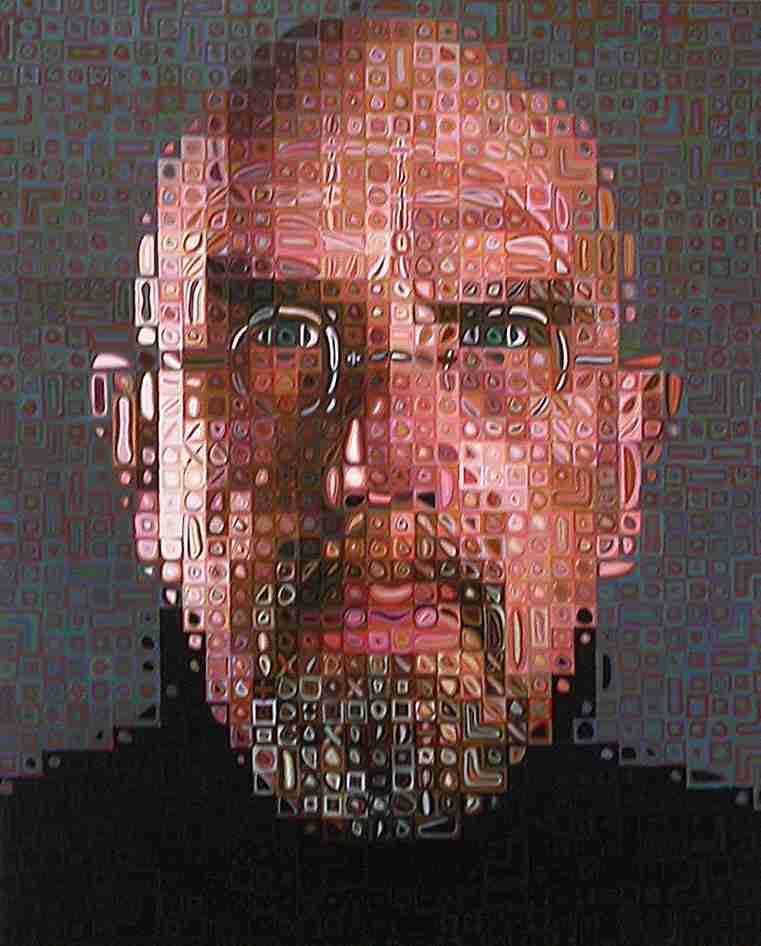
Chuck Close, Self-Portrait. Photorealism created a paradox at the centre of 1970s painting: why reproduce a photographic image by hand precisely when photography appeared capable of replacing such labour?
Explore Art Movements and Trends of the 1970s
Open a section to explore the major movements, artists and critical questions that shaped contemporary art during the decade.
- Conceptual Art, Minimalism and Post-Minimalism
- Performance Art, Body Art and Endurance
- Feminist Art and the Politics of the Body
- Institutional Critique and the Politics of the Museum
- Arte Povera and the Politics of Materials
- Land Art, Environmental Art and the Expanded Site
- Video Art, Installation and Electronic Media
- Photorealism and Hyperrealism
- Light and Space: Perception as Material
- Pattern and Decoration, Craft and Ornament
- Mail Art, Papunya Tula and Alternative Networks
Conceptual Art, Minimalism and Post-Minimalism
The idea could become more important than the object, while process, language and systems challenged the authority of traditional artistic form.
Conceptual Art had emerged during the 1960s, but its consequences became fundamental to contemporary art in the 1970s. Joseph Kosuth, Lawrence Weiner, Art & Language, Sol LeWitt and many others questioned the assumption that an artist’s primary task was to produce visually distinctive objects.
A work could instead consist of a proposition, written instruction, photograph, document, diagram or system. The physical object might simply provide evidence that an idea had been executed. This did not make visual form irrelevant. It changed where artistic authority was located.
Sol LeWitt made the distinction particularly clear. His wall drawings could be executed by other people according to instructions. Authorship therefore shifted from the artist’s hand toward the structure that determined what could happen.
Minimalism remained essential to this transition. Donald Judd, Robert Morris, Carl Andre and others had reduced sculpture to serial objects, industrial materials and direct relations with architectural space. During the 1970s, however, artists increasingly resisted Minimalism’s apparent stability.
Post-Minimal and Process Art allowed gravity, chance, flexibility, repetition and material behaviour to interfere with predetermined form. Lynda Benglis poured latex and polyurethane. Richard Serra used weight, balance and industrial processes. The artwork could become an event produced by materials rather than an image imposed upon them.
The larger transformation was conceptual: the finished object was no longer the unquestioned centre of artistic meaning.
Performance Art, Body Art and Endurance
The artist’s body became material, duration became structure and the spectator acquired a new ethical responsibility.
The 1970s were decisive for Performance Art. Actions developed from Happenings, Fluxus, dance, Conceptual Art and earlier body-based experiments, but artists increasingly used their own bodies as the central material of the work.
Marina Abramović made risk and endurance inseparable from spectatorship. In Rhythm 0 in 1974, she allowed visitors to use a selection of objects on her body, transforming participation into an examination of responsibility and violence. Chris Burden used danger and vulnerability to destabilise the distance between artwork and real event, while Vito Acconci turned following, surveillance, sexuality and psychological exposure into performance.
Ana Mendieta connected the body with land, displacement, gender and ritual. VALIE EXPORT confronted public space and the politics of looking. Gina Pane used bodily injury as deliberate evidence rather than theatrical illusion.
Joseph Beuys expanded performance toward what he called social sculpture. In works such as I Like America and America Likes Me in 1974, myth, politics, symbolism and the artist’s public persona became inseparable.
These practices created a problem that performance art has never fully resolved. If the original event disappears, what remains? Photographs, video recordings, instructions and testimony preserve evidence, but documentation can never become exactly the action it records.
Feminist Art and the Politics of the Body
Feminist artists did more than demand representation. They challenged the materials, histories and institutions that defined what serious art was supposed to be.
The rise of Feminist Art is one of the most important transformations of the 1970s. Women artists confronted exclusion from museums and art history, but representation was only part of the conflict. Feminism questioned why certain experiences and materials had been classified as culturally minor in the first place.
Judy Chicago and Miriam Schapiro helped establish the Feminist Art Program at CalArts, and Womanhouse in 1972 transformed domestic space into a site of artistic and political analysis. Chicago’s The Dinner Party, created between 1974 and 1979, turned ceramics, embroidery, collaborative production and historical research into a monumental counter-history of women.
Schapiro developed femmage, combining collage with fabric and materials associated with domestic craft. What had historically been dismissed as “women’s work” could become a direct attack on the hierarchy separating high art from decoration.
The transformation was international. In Italy, Carla Lonzi, Carla Accardi and Elvira Banotti founded Rivolta Femminile. Their 1970 manifesto rejected the idea that female emancipation could simply mean gaining admission to structures whose values remained fundamentally patriarchal.
Ana Mendieta connected body, gender, violence, exile and landscape. Similar tensions developed in Latin America and Europe under very different political conditions. Feminist art therefore cannot be reduced to one aesthetic language. Its radical contribution was to demonstrate that apparently private experiences are structured by public systems of power.
- Explore Feminist Art
- Feminism in Art: The Battle Over Visibility and Power
- Feminist Art: When Women’s Work Becomes a Weapon Against Hierarchy
- Miriam Schapiro: Femmage and Pattern & Decoration
- Carla Lonzi, Carla Accardi and Rivolta Femminile
- Feminist Art in Latin America: Body, Dictatorship and the Street
Institutional Critique and the Politics of the Museum
Museums and galleries ceased to look like neutral containers. Their money, collections, architecture and authority became artistic material.
Institutional Critique emerged during the late 1960s and became increasingly important in the 1970s. Hans Haacke, Michael Asher, Daniel Buren and Marcel Broodthaers examined the systems through which artworks acquired meaning and legitimacy.
Haacke made the relationship between culture and economic power especially explicit. When his planned Guggenheim exhibition was cancelled in 1971, the conflict demonstrated that the museum could not easily separate artistic freedom from its own institutional interests. His later works investigated trustees, property and financial networks rather than presenting political power as something located safely outside the gallery.
Michael Asher intervened more quietly, altering walls and architectural structures so that the supposedly invisible conditions of exhibition became perceptible. Broodthaers used the fictional museum to expose how classification, display and language manufacture cultural authority.
The transformation was decisive. The museum was no longer only where art appeared. It could itself become the object being analysed.
This created a paradox that still defines contemporary art: once Institutional Critique enters a major museum collection, has the institution neutralised the criticism, or has the criticism permanently altered how the institution can be understood?
Arte Povera and the Politics of Materials
Earth, rags, fire, plants, industrial fragments and ordinary materials challenged the cultural and economic prestige of the conventional art object.
Arte Povera emerged in Italy during the late 1960s and remained a crucial force in the early 1970s. Artists including Jannis Kounellis, Mario Merz, Michelangelo Pistoletto, Alighiero Boetti, Giuseppe Penone, Luciano Fabro and Marisa Merz resisted the expectation that contemporary art should depend on precious, stable or conventionally artistic materials.
The “poverty” of Arte Povera was not a celebration of deprivation. It described an artistic strategy. Soil, coal, fabric, glass, branches, fire, animals, vegetables and industrial materials could interrupt established systems of cultural and economic value.
These works also complicated the boundary between nature and industry. Mario Merz combined organic forms with neon and mathematical systems. Penone treated the tree as a structure containing time and bodily memory. Pistoletto moved between mirror works, ordinary objects, performance and collective action.
Arte Povera therefore should not be reduced to a recognisable rustic aesthetic. Its deeper challenge concerned value: why should certain materials automatically possess greater artistic legitimacy than others?
That question links Arte Povera directly to feminist critiques of craft, ecological art and many material practices that would emerge later.
Land Art, Environmental Art and the Expanded Site
The landscape stopped being something represented inside a frame. It became the location, material and duration of the artwork itself.
Land Art had begun during the late 1960s, but several of its defining works belong to the 1970s. Robert Smithson’s Spiral Jetty, constructed in Utah’s Great Salt Lake in 1970, made geology, entropy, scale and changing environmental conditions integral to the artwork.
Nancy Holt’s Sun Tunnels, created between 1973 and 1976, framed light and astronomical events through monumental concrete structures in the Utah desert. Walter De Maria’s The Lightning Field of 1977 reorganised an enormous landscape through a grid of metal poles whose full experience required time, weather and physical presence.
These works challenged the museum by placing art beyond its walls, but they also introduced contradictions. Monumental interventions into remote landscapes required money, transport, property and physical transformation of the environment. Escape from the museum did not mean escape from infrastructure.
Environmental practices also developed in less monumental ways through restoration, maintenance, ecological systems and attention to damaged environments. Mierle Laderman Ukeles, for example, transformed the invisible labour of maintenance into artistic practice, connecting environmental responsibility with social labour.
The question eventually shifted from “Can nature become art?” toward something harder: what responsibility does an artwork have toward the environment it uses?
Video Art, Installation and Electronic Media
Television ceased to be only a machine for receiving images. Artists turned electronic time, signal and feedback into material.
Video Art developed rapidly during the 1970s as portable cameras and playback equipment became more accessible. Nam June Paik had already challenged television as an artistic medium during the previous decade, but the 1970s expanded video into performance, installation, documentation and perceptual experiment.
Joan Jonas combined performance, mirrors, video feedback and the female body. Bruce Nauman used closed-circuit systems and recorded actions to destabilise spectatorship and physical space. The Vasulkas explored the electronic signal itself, while Bill Viola began developing a language based on duration, perception and states of consciousness.
Video was particularly important because it could function simultaneously as artwork and documentation. A performance could disappear physically while surviving through a recording. Yet this created another problem: the camera never simply preserves an event. It selects a viewpoint and produces a new work.
Installation Art expanded for similar reasons. Artists increasingly constructed environments rather than autonomous objects, allowing architecture, light, moving image, sound and the viewer’s body to operate together.
Technology therefore did not simply add another medium to contemporary art. It changed the relationship between artwork, duration and spectator.
Photorealism and Hyperrealism
Painting responded to photography not by retreating from it, but by competing with its mechanical precision.
While Conceptual and Performance Art appeared to move beyond traditional painting, Photorealism developed in almost the opposite direction. Artists including Chuck Close, Richard Estes, Audrey Flack, Ralph Goings and Robert Bechtle used photographs as the basis for paintings of extraordinary precision.
The apparent conservatism is misleading. Photorealism did not simply revive academic realism. Its source was already mediated. The artist was not painting reality directly but painting a photograph of reality, often using projection, grids and other mechanical procedures.
Chuck Close made this contradiction particularly powerful through monumental portraits. Seen from a distance, the image appears photographic. Seen closely, it becomes evidence of repeated manual decisions.
Hyperrealism pushed intensified realism into painting and sculpture, often exaggerating scale, detail and physical presence. Duane Hanson’s life-size figures, for example, transformed ordinary human bodies into objects that could feel more disturbing than traditional figurative sculpture precisely because they appeared so normal.
In a decade obsessed with dematerialisation, Photorealism demonstrated that painting could remain conceptually difficult without abandoning technical labour.
Light and Space: Perception as Material
Instead of producing another object to look at, artists engineered the conditions through which looking itself takes place.
The Light and Space movement, associated especially with Southern California, developed from the late 1960s through the 1970s. James Turrell, Robert Irwin, Doug Wheeler, Mary Corse and others used light, architecture, transparency and atmospheric conditions to reshape perception.
The work often appears visually restrained, but its ambition is radical. Light is not used simply to illuminate an object. It can become the object. Architecture is not background. It becomes an instrument controlling what the viewer can perceive.
James Turrell’s environments make physical space appear unstable through carefully controlled illumination. Robert Irwin gradually reduced the distinction between artwork and surrounding architecture. Mary Corse used reflective materials to produce surfaces that change as the spectator moves.
These practices inherited some of Minimalism’s reduction but rejected the idea that the artwork could be understood as an autonomous physical object. What mattered was an encounter between material, environment and human perception.
Pattern and Decoration, Craft and Ornament
Decoration stopped apologising for itself and became an attack on the cultural hierarchy separating fine art from craft.
Pattern and Decoration emerged during the 1970s as artists challenged modernism’s long suspicion of ornament. Miriam Schapiro, Joyce Kozloff, Valerie Jaudon, Robert Kushner and others embraced textiles, decorative pattern, repeated motifs and cultural traditions frequently dismissed as secondary to supposedly serious Western abstraction.
The movement had a strong feminist dimension. Craft traditions associated with women and domestic labour had historically been excluded from the highest ranks of fine art. Reintroducing fabric, embroidery, quilting and decoration therefore challenged more than aesthetic taste.
Pattern and Decoration also widened the cultural sources available to contemporary art, drawing from Islamic design, textiles, folk traditions and non-Western ornament. This expansion could itself produce difficult questions around appropriation and cultural translation, but it challenged the fiction that modernist abstraction developed in isolation from decorative histories.
Schapiro’s femmage made the politics especially explicit. Materials labelled feminine, domestic or minor became the means through which the hierarchy itself was confronted.
Pleasure, colour and ornament were no longer the opposite of serious critical art. They could be the argument.
Mail Art, Papunya Tula and Alternative Networks
Not every artistic network depended on the museum. Postal systems, communities and Indigenous structures created other ways for art to circulate and acquire authority.
The 1970s are often narrated through movements centred on Europe and the United States, but that leaves out some of the decade’s most significant transformations in circulation and cultural authority.
Mail Art created an international network that deliberately bypassed much of the conventional gallery system. Ray Johnson had pioneered correspondence practices earlier, while artists such as Anna Banana, Robert Filliou and Guglielmo Achille Cavellini expanded networks of exchange during the 1970s.
A mailed artwork could be cheap, collaborative and difficult to commodify. The postal system became medium, exhibition infrastructure and distribution channel at the same time. Long before social media, artists were asking whether a network itself could become an artistic form.
An entirely different transformation began at Papunya in Central Australia in 1971. Artists from Indigenous communities translated complex relationships with Country, ceremony and ancestral knowledge into works on board and later canvas. Papunya Tula Artists was formally incorporated in 1972.
This history should not be told as though Western institutions “discovered” an art that previously did not exist. The important shift was in format, circulation and visibility. Indigenous cultural systems preceded the contemporary art market that later encountered them.
The movement that developed from Papunya became foundational to Western Desert painting and transformed Australian art. It also exposes a recurring problem in global contemporary art: recognition by an institution is not the same as cultural authority belonging to that institution.
Other Art Trends and Experiments of the 1970s
The decade was even more heterogeneous than these eleven fields suggest. Several additional practices deserve a place in the wider map without being given the same historical weight as Conceptual Art, feminism, performance or Land Art.
Bad Painting and the Rejection of Good Taste
The exhibition Bad Painting, organised by Marcia Tucker at the New Museum in 1978, gave a provocative name to painting that deliberately rejected conventional standards of technical refinement and respectable taste. Its importance lies partly in anticipating the pluralism and anti-purity that would become even more visible during the following decade.
Funk Art and Anti-Heroic Sculpture
Funk Art, especially associated with Northern California, used humour, ceramics, found materials, sexuality and deliberately unmonumental forms. It challenged the seriousness of Minimalism through objects that could appear comic, bodily, handmade or absurd.
ASCII, Computer and Robotic Experiments
Computer-generated imagery remained far from the centre of the institutional art world, but experiments with ASCII images, algorithmic processes, plotters, robotics and electronic systems were already destabilising the assumption that the artist’s hand must produce the visible result.
These practices were small compared with Conceptual Art or Performance Art, but their historical importance becomes clearer from the perspective of later digital art. Questions around automation, instructions and machine authorship were already present long before artificial intelligence entered everyday culture.
Holography and the Technological Image
Artists also experimented with holography as a way of producing images that appeared to occupy three-dimensional space. The medium never became a dominant art movement, but it belongs to the wider 1970s fascination with technology, perception and the possibility of escaping the traditional flat image.
Regional and Indigenous Modernities
Haitian painting, the Warli painting revival in India and other practices remind us why a decade cannot simply be treated as a sequence of Western movements. Different forms of modernity developed from distinct social, spiritual and political histories. Incorporating them into contemporary art history requires more than adding them as exotic side categories. It requires questioning who constructed the chronology in the first place.
What Defined Contemporary Art in the 1970s?
The 1970s are often described as the decade of Conceptual Art and Performance Art. That description is useful, but it does not go far enough. The deeper transformation concerned authority.
Conceptual Art challenged the authority of the physical object. Performance challenged the distance between artist and artwork. Feminist Art challenged the authority of a male-dominated canon. Institutional Critique challenged the museum. Land Art challenged the gallery as the natural location of art. Video challenged the permanence of the image, while Mail Art challenged conventional systems of distribution.
Even painting participated in the conflict. Photorealism made the relationship between hand and camera deliberately unstable, while Pattern and Decoration questioned why ornament and craft had been excluded from the highest categories of modern art.
The result was not the disappearance of painting or sculpture. It was something more important: neither could claim to represent contemporary art by itself anymore.
The 1970s transformed contemporary art by taking away its single centre.
An artwork could now exist as idea, action, body, landscape, signal, institution, photograph, network or object. Once that possibility had been established, there was no convincing way back to a history organised purely through styles of painting and sculpture.
The contradiction was that liberation generated new dependencies. Performance needed documentation. Land Art required ownership and financing. Institutional Critique often depended on the museum it criticised. Conceptual works entered collections despite challenging the commodity object. Alternative networks developed their own forms of authority.
That contradiction is precisely why the decade remains contemporary. Many of the central conflicts of art today, around participation, authorship, visibility, institutions, ecology, gender and technology, were not invented in the digital age. The 1970s had already made them impossible to ignore.
Related Articles
- Conceptual Art: Ideas, Language and Systems
- Performance Art: The Body as Medium
- Feminism in Art: Visibility and Power
- Arte Povera: Radical Materials and Ideas
- Robert Smithson and Spiral Jetty
- Video Art: The Moving Image as Artistic Material
- Chuck Close: Photorealism and the Grid
- Pattern and Decoration: Ornament as Resistance
- Mail Art: Networks Before Platforms
- Papunya Tula and Western Desert Painting