Social Media Censorship of Artistic Nudity: The Algorithm Has No Culture
From Michelangelo’s Fig Leaf to Instagram: How We Automated the Censorship of the Body
We did not abolish the fig leaf. We automated it. What once required a censor, a brush and a piece of plaster can now be done in milliseconds by a platform trained to recognise skin before it recognises culture.
Start here: Feminism in Art Isn’t a Style: It’s a Battle Over Visibility
Explore: Feminism · Performance Art · Digital Art
An artist in Italy can photograph a naked body, exhibit that photograph, write about it, discuss it at a university and, within the limits established by law, claim the protection of artistic freedom. Article 33 of the Italian Constitution begins with an unusually uncompromising sentence: “The arts and sciences are free.” Then the artist uploads the same work to a social network and discovers that constitutional solemnity ends rather abruptly at the gates of a private platform.
This does not mean that Article 33 obliges Instagram, Facebook or TikTok to publish every artwork. It does not. The constitutional principle and the contractual rules of a private service operate on different legal levels. The more uncomfortable question is what happens when a large part of contemporary public visibility has migrated into privately governed infrastructures. The artist may remain legally free to make an image while becoming technologically dependent on companies that decide whether that image can circulate, be recommended, monetised or even remain visible.
The contradiction becomes particularly obvious with nudity. Social networks speak the language of safety, moderation and community standards, all legitimate concerns in themselves. They also operate inside an advertising economy in which sexual content is considered commercially risky. Meta’s own monetisation policies identify nudity, sexual poses, suggestive material and sex objects as categories that can restrict monetisation. The result is not exactly censorship in the old state sense. It is something more diffuse and, because it is largely infrastructural, perhaps more difficult to resist: a form of corporate puritanism built into distribution.
What Would Happen to Lynda Benglis Today?
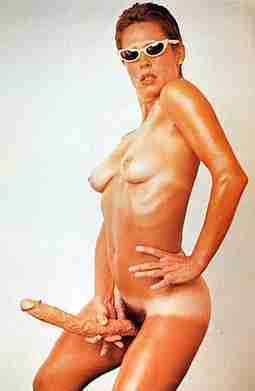
In November 1974, Lynda Benglis occupied two pages near the beginning of Artforum with an image that has never quite stopped causing trouble. Photographed by Arthur Gordon, Benglis appeared naked and oiled, wearing white sunglasses and holding an absurdly large double-ended dildo between her thighs. The image appropriated pornography, masculine aggression, commercial advertising and the mythology of the virile male artist, then compressed them into something deliberately impossible to stabilise.
Five associate editors of Artforum publicly dissociated themselves from the work in the following issue. Rosalind Krauss and Annette Michelson later left the magazine and founded October. Benglis, however, resisted the desire to reduce the photograph to one fixed feminist message. She wanted the work to remain ambiguous enough that its meaning could not be comfortably settled.
That ambiguity is precisely what an automated moderation system finds difficult. A machine can identify skin, nipples, a sexual object and a naked adult body. It is considerably harder to ask whether the image is parodying phallic power, exposing the art world’s gender hierarchy, commenting on pornography or deliberately using obscenity as a critical language. Benglis’s photograph, if uploaded for the first time today, would enter a system whose first task is not to understand its place in feminist art history. Its first task is to classify risk.
This does not mean that every automated system would inevitably delete it. The point is more disturbing than that. A work that has spent fifty years being analysed by artists, historians, museums and feminist scholars can enter a digital infrastructure where its cultural history initially counts for less than the statistical probability that an image contains nudity or sexual content.
What was scandalous in 1974 could therefore become merely non-compliant in 2026. There is something almost tragic in that downgrade. Scandal at least assumes that somebody understood enough to be offended.
Deborah de Robertis: When the Museum Understands More Than the Platform
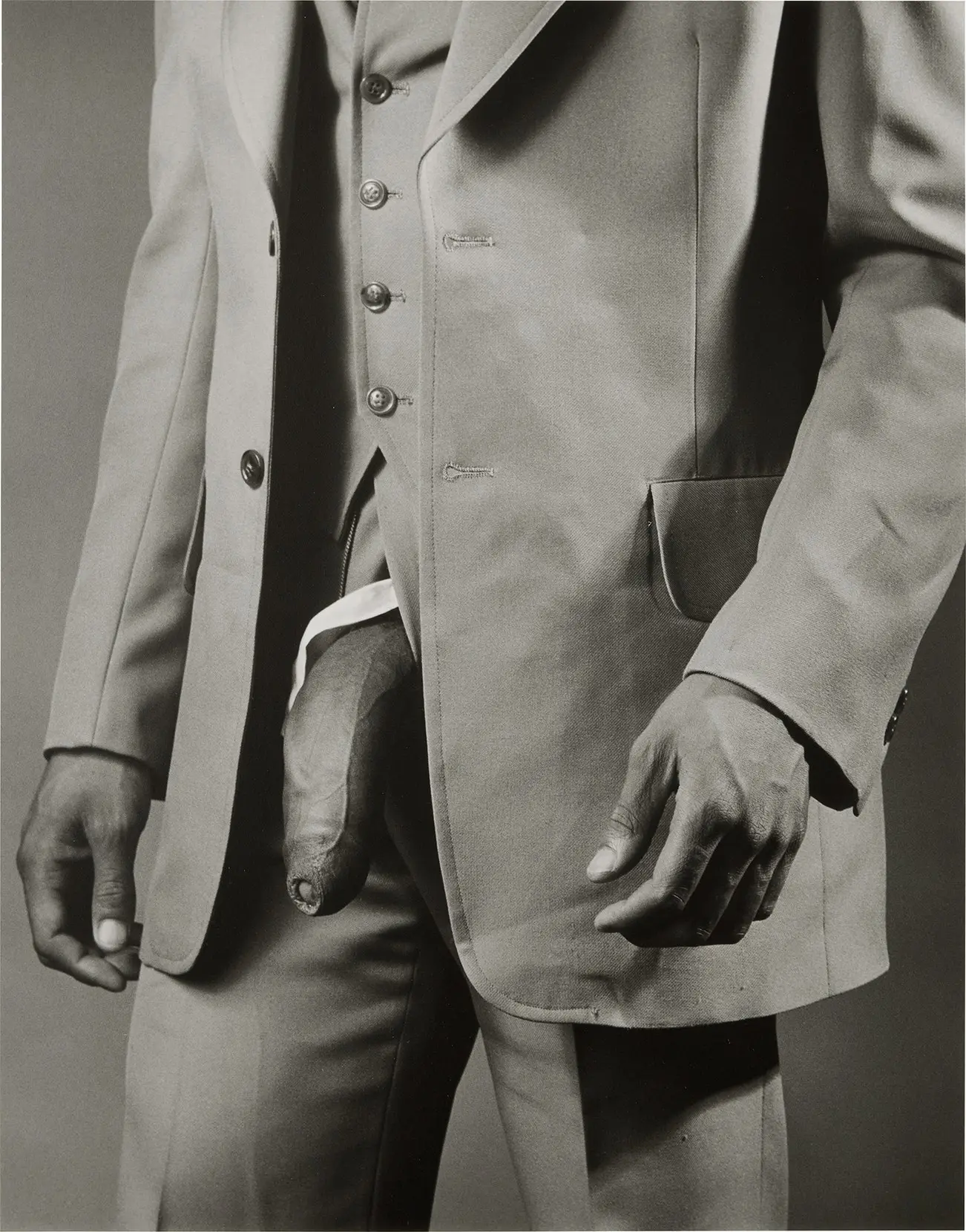
The same contradiction becomes even sharper in performance art. Deborah de Robertis has repeatedly used her naked body to intervene in the history of representation. In 2014, she sat beneath Gustave Courbet’s L’Origine du monde at the Musée d’Orsay, exposing the part of the female body that Courbet had painted and turning the relationship between representation, spectator and living woman inside out. In 2017, her intervention in front of the Mona Lisa at the Louvre led to a prosecution for sexual exhibitionism.
A real court was capable of considering context. In the Louvre case, De Robertis was acquitted of sexual exhibitionism, with the court taking into account the militant and artistic character of the action. That judgment should not be transformed into a simplistic principle that whatever an artist calls art is automatically protected from every legal restriction. It tells us something more useful: context can alter the meaning of a naked body.
This seems almost embarrassingly obvious inside a museum. It becomes strangely difficult online. The same body photographed during a performance can be separated from the action, the institution, the title and the political argument that gave it meaning. It arrives before a moderation system as an image file. The museum asks what the body is doing. The classifier first asks how much of it is visible.
This is not a minor technical inconvenience for performance artists. Documentation is how an ephemeral work survives. If the performance disappears when the action ends and its photographic or video documentation cannot circulate, then moderation does not simply restrict publicity. It intervenes in the afterlife of the artwork itself.
From the Fig Leaf to the Automatic Filter
There is something almost comic about the route that brought us here. For centuries Western culture accepted the naked body when it had been transformed into marble, bronze or paint. Classical and Renaissance nudity entered palaces, churches, academies and eventually museums. Yet this history should not be romanticised. The same culture that produced extraordinary naked bodies also repeatedly found ways to cover them when religious, political or moral authority decided that they had become too visible.
Michelangelo offers the perfect example. After years of controversy surrounding the nudity of the Last Judgment in the Sistine Chapel, Daniele da Volterra was commissioned in the sixteenth century to paint draperies over some of its nude figures. The intervention earned him the enduring nickname Il Braghettone, roughly the “breeches maker”. The censor did not destroy the bodies. He dressed them after the fact.
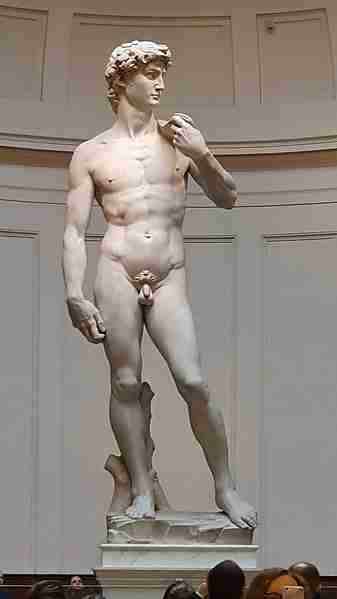
Three centuries later the anxiety remained remarkably healthy. The Victoria and Albert Museum still preserves the enormous plaster fig leaf produced for the cast of Michelangelo’s David. According to the museum, the leaf could be hung over the statue’s genitals for occasions when respectable sensibilities required additional protection. The absurdity is almost perfect: one of the most celebrated bodies in Western art was culturally acceptable, provided that a detachable piece of plaster was available when necessary.
The story is amusing until we recognise ourselves in it. The fig leaf did not disappear. It became digital. Yesterday a censor placed plaster over the genitals of a sculpture. Today a moderation system can limit an image because it identifies a breast, a nipple, exposed genitals or another visual signal associated with sexual content. The technology has changed dramatically. Our nervousness around the body has proved far more resistant to innovation.
Photography Did Not Turn the Body Into Pornography
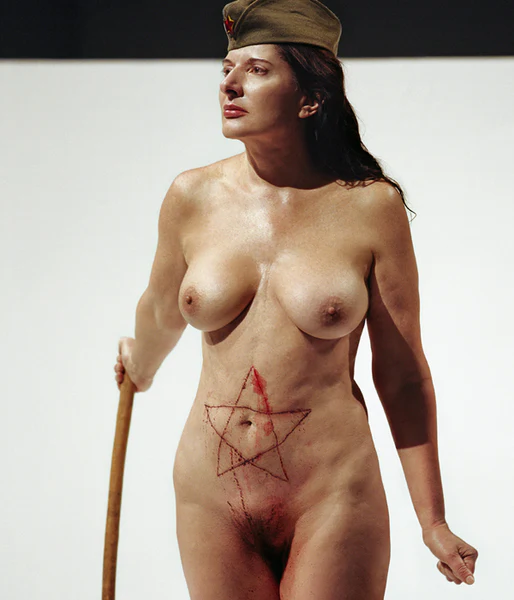
There is another hierarchy hidden inside this history. Painting and sculpture were once among the principal media through which the human body could be represented. Photography changed the relationship between representation and physical reality because the photographed body appears optically much closer to the body we encounter in life. But greater realism does not abolish mediation. A photograph remains constructed through framing, light, timing, pose, selection, editing, circulation and context.
Why, then, should the transition from brush to camera automatically move nudity closer to pornography? The distinction cannot be located simply in realism. A hyperrealist painting may be more explicit than an abstract photograph. A medical photograph can reveal more of a body than an erotic painting without becoming pornography. The medium does not determine the intention.
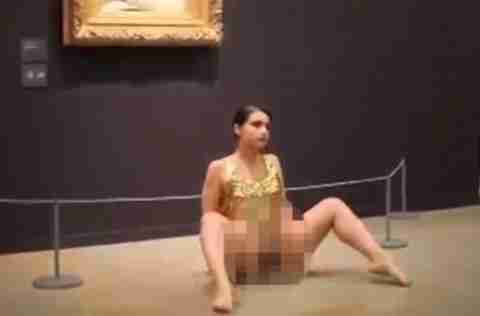
Contemporary performance pushes the question even further because sometimes the medium is no longer an image of the body. It is the living body itself. Marina Abramović made vulnerability, endurance and physical presence into artistic material. VALIE EXPORT turned the female body against the politics of looking in public space. Ana Mendieta used bodily presence and absence to think through violence, belonging and displacement. De Robertis places her living body directly against the archive of art history.
None of these practices becomes intelligible simply by measuring exposed skin. A naked body can be erotic, political, vulnerable, ritualistic, medical, comic, grieving, aggressive, maternal, anti-erotic or deliberately banal. Sometimes it can be several of these things at once. Context is not an accessory added to the image. Context is part of what the image means.
The closer a medium comes to the living body, however, the more our culture seems to demand protection from it. This is not a hierarchy of artistic value. It is a hierarchy of modesty.
The Problem Is Not Nudity. It Is the Meaning We Force Onto It
Digital moderation becomes especially revealing when three very different concepts are collapsed into one another: body equals sex, sex equals pornography, pornography equals danger. Once that chain has been accepted, censorship begins to look like common sense. The body itself becomes the first piece of incriminating evidence.
This equation has religious, moral, commercial and legal histories. It also has a profoundly patriarchal one. The female body has been simultaneously overexposed and controlled for centuries. It can be available as an object of desire while becoming problematic when a woman controls the conditions of its visibility. Western art museums are filled with naked women produced predominantly within histories in which authorship, collecting and institutional power belonged disproportionately to men.
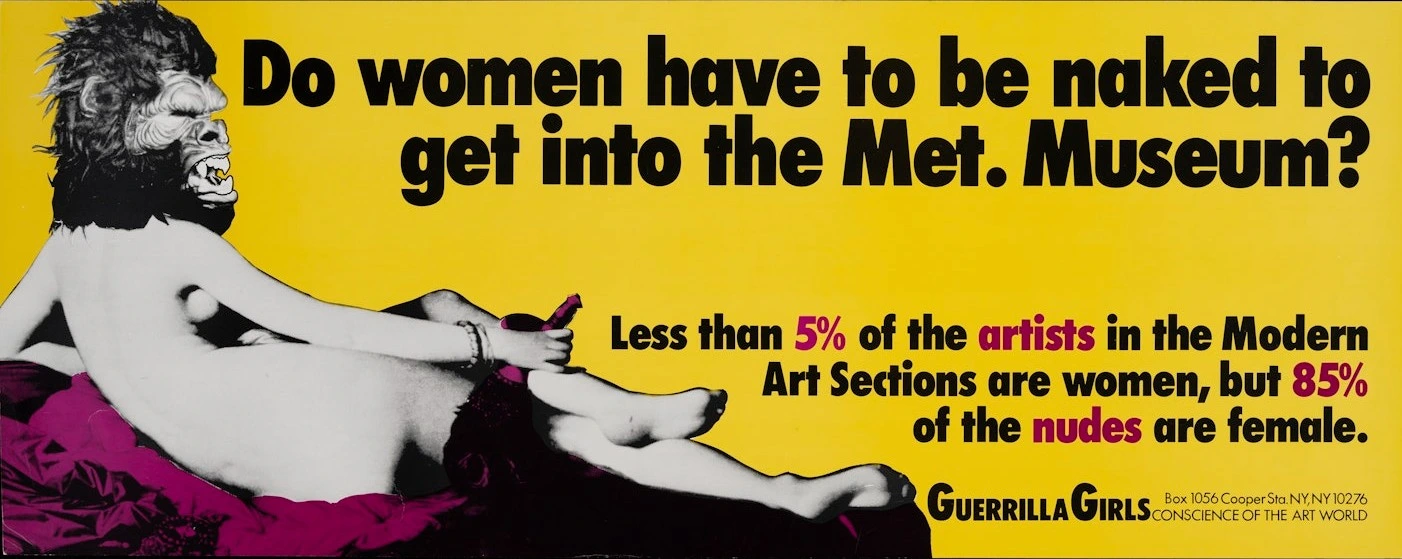
The Guerrilla Girls turned this contradiction into one of feminist art’s most devastating jokes when they asked whether women had to be naked to get into the Met Museum. The joke worked because the statistics behind it were not funny. Women’s bodies were welcome. Women with power over the production and historical status of those bodies were considerably less common.
Social media did not invent that contradiction. It inherited it and converted it into rules, datasets and moderation workflows. Meta’s policies have historically made explicit distinctions around the visibility of female nipples, while allowing exceptions for particular medical, protest, breastfeeding and other contexts. The language changes over time and exceptions become more sophisticated, but the category itself tells us something. The female nipple continues to arrive culturally pre-classified.
The paradox becomes difficult to ignore: a woman’s body can be used relentlessly to sell fashion, cosmetics, entertainment and desire, while an artist using the same body as a political subject can trigger restrictions. The issue is not simply exposure. It is agency. The crucial question remains the same one that runs through much of feminist art: who controls visibility, and who profits from it?
Jago and the Absurdity of a Sculpture Being Too Naked
Sometimes the system manages to parody itself. In August 2025, Italian sculptor Jago reported that Meta had restricted images and videos of La David, his female reinterpretation of Michelangelo’s David. According to the artist, the restrictions affected not only the content but also the distribution of his account.
The irony is almost too neat. Instagram’s published guidelines state that nudity in photographs of paintings and sculptures is permitted. Yet here was a contemporary sculpture, conceived explicitly in dialogue with perhaps the most famous nude sculpture in Western art, colliding with the machinery designed to distinguish acceptable nudity from prohibited nudity.
Jago himself said that artificial intelligence flagged potentially explicit content and that the final decision involved human review. That detail makes the case more interesting, not less. The problem cannot therefore be reduced to the cliché of the stupid machine versus the intelligent person. Humans can reproduce exactly the same blindness when the institutional process trains them to classify before they interpret.
The algorithm has no culture, but bureaucracy can have very little of it too.
And Then We Say: Think of the Children
The protection of minors is the strongest argument in this debate, which is precisely why it should be treated seriously rather than used as a rhetorical emergency exit. Children must be protected from exploitation, abuse, non-consensual sexual material, grooming and genuinely age-inappropriate sexual content. Nothing about defending artistic nudity requires weakening those protections.
But protecting children from sexual exploitation and protecting them from knowledge of the human body are two completely different operations. Confusing them does not necessarily produce safety. It can produce ignorance.
The distinction is supported by international guidance on age-appropriate sexuality education. The World Health Organization and partner UN agencies include knowledge about the body, correct terminology for body parts, privacy, bodily integrity, boundaries, puberty and the prevention and reporting of abuse within age-appropriate education. The most recent guidance explicitly rejects the idea that such education simply introduces children to sexual activity. For younger children, much of it concerns understanding bodies, relationships, emotions and safety.
A child looking at Michelangelo’s David is not looking at pornography. A child learning the anatomy of a human body is not being sexualised by anatomy. Sexual meaning can certainly exist in bodies, images and artworks, but it is not produced automatically by the presence of genitals or breasts. It is the adult gaze that can impose a sexual interpretation on nudity even when the context contains none.
This matters politically. If children learn that genitals are primarily shameful, that nudity automatically means sex and that sex automatically means danger, we may not be dismantling sexualisation at all. We may be teaching the conceptual structure that allows it to reproduce itself. A patriarchal culture does not survive only by showing too much. It can survive just as effectively by deciding what must never be seen, named or discussed.
The Algorithm Did Not Invent This Mentality
That is why blaming artificial intelligence alone is too comfortable. The machine did not wake up one morning scandalised by nipples. We gave it categories. We wrote the policies. We assembled the datasets. We decided what counted as risk. We built advertising systems in which certain representations become financially inconvenient and then asked technology to enforce the distinction at planetary scale.
The algorithm did not invent our relationship with nudity. It inherited it from us. What automation changes is speed, scale and invisibility. Daniele da Volterra had to physically paint draperies over Michelangelo’s bodies. The Victorian fig leaf had to be manufactured, stored, carried and attached. Digital moderation can perform the cultural equivalent millions of times without a visible censor standing anywhere near the artwork.
That is the real historical shift. We have not necessarily become more puritanical than earlier societies. We have made puritanism infrastructural.
Artists Are Not Powerless: The Digital Services Act Changes the Balance
There is, however, an important difference between the digital world of ten years ago and the European internet of 2026. Artists are no longer entirely dependent on whatever explanation a platform chooses to provide. The Digital Services Act has introduced procedural rights that matter directly to anyone whose work is removed, restricted, demonetised or whose account is suspended.
- Platforms must explain moderation decisions. The DSA requires statements of reasons for restrictions covered by the regulation, including information about the grounds for the decision and the role played by automated systems.
- Users can challenge decisions internally. Online platforms must provide complaint mechanisms, and European Commission guidance makes clear that complaints must be handled by qualified staff rather than treated as a purely automated ritual.
- There is an alternative to immediately going to court. Users can turn to certified out-of-court dispute settlement bodies when eligible disputes cannot be resolved with the platform.
- Courts remain available. Depending on the circumstances, national law and the contractual relationship between platform and user, arbitrary suspensions or decisions that contradict the platform’s own terms may also raise contractual or civil-law questions. This route is case-specific, but the idea that platforms exist entirely outside legal accountability is increasingly difficult to sustain.
The numbers make the point better than rhetoric. In February 2026, the European Commission reported that users had challenged roughly 165 million moderation decisions through the internal mechanisms of very large platforms and search engines since the DSA became applicable. Almost 30 percent were reversed. In the first half of 2025, independent out-of-court bodies reviewing disputes concerning Facebook, Instagram and TikTok overturned platform decisions in 52 percent of the closed cases they examined.
Nearly fifty million reversed moderation decisions are not a rounding error. They are evidence that moderation systems get things wrong at industrial scale.
Don’t Delete Art: Turn the Error Into Evidence
Artists should therefore stop treating every removal as an isolated personal humiliation. Documentation matters. Screenshot the notice. Save the original post. Record the date, the stated reason, the appeal and the outcome. If distribution collapses without formal removal, document that too. Censorship becomes politically useful only when individual experiences can be turned into evidence of a pattern.
Don’t Delete Art was created precisely around this problem. Convened by the National Coalition Against Censorship in 2020 and, since June 2026, formally part of its Arts and Culture Advocacy Program, the initiative collects examples of art removed or restricted online and advocates for artistic freedom on digital platforms.
The movement matters because an artist negotiating alone with a platform is structurally weak. Thousands of documented cases create another kind of object: an archive of the cultural consequences of automated moderation. In that archive the removed photograph, the restricted sculpture and the banned performance stop being isolated accidents. They become evidence about the infrastructure through which contemporary culture is now distributed.
Further Reading: Sex, Desire and Representation
Sex Objects: Art And The Dialectics Of Desire
Jennifer Doyle
Jennifer Doyle’s study is particularly useful for understanding why sexuality in art cannot be reduced to the presence of explicit imagery. The book examines desire, spectatorship and the unstable boundary between subject and object, offering a critical framework for thinking about what happens when bodies, sexuality and artistic representation enter the same field.
View Sex Objects: Art And The Dialectics Of Desire on Amazon →
As an Amazon Associate, I earn from qualifying purchases. The price paid by the reader remains unchanged.
A Public Digital Space Cannot Behave Like a Private Puritan Club
Social networks are private companies. They are also among the most powerful infrastructures ever created for the circulation of public culture. Both statements can be true at the same time. Pretending that the first erases the political consequences of the second is no longer credible.
We do need moderation. We need aggressive action against child sexual abuse material, non-consensual sexual imagery, exploitation, harassment and violence. We need systems capable of responding faster and more effectively to genuine harm. But protecting people does not require collapsing Courbet, Benglis, De Robertis, a medical image and pornography into a single visual category called “nudity”. That is not safety. It is intellectual laziness performed at scale.
Art has never promised to be brand safe. Sometimes it is beautiful. Sometimes it is obscene. Sometimes it produces desire, disgust, vulnerability or embarrassment. Sometimes its job is precisely to expose the mechanisms through which societies decide which bodies may be seen and under what conditions. Performance art made that conflict physical. Feminist artists made it political. Digital platforms have now made it computational.
The irony is that we congratulate ourselves on living after the age of Michelangelo’s Braghettone and the Victorian fig leaf while reproducing the same cultural reflex through vastly more sophisticated technology. We did not abolish the fig leaf. We automated it.
The digital version is infinitely faster, invisible and scalable. But speed is not intelligence, and classification is not understanding. If, after Michelangelo, Courbet, Benglis and more than half a century of body and performance art, we still cannot distinguish a naked body from pornography without asking a machine to hide it first, the most serious problem is not what artificial intelligence sees.
It is what we have taught it to see.