Spatialism: The Movement That Succeeded by Failing as a Style
Spatialism Has a Fontana Problem Lucio Fontana was the greatest artist to emerge from Spatialism. He may also be the
Read MoreContemporary Art Criticism, Interviews, Essays and Visual Politics
Spatialism, or Spazialismo, was an Italian postwar art movement that emerged in the late 1940s around Lucio Fontana and a wider network of artists and intellectuals. Rather than developing a single visual style, Spatialism questioned whether traditional painting and sculpture were still adequate to a world transformed by science, technology, movement, new media and changing ideas of space.
The movement explored real depth, light, matter, gesture, environmental space and technological transmission in radically different ways. Fontana pierced and cut the canvas, Roberto Crippa transformed pictorial space through dynamic spirals, Mario Deluigi investigated light through grattage, while Gianni Dova, Cesare Peverelli and Tancredi Parmeggiani pushed Spatialist ideas toward biomorphic, psychological, gestural and atmospheric territories.
Spatialism is therefore best understood not as a uniform aesthetic but as a shared critical problem: how should art change when reality itself changes? Its manifestos and experiments helped challenge the limits of the traditional artwork and anticipated later developments in installation, environmental art, conceptual practices and new relationships between artwork, space and viewer.
This tag gathers articles, critical essays and artist profiles related to Spatialism, its manifestos, its major protagonists and its wider influence on Italian and international postwar art.
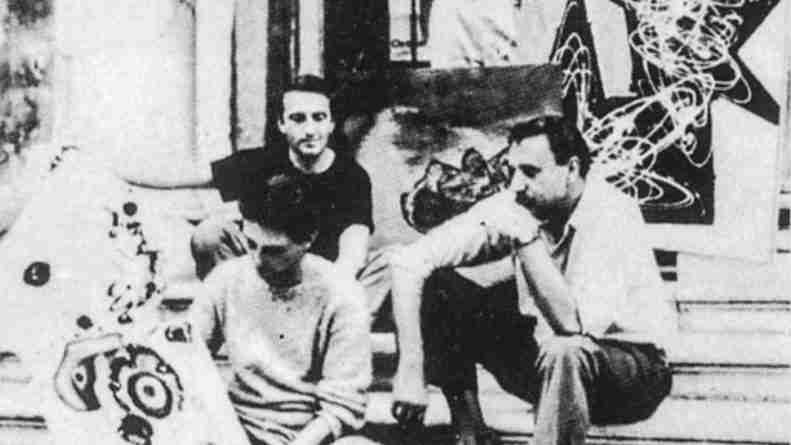 Gianni Dova with Roberto Crippa, Tancredi Parmeggiani and Carlo Cardazzo, 1952. Courtesy Gianni Dova Archive.
 Spatialism Has a Fontana Problem Lucio Fontana was the greatest artist to emerge from Spatialism. He may also be the
Read More Lucio Fontana - Concetto spaziale: Clara ha lasciato la motoretta in cortile
 Lucio Fontana; Spatial Concepts and the Cut that Opened Infinity From sculpture to the slash; how Spatialism turned the canvas
Read More