Piero Dorazio and Kasimiro Medio
Masters of Color and Form: Piero Dorazio and Kasimiro medio (1967)
Piero Dorazio stands among the key builders of Italian post-war abstraction. He did not treat painting as decoration. Instead, he used it as a rigorous field of research, where color becomes structure and light becomes a method. One work captures this ambition with rare clarity: Kasimiro medio (1967), now associated with the Farnesina Collection in Rome. Through this painting, you can read Dorazio’s wider project: to make abstraction precise, international, and intellectually “necessary.”
At a glance
- Artist: Piero Dorazio (Rome, 1927 – Perugia, 2005)
- Key work discussed: Kasimiro medio (1967), oil on canvas, 200 × 200 cm
- Why it matters: a mature statement on color, rhythm, and optical vibration
- Context: Italian abstraction after WWII, Forma 1, and the international networks of the 1950s–60s
First, a correction: “Kasimiro Medio” is not an artist
Many readers assume “Kasimiro Medio” refers to a second painter. However, it is the title of Dorazio’s painting: Kasimiro medio (1967). This matters because it changes the interpretation. You are not comparing two biographies. Instead, you are entering one painter’s studio logic, where a title becomes a poetic label for a chromatic system.
Who was Piero Dorazio?
Dorazio was born in Rome in 1927. Early on, he studied at a classical high school and then moved toward architecture at La Sapienza, although he later left that path. Still, architecture never left him. You can see it in the way he builds paintings through grids, sequences, and “load-bearing” color.
In the 1940s, he helped found small groups that tried to restart culture after fascism and war. He moved from early collective experiences (like Gruppo Ariete and Gruppo Arte Sociale) toward a sharper position: abstraction as a modern, public language. Therefore, his career begins with urgency, not comfort.
Forma 1: abstraction as a political decision (not an escape)
In 1947, Dorazio co-founded Forma 1 together with artists such as Carla Accardi, Antonio Sanfilippo, Giulio Turcato, and others. The group’s famous claim—“formalists and Marxists”—did not aim for provocation only. It aimed for a new logic: political consciousness could exist without figurative propaganda.
This debate still feels contemporary. Even today, many institutions prefer images that “explain” themselves. However, Dorazio and his peers defended a different power: form can train perception, and perception can reshape ideology. Consequently, abstraction can work as resistance, not as evasion.
Rome, networks, and L’Age d’Or
Dorazio did not build abstraction alone. He built it through places, books, and alliances. In 1950, with Achille Perilli and Mino Guerrini, he opened L’Age d’Or, a library-gallery on Via del Babuino in Rome. The space distributed avant-garde magazines and hosted exhibitions. So, it functioned as both a cultural engine and a meeting point.
If you want to understand why Italian abstraction survived, start here. A painting needs an ecosystem: critics, printers, translators, collectors, and stubborn conversations. L’Age d’Or gave Dorazio that ecosystem, and it helped connect Rome to Paris and New York.
International breakthrough: New York, Venice, and Documenta
In the early 1950s, Dorazio pushed outward. He joined seminars and exhibitions in the United States, then showed in New York (including early gallery presentations that introduced him to an American public). Meanwhile, Europe also recognized him. He participated in the Venice Biennale in 1956 and 1958. Then, in 1960, the Biennale granted him a solo room. In 1959, he also took part in Documenta 2 in Kassel, which placed him inside the main narrative of post-war abstraction.
These milestones matter for one reason: Dorazio did not “import” a style from abroad. He negotiated an equal position. He made Italian abstraction visible as a serious, international research language.
Teaching and theory: color as a system
Dorazio also wrote and taught. He published an early, ambitious book on modern art trends in Italy, and he worked as a cultural organizer. Later, he taught for years at the University of Pennsylvania in Philadelphia, while continuing to paint in Italy. This double life matters. Teaching forced clarity. It also strengthened his belief that abstraction needs rules, not myths.
As a result, his mature paintings feel both sensorial and controlled. They do not rely on gesture alone. They rely on structure, repetition, and calibrated contrast.
Kasimiro medio (1967): what you are really seeing
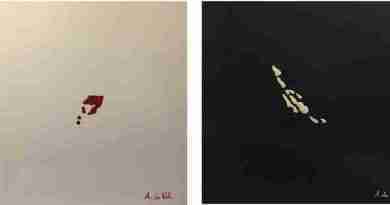
Kasimiro medio dates to 1967. It is an oil on canvas, 200 × 200 cm, and it is connected to the Farnesina Collection (Italian Ministry of Foreign Affairs). Those facts already tell you something. Dorazio works at a scale that surrounds the eye. He wants immersion, not a quick glance.
Now look at the painting as a construction:
- First, notice the weave. Dorazio does not place colors in blocks. He threads them.
- Next, track the rhythm. Lines repeat, but they never become mechanical.
- Then, watch the light effect. Transparent layers make colors appear to advance or recede.
- Finally, feel the tension. The surface vibrates, yet the structure holds.
This is why Dorazio matters. He turns “pure painting” into an event of perception. Therefore, the canvas becomes a field where your eye works, hesitates, and re-starts.
Dorazio, optical research, and the 1960s climate
During the 1960s, many artists tested perception: repetition, vibration, seriality, and the psychology of seeing. Dorazio joined this climate while keeping his own identity. He never turned painting into a trick. Instead, he turned it into a disciplined experiment. So, even when his surfaces pulse, they do not shout.
If you place Dorazio near artists like Accardi, Perilli, Sanfilippo, and Turcato, you can also see the difference. Dorazio pushes toward a “chromatic architecture.” Others push toward sign-language, material conflict, or gestural density. Together, they show how rich post-war Italian abstraction really was.
How to read Dorazio in a museum
Dorazio rewards slow viewing. Try this:
- Stand back and let the whole field hit you.
- Move closer to see the layering and the brush decisions.
- Shift left and right to catch subtle optical changes.
- Return to distance and notice how the image “re-forms.”
This small choreography mirrors Dorazio’s aim. He wants an active viewer. He wants perception to become participation.
Legacy: why Dorazio still helps us
Dorazio’s legacy is not only historical. It is methodological. He shows how abstraction can stay grounded, even when it refuses representation. He also shows how form can carry ethics without becoming propaganda. In a time when images spread fast and simplify everything, Dorazio reminds us to slow down, rebuild complexity, and trust the intelligence of the eye.
Related articles
- The Forma 1 Group – How political conditions destroied the Italian Abstractism
- Carla Accardi, Italian Avantgarde
- Kasimiro Medio and the Essence of Abstraction
- Achille Perilli – Il collasso del carnale
- Antonio Sanfilippo: The Vibrant Pulse of Post-War Italian Art
- Discover the Brilliance of Giulio Turcato: A Master of Abstract Art
- Ugo Attardi
- Pietro Consagra’s Colloquio Definitivo: A Forma 1 Group Masterpiece in Bronze