Pipe Yanguas: The Alphabet of Points – When an Insect Becomes a Cosmology
Between his homeland and Miami, the Colombian artist transforms points and lines into a grammar of relationships. Taking the projects underway for 2026 as a starting point, he talked to us about his murals, the Together We Are Infinite project, and the discovery of an insect in Colombia…
I originally wrote this interview in Italian, and it was first published by Artribune, Italy’s leading magazine for contemporary art. You can read the original version here
In 2026, Pipe Yanguas (b. 1982, Cali, Colombia) will bring his points and lines to Guatemala. He arrives there after years of work, with a grammar pared down to its bare bones and now unmistakable: two marks, repeated until they become a pattern. In the studio, that gesture is patience and rhythm; in public space, it becomes a test. A wall is never neutral, and the work must contend with permits, communities, memory, and misunderstandings; as shown by the story of Cali Florece, which ended up at the center of a misunderstanding on March 8.
In addition to painting and murals, Yanguas is also pursuing a “biographical” photography practice developed over time, as well as hybrid projects straddling image and performance. The stated guiding thread is simple, “We are all connected”, but the work plays out in the details: densities and voids, frictions and recompositions, individual choices that become a system.
Pipe Yanguas’s Connections
In his vocabulary, a point can be an individual, a presence, a fragment of experience; a line is what happens between two points: a bond, a passage, a possible contact. The rest is made up of densities and pauses, like in a piece of music written by hand.
At the origin there is a minute episode. In 2020, during the quarantine in Colombia, the artist recounts that he encountered an exceptionally colorful insect: its anatomy appeared to him like a natural pattern of points and lines. That initial drawing, made using only those two elements, gave rise to a study that continues to change format: from paper to walls, and on to video.

Interview with Pipe Yanguas
Let’s start with the future: in 2026 you have a new intervention awaiting you. What are you working on right now?
I’m working on new projects between Miami and other geographies, and at the beginning of 2026 I’ll be in Guatemala for an intervention in a Biennial space. I’m interested in bringing this language into different contexts, because each place changes the way relationships manifest: sometimes in balance, sometimes in fracture. The work is born precisely there, in an attempt to piece things back together.
How does this idea of connection translate when you work on an actual site, on a wall?
It means listening. A wall is never neutral: it holds memory, layers, rules, people who encounter it. I don’t arrive to “cover” it, but to enter into dialogue with what’s already there. When something breaks, I don’t consider it a failure: it’s often a temporary phase, and the work can become a space where that fracture is set back in motion.
Yet the origin of your language is tiny: an encounter with an insect. What did you see, exactly, in 2020?
During the quarantine I was in Colombia, at my parents’ home. One morning I saw an enormous and incredibly colorful insect: a nymph of the Coreidae family. It struck me because its anatomy seemed to be constructed precisely of points and lines. I drew it using only those two elements, and that’s where it all began: a study that hasn’t stopped since.
That drawing became the seed of your DNA Series. Why call it that?
Because for me that series is a code: not in a cold sense, but as identity, mutation, origin. In the DNA Series I’m not “representing” the insect; I’m transforming the experience into structure. It’s like saying: if I remove everything, what remains? What remain are minimal units, points, and relationships, lines. From there I can build anything.


In your works repetition isn’t decoration: it’s a ritual. What role does it have for you?
Repetition is how I achieve calm. Placing many points together, one by one, forces you to slow down. And I want that slowing down to reach whoever is looking as well: a moment of pause, of peace. I don’t think art “saves the world” forever, but if it heals you for a moment, if it carries you elsewhere even just for a day, it has already done its job.
You often say that every action produces effects. Is this where your art touches on ethics?
Yes. Every decision, every action, has an effect on everything else. If I do something good, that effect returns; if I do something that breaks harmony, that returns as well. It’s a simple idea, but it’s not so common to truly live it. We often think about ourselves instead of the collective. My painting tries to make this visible: the connections, the consequences, the fact that we are all part of the same network.
Among your series, one of the most poetic is Day and Night. What happens in those works, between light and dark?
It’s a series that observes nature’s processes: what happens when there is light and when there isn’t. It’s not just a chromatic theme; it’s a way to talk about time, cycles, about what changes while still remaining itself.
And then there’s the Miniature Metallic Series, which introduces an almost “jewel-like” dimension: small formats, gold, silver, vibration. Where does that come from?
I come from a family connected to jewelry: my father studied gemology, and I grew up surrounded by metals, precious forms, stones. That imagery stayed with me: not as luxury, but as an attraction to uniqueness, to changing light, to vibration. The Miniature Metallic Series is that memory transformed into painting: a material that is never still.
If you had to choose one work that represents you more than any other today, which would it be?
“El Destino”. It’s a work that contains silver and gold, and above all a phrase that stays with me: “Isn’t Faith just a collection of everybody’s choices.” The idea is this: destiny is not a mystical thing that falls on you. It’s the collection of everyone’s choices, all at the same time. Life takes a direction because decisions intertwine, even when you don’t control them.
In an urban context, one of your most debated murals is Cali Florece, not only for its visual impact, but for what happened afterward.
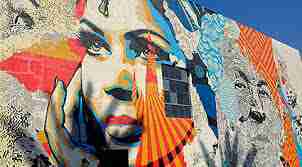
It was an emblematic case. The mural was in the historic center, and it took me eleven months to obtain the permits. I funded the production myself. The work was born from a positive idea: the fertility of Cali and a popular song, “Las caleñas son como las flores.” I wanted to use it as a backdrop for a photo with two salsa dancers and allocate a portion of the print’s sale to a foundation for art and music. The inauguration took place on March 8 and the city presented it as “a gift to women.” That day, during a feminist march, the mural was defaced: a rumor had spread that I’d been paid to depict women as “flowers.” I published a video to clarify the situation. It was a lesson: in public space the work lives on perceptions, and communication can decide everything.


However, your most ambitious project seems to be Together We Are Infinite — you describe it as a “life project.”
Yes. I will continue painting murals in as many cities as possible. Then I use each mural as the backdrop for a photograph, inviting people who represent that city’s creativity: musicians, writers, actors, dancers. The photo is sold and a percentage goes to a local foundation that works with art and creativity. It’s a way to create real connections between places, people, institutions, and to give something back to the community.
There is also a video work, Air Connected, in which the body interprets air as an invisible bond. What did you want to communicate?
I wanted to make visible, through bodies, what we often forget: the elements pass through us and bind us continuously. Air isn’t an abstract symbol; it’s a real force that travels from one place to another and connects everything. I worked with the pianist and composer Elar because I was interested in an essential dialogue between movement and sound, almost “primordial.” The project was born during the pandemic: an event that happens at one point in the world can propagate everywhere.
You live between Cali and Miami and have many projects underway. What’s coming next?
In the short term I have projects in Miami, and then in January I’ll be in Guatemala. I’m also beginning to think about a project in Egypt for next year, and another in Colombia, in Barranquilla. It’s important for me to continue bringing this language to different contexts, because each place changes the way connection manifests.
And what about Italy? How do you imagine one of your murals here, and why might it interest Italian curators and institutions?
I haven’t painted in Italy yet, but I have a strong connection with Milan: for me it was a formative city, one that left a mark on me. If an opportunity opened up, I’d love to create a site-specific mural, conceived with curators and the community, in dialogue with the memory of the place and with those who live it today. I know what it means to work through permits and preservation constraints: it can become part of the project, if there’s trust and a clear vision. And with Together We Are Infinite I could involve local artists and creatives and give something back to the community: an Italian city not as a backdrop, but as a protagonist.