When Spain Carried Pepe Espaliú in Its Arms
If you’re new to this wider project, start here:
LGBTQ+ Art: From Classical to Contemporary.
You can also browse the full archive in my
LGBTQ+ category.
In 1992, Pepe Espaliú turned his own HIV-positive body into one of the most unforgettable images of public care in Spanish art.
When Spain Carried Pepe Espaliú in Its Arms
Pepe Espaliú’s Carrying is one of those rare works that can be described in a single sentence and still not be exhausted by it.
A man with AIDS was carried through the city in the arms of others.
That is almost all. It is also not enough. The force of the action lies in everything that simple sentence cannot hold: the fear of touch, the silence around AIDS, the public shame attached to queer bodies, the weight of illness, the failure of institutions, the possibility of care when care is not sentimental but physical.
This article continues from my previous piece on Pepe Espaliú, AIDS and queer performance art in Spain. There, the question was how Espaliú transformed his own sick body into a public demand. Here, the focus narrows to the action that made that demand impossible to ignore: Carrying.

A body that could not touch the ground
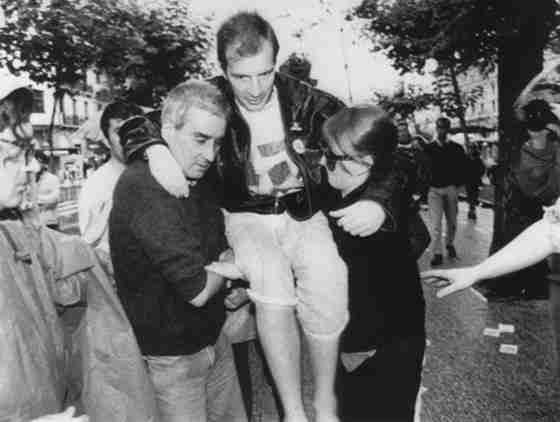
On December 1, 1992, World AIDS Day, Espaliú staged the Madrid version of Carrying. He was thirty-seven, visibly weakened by AIDS, and already close to death. Yet the performance was not a disappearance. It was an appearance staged with terrible precision.
Friends, artists and public figures carried him through Madrid. His bare feet never touched the ground. The route moved from the area of the Spanish Parliament, past the Ministry of Health, toward the Museo Reina Sofía. Among the people who took part were Pedro Almodóvar, Alaska, Bibiana Fernández and Carmen Romero.
The image was almost impossible to misunderstand. A body that society had learned to fear was held in public. A body associated with contagion was touched. A gay man with AIDS, the kind of figure often pushed into silence or euphemism, became the center of a collective action.
Not pity, not metaphor
The danger with Carrying is to soften it into a beautiful humanitarian image. That would be too easy. Espaliú did not create a scene of pity. He created a scene of responsibility.
Being carried is not the same as being represented. Representation can happen at a distance. Care cannot. To carry someone, the body must come close. Arms must make contact. Weight must be accepted. Balance has to be negotiated. The person who carries cannot pretend to be neutral.
That is why Carrying remains more radical than many louder forms of political art. Its language was quiet, but its structure was severe. It asked people to perform the care that society had failed to provide.
San Sebastián: the first act
The Madrid action was not the beginning. A first version of Carrying took place in San Sebastián in September 1992, during a workshop at Arteleku. That first action already contained the essential grammar of the work: a body passed from person to person, a city used as a stage, care made visible as a chain.
Artists and friends took part. The gesture was intimate but public, improvised in feeling but clear in form. Espaliú was not simply transported. He was transferred. That difference matters. The work did not function like a vehicle moving a passive body from one point to another. It functioned like a social organism discovering, step by step, how to hold someone.
In that first version, the image had the power of something fragile and experimental. Madrid would make it national.
Madrid: the city as accusation
The Madrid route was not neutral. Beginning near Parliament and passing the Ministry of Health before reaching the Reina Sofía, the action crossed the symbolic machinery of public life: politics, health, culture.
Espaliú was not merely making a performance for the art world. He was moving his body through the spaces that decide what counts as a public issue. Parliament suggested law and state responsibility. The Ministry of Health evoked institutional failure, medical response, public policy. The museum turned the action toward cultural memory, but without allowing it to become harmless.
His body moved between those points like a question none of them could fully answer.

The scandal of touch
In the early 1990s, AIDS was still surrounded by misinformation, panic and moral judgment. Fear of casual contact remained part of the social atmosphere, even when medical knowledge had already shown how HIV was transmitted.
Espaliú answered that fear without didactic explanation. He made touch visible.
A chain of people held him. Their gesture did not say, abstractly, that people with AIDS should not be abandoned. It enacted the opposite of abandonment. That is the difference between a message and an action. A message can be ignored. A body in someone’s arms changes the arrangement of the scene.
In the wider history of art, AIDS and queer love, Espaliú’s gesture stands apart because it does not begin from absence. It begins from contact before absence arrives.
AIDS art without the safe distance
Many of the strongest works connected to AIDS deal with loss, memory and disappearance. Félix Gonzalez-Torres turns disappearance into tenderness. David Wojnarowicz turns rage into a refusal of silence. Nan Goldin keeps intimacy too close to become clean history. The NAMES Project AIDS Memorial Quilt transforms mourning into collective fabric.
Espaliú enters that history from another angle. The body is not yet gone. It is not only remembered, photographed, mourned or symbolized. It is still there, weak and exposed, asking to be held.
That is why Carrying has a different pressure. It leaves less room for the viewer to hide behind elegy.


The famous faces mattered, but they were not the work
Pedro Almodóvar, Alaska, Bibiana Fernández and Carmen Romero gave the Madrid action public visibility. Their presence helped the performance enter the media and the national imagination. It mattered that these were not anonymous figures. They belonged to culture, politics, nightlife, cinema, public life.
Still, the celebrity dimension should not be mistaken for the work’s meaning. Espaliú did not use famous people to decorate suffering. He used public recognition to move stigma into a space where it could not be ignored.
The action became stronger because different parts of Spanish society appeared around the same fragile body. Bohemia, politics, queer culture, cinema and the museum briefly formed a structure of support.
Care as choreography
Every transfer in Carrying mattered. One pair of arms gave way to another. The body passed across a human chain. Nobody possessed it. Nobody saved it alone.
This is where the performance becomes more than an image. It is choreography, but not in the decorative sense. It choreographs responsibility. It shows that care is not a feeling stored inside the good person. Care is a practice that needs coordination, proximity, attention and time.
In this sense, Espaliú’s action belongs to the history of performance art as bodies, time and presence, but it refuses the heroic solitude often attached to performance. Here, endurance is not the artist standing alone against pain. Endurance is distributed across others.
The body as social sculpture
Carrying is often understood through the idea of social sculpture, the belief that society itself can become the material of art. But Espaliú’s version is not abstract or utopian. It is grounded in illness.
The material is not only society. It is a sick body inside society.
That makes the work sharper. The carriers do not shape a vague collective ideal. They shape, for a brief time, another relation to a body marked by stigma. What is sculpted is not iron, stone or even only space. What is sculpted is the social relation around fear.
For this reason, Carrying also speaks to later practices of embodied resistance, including Cassils and the sculptural violence of the trans body. Both insist that the body is not simply an image. It is pressure, risk, labor and demand.
Against the fantasy of the untouchable body
AIDS stigma turned many people into untouchable figures before death. The cruelty was not only medical. It was social. Fear withdrew touch, language, intimacy and ordinary forms of presence.
Espaliú reversed that logic. He made his body almost excessively touchable, but without surrendering its dignity. The performance did not expose him as an object of pity. It forced those around him to become accountable.
This is why the bare feet matter. They made vulnerability visible without theatrical excess. The feet did not touch the ground, yet the body was not floating. It was held. The image turns fragility into a shared structure.
The museum was not the destination
Because the Madrid route ended at the Reina Sofía, it is tempting to read the museum as the final point of the work. That would be too comfortable. The museum was part of the route, not its solution.
Art institutions are very good at preserving radical gestures once their danger has passed. Espaliú’s work resists that conversion. It enters art history, but it keeps asking what art history does with bodies that were abandoned while they were alive.
This question also matters for artists such as Patrick Angus, whose recognition arrived late, after desire, loneliness and AIDS had become easier to frame historically. Espaliú does not allow the same comfort. His work still feels present tense.
What Spain had to see
Spain in 1992 was not the Spain of Franco, but it was not free of inherited silence. The democracy was young. Public culture had changed. Queer life had become more visible in certain spaces. Yet AIDS revealed what remained underneath: fear, shame, moral judgment, institutional hesitation.
Carrying forced a public contradiction into view. A society that celebrated cultural liberation was asked whether it could care for the bodies that liberation had not fully protected.
That is the reason the performance still matters. It did not simply say AIDS exists. It asked who was willing to touch the person carrying its stigma.
Why Carrying still disturbs
The performance belongs to 1992, but it does not stay there. Its question travels.
Which bodies are made untouchable now? Which lives become visible only when they are already damaged? Which institutions preserve images of care while failing to practice it? Which forms of vulnerability are admired only after they have stopped making demands?
Espaliú’s answer was not a theory. It was a body held above the street.
Not a beautiful ending
Pepe Espaliú died in 1993, one year after the Madrid action. He was thirty-eight.
That death can make Carrying look like a final image, almost a secular procession toward disappearance. Yet the work should not be trapped inside mourning. It was not only a farewell. It was an accusation placed inside a gesture of tenderness.
A society could abandon the sick body.
Or it could carry it.
The question left in the street
What remains of Carrying is not only a photograph, a document or an art historical milestone. It is an unfinished demand.
The artwork is Espaliú’s body, but not only his body. It is the chain of arms. It is the route through Madrid. It is the shame of fear made visible. It is the brief invention of another social relation.
More than thirty years later, the work still asks the same thing.
Not who is visible.
Who is carried?
Further reading on Pepe Espaliú
Pepe Espaliú. Visibilidad, experiencias y construcciones culturales en torno al VIH
places the artist’s work within a broader history of visibility, illness,
queer experience and cultural representations of HIV. Edited by Carlos Barea,
the volume brings Espaliú into dialogue with other artists, activists and
collectives whose work challenged stigma, exclusion and institutional silence.
View Pepe Espaliú. Visibilidad, experiencias y construcciones culturales en torno al VIH on Amazon
As an Amazon Associate, I earn from qualifying purchases. The price paid by the reader remains unchanged.
Related articles
- Pepe Espaliú: The Mask, the Object, the Wound
- Art, AIDS and Queer Love: Scores for the Absent in the Work of Aviva Rahmani, Nan Goldin and Félix Gonzalez-Torres
- David Wojnarowicz: The Artist Who Made Rage Beautiful
- Félix Gonzalez-Torres and the Silent Elegy of “Untitled (Portrait of Ross in L.A.)”
- Nan Goldin: The Tender Witness of a Beautiful, Broken World
- Cassils: The Sculptural Violence of the Trans Body
- Threads of Remembrance: The NAMES Project AIDS Memorial Quilt and Its Global Impact