Eve Babitz was naked. Duchamp was not.
In 1963, Eve Babitz sat naked across a chessboard from Marcel Duchamp after being excluded from the opening of his exhibition. Sixty-three years later, the interesting question is no longer why she took off her clothes, but how someone kept outside the room became inseparable from the memory of what happened inside it.
She didn’t get the invitation. She got the image.
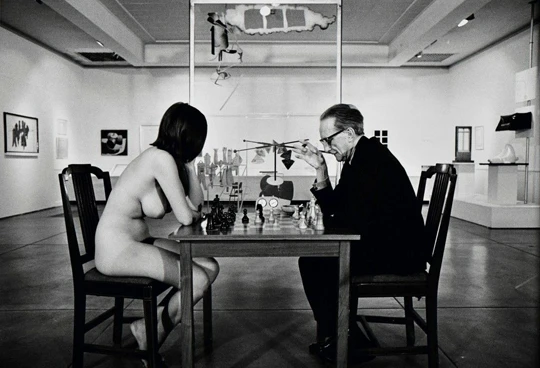
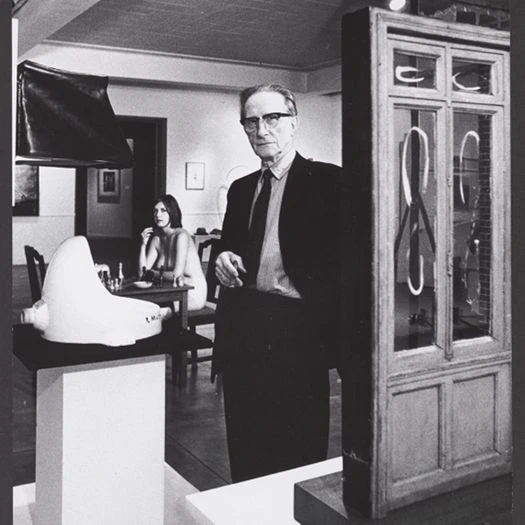
Julian Wasser’s 1963 photograph of Eve Babitz playing chess with Marcel Duchamp at the Pasadena Art Museum has the deceptive clarity of an image that seems settled until biography begins interfering with composition. Duchamp is seventy-six, dressed, already secured inside the history of twentieth-century art; Babitz is twenty, naked, impossible not to notice and, institutionally speaking, almost irrelevant to the occasion. The retrospective is Duchamp’s, the museum is showing Duchamp, the chessboard immediately activates Duchamp’s mythology, while Babitz had not even been invited to the opening.
Walter Hopps, curator of the retrospective, was married and involved with Babitz. His wife attended the opening; Babitz did not. Soon afterwards Wasser photographed Babitz naked opposite Duchamp inside the museum, and the episode has often been filed under revenge. Fair enough, perhaps. But revenge explains the impulse much better than it explains the photograph. The exclusion survived mainly as biographical information; the image acquired a cultural life of its own and gradually made Babitz difficult to separate from the historical memory of the exhibition. In practical terms, she lost the evening and gained something much harder to withdraw later.
THE GUEST LIST EXPIRED
The reversal matters because Babitz never receives the thing she was denied. Nobody corrects the guest list or restores her place in the opening. Instead, she creates another event whose afterlife proves more durable than the official one. The institution controls attendance for a few hours; the photograph starts interfering with what those hours will mean for decades. Museums are very good at doors, invitations, credentials and all the small bureaucratic devices by which culture decides who is expected to be present. They are much less efficient once memory starts doing its own editing.
This is where the photograph becomes larger than its anecdote. Cultural power usually presents itself through ownership: who has the museum, the title, the authority to invite, select and exclude. Babitz has none of these things, yet she introduces an image strong enough to survive the hierarchy that kept her outside the room. She does not defeat the institution, which would be a rather heroic way of misreading the story. She simply makes its authority look temporary, and temporary authority is often more revealing than absolute power because it shows how quickly a room can lose control of its own meaning.
THE PHOTOGRAPH SHOULD BELONG TO DUCHAMP. IT DOESN’T.
Everything in Wasser’s frame should secure Duchamp’s dominance. He has age, reputation, artistic authority, the museum, the retrospective, the surrounding works and the considerable advantage of already being Marcel Duchamp. Babitz has youth, nakedness and the rather unfair visual advantage that nobody looking at the photograph can convincingly claim to have noticed the chessboard first.
Yet the image never quite settles around him. Wasser had gone there to photograph Duchamp, but attention keeps slipping toward Babitz, then back to the board, the works, the museum, Hopps and the circumstances around the shot. What should have been a stable centre becomes oddly provisional.

WHO OWNS THE FRAME?
It is more useful to think of the photograph as a collision of different kinds of authority than as a contest with a winner. Wasser determines the frame; Duchamp brings the cultural gravity; Babitz introduces the disturbance around which the eye reorganises itself; the museum lends seriousness, performing that very old and useful trick whereby an eccentric situation becomes more discussable once it happens near a wall label. Later viewers arrive with information nobody in the room possessed and complicate the scene again.
Calling Babitz simply the object of the picture explains too little, but turning her into its secret mastermind explains too much. She participates knowingly in the construction of her visibility without acquiring ownership of what that visibility will later signify. Duchamp, for all his accumulated authority, cannot dictate the distribution of attention inside a single frame. The photograph survives because these positions never fully settle.
DESIRE IS DOING MORE WORK HERE THAN NUDITY.
Nudity is the easiest entrance into Wasser’s photograph because eyes tend to reach bodies before concepts. It is also, on its own, not terribly interesting. Art history has accommodated such quantities of exposed flesh that one more naked body in a museum can hardly be expected to destabilise civilisation.
What gives this image density is desire, and not only sexual desire. Babitz wants to intervene in a situation that has excluded her. Wasser wants the photograph. The viewer wants to understand the absurdity of the scene. The museum wants seriousness, art history wants mythology, and Duchamp appears perfectly comfortable inside an encounter whose strangeness would hardly have disturbed him.

NOBODY GETS TO INVENT THE BOARD
The chessboard keeps all of this from becoming merely atmospheric. Without it, the photograph might belong to the familiar twentieth-century genre of celebrated man accompanied by nude woman. But Babitz is not simply beside Duchamp; she is playing him, and Duchamp’s relationship with chess was serious enough for the board to introduce calculation, delay and decision into the image.
The result is slightly irritating in the best sense. The eye is invited to treat Babitz as spectacle, while the game refuses to let spectacle exhaust her presence. She is not “saved” by chess, and the board does not elevate the picture through some magical infusion of intellect. It simply makes the viewer work harder. The body attracts attention, but the scene keeps producing other demands.
Chess also offers a cleaner way to understand the position Babitz occupies. Nobody gets to invent the board. The pieces enter an existing structure and intelligence lies in what can be done within its limits. Babitz’s gesture is interesting for the same reason. She does not step outside the mechanisms of prestige, spectacle or institutional authority surrounding her; she moves inside them and alters the arrangement.
This has aged better than the nudity. Transgression often depends on the survival of the taboo it violates, and once the taboo weakens the gesture can look strangely theatrical. Structure is harder to exhaust. Babitz’s nakedness may no longer shock, but the logic of her intervention remains sharp: someone occupying a minor position within an established cultural arrangement changes the distribution of attention without ever controlling the apparatus itself.
Behind the players, The Bride Stripped Bare by Her Bachelors, Even makes the symbolism almost suspiciously cooperative. A bride stripped bare, a woman stripped bare, Duchamp present, Wasser photographing and Hopps absent from the frame while remaining biographically impossible to remove. It is a little too perfect, which is probably why it works. Yet the obvious parallel hides the more interesting distinction: Duchamp’s Bride remains inside the work, while Babitz can stand up and leave.
WHEN THE BODY GETS A NAME
Babitz’s ability to leave the photograph is what eventually changes it. She becomes a writer, a chronicler of Los Angeles and a cultural figure whose identity develops far beyond the circumstances of Wasser’s image. Her later biography does not simply add context; it feeds back into the photograph itself. A body that might once have been described as a nude acquires a proper name, the name acquires books, and the books make the original category increasingly inadequate.
Archives have always been comfortable with functional descriptions such as “model”, “muse”, “wife”, “assistant” or “unknown sitter”. They preserve the visual evidence while flattening the person attached to it. A proper name is more troublesome because biography drags work, contradiction, later decisions and the possibility of a history of one’s own into the frame.

THE ARCHIVE HAS TO WORK HARDER
The shift from “Marcel Duchamp playing chess with a nude” to “Marcel Duchamp and Eve Babitz” therefore matters. Nothing changes in Wasser’s negative, but the hierarchy inside the photograph does. Photography appears to freeze time while remaining oddly vulnerable to it: bodies stay where the shutter left them, while knowledge continues accumulating around them and rearranging their significance.
Duchamp is almost comic in his stability. By 1963 history already knew what to do with him. Babitz keeps moving because the meaning of her presence grows over time: naked young woman, Eve Babitz, writer, cultural figure, historical subject whose later voice modifies an earlier image. For once, Duchamp becomes the fixed piece and Babitz the one whose position keeps changing.
That does not amount to a retrospective victory, and I am not sure the photograph needs one. What changes is simply the possibility of reducing her. The category “nude” becomes increasingly lazy as a description, and once that happens the archive has to work a little harder.
THE IMAGE EVENTUALLY FIRES EVERYONE
The most contemporary aspect of Wasser’s photograph is not that Babitz chose to expose her body. What matters more is what happens when a person successfully produces visibility and then discovers that visibility develops a history of its own.
Once a photograph enters circulation, intention begins to lose authority. Other people bring memory, desire, hostility, admiration, theory, gossip and context. Time adds facts that were not there when the shutter clicked. A provocation can become historical evidence; an anecdote can acquire theoretical weight; a body can acquire a biography strong enough to resist the first reading imposed on it.
Wasser could control composition but not the photograph’s cultural future. Duchamp could provide the occasion and an extraordinary amount of pre-existing significance without remaining its uncontested centre. Babitz could choose to participate and understand perfectly well that the result would attract attention, but she could not determine what later decades would make that attention mean. Hopps, meanwhile, managed the invitation list with immediate success and posterity with considerably less precision.

WHEN AN IMAGE STOPS OBEYING
At some point, images that remain culturally alive stop behaving like obedient extensions of the people who made them. They retain those intentions, of course, but they accumulate other lives around them. New contexts arrive, biographies develop, gossip hardens into history, history gets corrected, and viewers discover problems or possibilities that none of the original participants could have anticipated.
This is where Wasser’s image reaches the present without requiring the obligatory detour through Instagram or algorithms. We have become unusually invested in visibility as a form of agency while visibility itself remains resistant to ownership. Artists, writers, curators, institutions and public figures operate inside systems where reputation is continually produced through images and narratives whose reception cannot be fully managed. Personal branding has tried to make this sound controllable. It mostly succeeds in making it sound expensive.
Babitz’s photograph offers a more interesting model because it contains no fantasy of complete control. Her success lies not in forcing the world to understand her correctly, whatever “correctly” might mean, but in making her initial exclusion historically unstable. She cannot possess the museum, Duchamp’s status or the photograph’s future, yet she becomes difficult to leave out of any later account.
WHO GETS REMEMBERED?
That is more interesting than visibility for its own sake. It is closer to a form of counter-memory, though the term probably sounds grander than the gesture did at the time. The institution organises the present, but it cannot entirely organise what will later stand in for that present. What looked in 1963 like an eccentric appendage to Duchamp’s retrospective gradually became one of the images through which that cultural moment itself is recalled.
The original hierarchy never had to disappear for this to happen. Duchamp remains Duchamp, Hopps remains an influential curator, the museum remains important and Babitz’s exclusion remains a fact. History simply refuses to treat that exclusion as the final arrangement, which is a more interesting outcome than pretending the door had somehow been open all along.
That is why the photograph still matters. It is not a lesson about how to become visible, nor a morality tale about exposure. It is about the unreliable relationship between institutional access and cultural memory, and about the possibility that someone kept outside an event may become harder to erase than many of the people officially inside it.
In 1963 the room belonged to someone else. Wasser’s photograph suggests, rather more elegantly than most theories of visibility, that the room and the memory of the room are not the same territory.
READ MORE: EVE BABITZ AND THE SECRET HISTORY OF LOS ANGELES
If this photograph opens a door onto Eve Babitz, Los Angeles, celebrity, art and the peculiar cultural ecosystem that surrounded her, Hollywood’s Eve: Eve Babitz and the Secret History of L.A. is an excellent place to continue.
Hollywood’s Eve: Eve Babitz and the Secret History of L.A.
View the book on Amazon
RELATED ARTICLES
- Feminism in Art Isn’t a Style: It’s a Battle Over Visibility
A wider investigation into visibility, memory, institutions and the mechanisms through which art history decides who remains visible. - Juliana Huxtable: Bodies, Identity, and the Poetry of Digital Mutations
From the physical body to the constructed image, a contemporary exploration of identity, self-representation and the instability of the visible self. - Camille Claudel and the Invisible Brilliance of Women in Art
A different historical case in which biography, memory and the canon change the position assigned to a person by art history.