Matthias Weischer: Architect of Interior Worlds
The Intricacies of Space, Memory, and Imagination
Matthias Weischer invites us into meticulously constructed worlds: spaces that feel familiar and fantastical at once, comforting yet subtly unsettling. As one of the leading figures associated with the New Leipzig School, Weischer focuses on interiority in two senses: domestic space as a stage, and interior space as psychology. His paintings turn rooms into mindscapes, where décor becomes narrative and absence becomes a form of pressure.
From Leipzig to the world: an emerging vision
Weischer was born in 1973 in Elte, Germany, and studied at the Academy of Visual Arts in Leipzig. In the late 1990s and early 2000s, he gained international attention alongside other Leipzig-associated painters for a language that recombined traditional technique with a restless approach to narrative, atmosphere, and cultural memory.
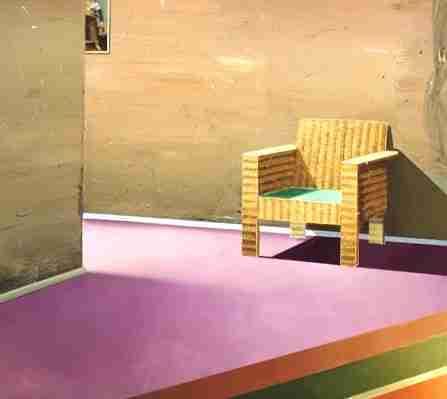
Many early works present empty rooms rendered with intense attention to detail. They feel like they are holding their breath: still, staged, and slightly suspended. Wallpaper, furniture, and minor objects are not simply “props” but clues. The result is nostalgia without comfort: spaces that suggest domestic life while also making you wonder what has happened here, or what is about to.
The language of interiors: creating and disrupting space
Weischer’s interiors are not just depictions of rooms. They are psychological architectures. His paintings blur the line between the real and the imagined, creating environments that are tangible yet dreamlike, ordinary yet uncanny.
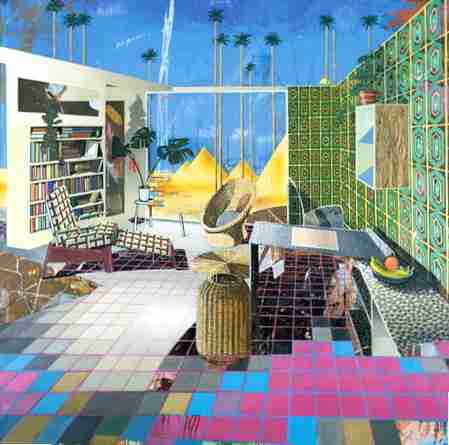
Perspective is often slightly off, proportions subtly distorted, angles made uncertain. This is where the paintings become active: space begins to behave less like a neutral container and more like an emotional instrument. Walls, floors, and objects carry layered textures and patterns that read as time, touch, and residue. The rooms feel lived-in but uninhabited, as if the human presence has been edited out, leaving only the evidence.
Color, texture, and the play of light
Color and surface are central to Weischer’s atmosphere. His palette often leans toward earthy, muted tones, then breaks itself open with sharper color accents that pull the eye and disrupt the scene’s quiet. The paint handling can feel tactile and built: thick areas, scraped passages, layered glazes that make the image behave like an object.
Light often enters like a theatrical device. It filters through curtains, sharpens edges, and produces shadows that feel slightly too charged for a “normal” room. In many paintings, Weischer stages a tension between order and disruption: a chair tipped at the wrong angle, an object that refuses to belong, a shadow that unsettles the logic of the space. These small fractures keep the viewer reading, searching for the narrative that is implied but never delivered in full.
The shift to the garden: new spaces, new questions
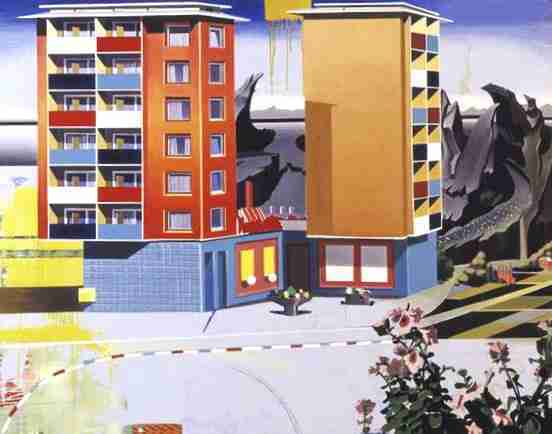
In more recent years, Weischer’s imagery has expanded beyond enclosed interiors into gardens. The garden becomes another kind of interiority: open-air, overgrown, and labyrinthine. These scenes can feel lush and alive, but also unpredictable, as if nature is becoming a theater of psychological projection.
Compared to the controlled rooms of earlier works, the gardens suggest a loosening of structure. Yet they are not “pure landscape.” Paths may lead nowhere, growth may feel impossible, and the image retains a sense of construction. Even outdoors, Weischer keeps asking how space is made, staged, and remembered.
The narrative of absence: what lies beneath the surface
A recurring theme is absence. Weischer’s rooms and gardens are often empty of figures, yet full of traces: objects, shadows, patterns, and signs of activity that imply an unseen inhabitant. The viewer arrives after the fact, and that delay produces tension. The spaces are charged with story potential rather than story content.
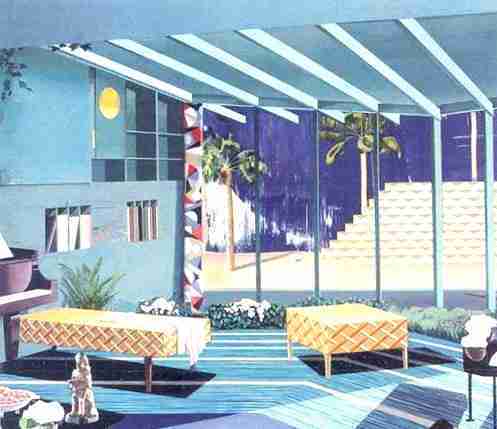
Memory also runs through the work. These paintings can feel like memories made physical: fragments of places that are both familiar and strange, comforting and disconcerting. By blurring reality and imagination, Weischer suggests that memory is not a record but a construction, and that space is one of its main materials.
A contemporary master of spatial storytelling
Weischer’s art is a journey into constructed space, both physical and psychological. His ability to build richly detailed environments that keep slipping between real and imagined makes him a master of spatial storytelling. Through interiors and gardens, he explores memory, absence, and the complex relationship between people and the places they inhabit.
His paintings encourage slow looking. They ask you to linger, to read surfaces and corners, to treat space as narrative. In a world that moves too fast, Weischer’s rooms insist on another tempo: one where attention becomes the real subject.