Contemporary Art 1990s
Contemporary Art of the 1990s: Globalisation, New Bodies and the Network
The 1990s promised a more global and connected art world. Borders appeared to open, the internet created new spaces, and neglected identities entered museums. Yet every new form of access produced another question: who controlled the network, the institution, and the right to be represented?
Contemporary art of the 1990s developed after the Cold War, during the expansion of globalisation and the early public internet. Biennials multiplied, artists travelled through new international circuits, and museums increasingly presented contemporary art through questions of identity, migration, gender, race, sexuality, and cultural difference.
The artwork also changed its behaviour. It could become a website, a social encounter, a biological experiment, an institutional intervention, or an intensely personal confession. Painting survived, but it no longer occupied the centre alone. Bodies, relationships, archives, interfaces, and exhibition systems became artistic material.
The decade appeared to expand visibility. At the same time, it exposed a conflict that remains unresolved: entering the institution is not the same as changing who controls it.
For a wider chronological view, visit the Contemporary Art Index.
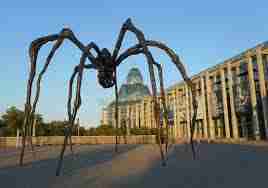
Louise Bourgeois, Maman. The body becomes monument, memory, protection, and threat. Bourgeois belonged to an earlier generation, but the scale and psychological exposure of her late work strongly marked the art encountered at the end of the 1990s.
Explore the Art of the 1990s
Open a section to explore the main artistic fields, movements, artists, and cultural conflicts connected with the decade.
- Globalisation, Biennials and Cultural Identity
- Identity, the Body and Personal Politics
- Relational, Context and Institutional Practices
- Net Art, New Media and Digital Culture
- Young British Artists, Spectacle and Confession
- Painting After the End of Painting
Globalisation, Biennials and Cultural Identity
The art world expanded geographically, but global visibility did not eliminate cultural hierarchy.
The 1990s transformed contemporary art into an increasingly international system. Biennials, travelling exhibitions, residencies, and new curatorial networks connected cities and artists beyond the traditional centres of Western Europe and the United States.
This expansion made practices from Africa, Asia, Latin America, Eastern Europe, Australia, and Indigenous communities more visible. Yet the language of a “global art world” could hide an older problem. Western institutions still often decided which artists represented a country, a culture, a conflict, or an identity.
Contemporary Indigenous Australian art demonstrates the limits of treating geographical visibility as a movement. Indigenous artists were not entering contemporary art from outside history. The problem was that Western art history had often failed to recognise their contemporaneity.
Identity, the Body and Personal Politics
The body became evidence of gender, sexuality, race, illness, violence, and the politics of being seen.
Identity politics became one of the central conflicts of 1990s contemporary art. Feminist, queer, Black, diasporic, and postcolonial practices challenged the assumption that the museum could present a universal human experience while remaining dominated by a narrow group of voices.
Artists used photography, performance, installation, autobiography, and the body itself to confront sexuality, gender, AIDS, race, illness, trauma, and social exclusion. Personal experience did not remain private. It became a way of exposing how political structures entered intimate life.
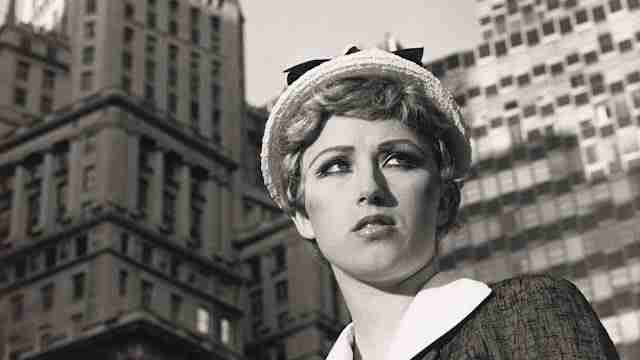
Cindy Sherman, Untitled Film Still #21, 1978. Although produced before the 1990s, Sherman’s constructed identities became fundamental to the decade’s debates around gender, representation, performance, and the unstable self.
Yet the decade also revealed the risk of institutional categorisation. Once identity became curatorial language, artists could be invited to appear primarily as representatives of gender, race, sexuality, or origin. Visibility opened doors, but it could also build new boxes.
Relational, Context and Institutional Practices
The artwork became a situation, a meeting, an intervention, or a temporary structure of human relations.
During the 1990s, artists increasingly created situations rather than autonomous objects. Meals, conversations, shared spaces, temporary communities, and forms of participation entered galleries and museums. Nicolas Bourriaud later grouped many of these practices under the term relational aesthetics.
The shift appeared democratic because the viewer could become a participant. However, participation did not automatically remove hierarchy. The artist still designed the situation, the institution selected the participants, and the museum often converted temporary social relations into cultural value.
Context art and institutional critique pushed the argument further. The conditions surrounding an artwork were no longer background. Funding, architecture, labour, curatorial authority, museum collections, and the politics of display became part of the work itself.
Net Art, New Media and Digital Culture
The internet became a studio, an exhibition space, and an early battlefield over access and control.
Net Art emerged when the public internet still appeared capable of creating spaces outside traditional cultural institutions. Artists used websites, hyperlinks, email, code, online identities, and networked collaboration as both medium and distribution system.
Cyberart, software-based practices, information art, and new media expanded the idea of the artwork as a system. Images could respond to data, interfaces could shape participation, and code could determine how a work behaved.
The early internet carried a strong promise of decentralisation. In retrospect, this optimism makes the decade especially important. Artists were already questioning interfaces, digital identity, surveillance, and information control before a small number of platforms came to dominate online visibility.
Young British Artists, Spectacle and Confession
Shock, autobiography, media attention, and market power became increasingly difficult to separate.
The Young British Artists became one of the most visible phenomena of the 1990s. Damien Hirst, Tracey Emin, Sarah Lucas, and other artists associated with the label used installation, found materials, the body, death, sexuality, humour, and autobiography with an aggressive directness.
The YBAs also understood the changing media environment. Controversy generated attention, newspapers amplified exhibitions, and individual artists became recognisable public figures. The boundary between artistic reputation and cultural branding grew increasingly unstable.
However, reducing the YBAs to shock misses the deeper change. Tracey Emin turned confession into material. Sarah Lucas used humour and crude objects to expose gendered looking. Hirst placed mortality inside systems of display, preservation, and financial value. The spectacle was real, but so were the conflicts beneath it.
Painting After the End of Painting
Painting survived every announcement of its death and returned carrying history, irony, memory, and doubt.
The expansion of installation, photography, video, and digital media did not eliminate painting. Instead, the 1990s produced a fragmented painted field in which artists worked after decades of predictions that the medium had exhausted itself.
The Neue Leipziger Schule and wider developments in European painting used figuration to explore post-socialist memory, failed utopias, interiors, historical fragments, and psychologically unstable spaces. Elsewhere, artists used quotation, kitsch, excess, and hybrid visual languages to reject the idea that contemporary painting needed a single coherent direction.
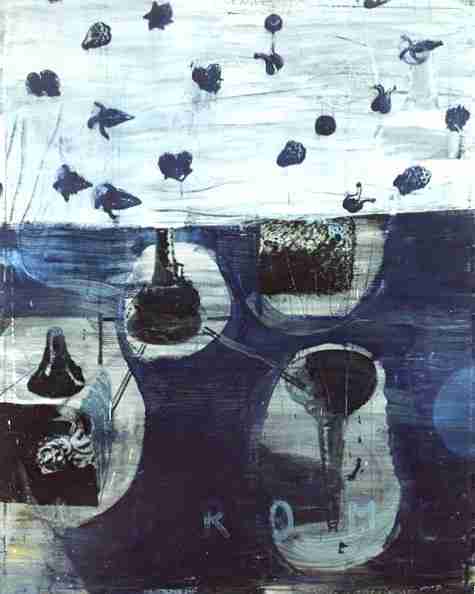
Neo Rauch, Dromos. History does not appear as a stable narrative. It survives as fragments, coded objects, industrial memories, and figures trapped between incompatible realities.
What returned was not a unified movement. Painting became one medium among many, but this loss of central authority gave it a different freedom. It could quote its own history, distrust the image, embrace technique, or produce worlds that photography could never document.
Other Defining Fields of the 1990s
These fields belong to the decade, but they do not describe the same kind of phenomenon. Some were emerging media, some were organised movements, and others were labels developed by individual artists or smaller communities.
BioArt and the Living Medium
Biology, laboratory processes, genetics, and living material began to enter artistic practice more directly. BioArt challenged the separation between artist and scientist while raising questions about experimentation, ownership, manipulation, and the ethics of treating life as material.
Explore BioArt and the convergence of science and creativity.
Massurrealism and Hybrid Image Culture
Massurrealism connected surrealist strategies with mass media, photography, digital manipulation, cinema, and popular visual culture. Its importance lies less in becoming a dominant movement than in recognising that dream imagery had entered a world saturated by reproduced and technologically altered images.
Maximalism, Kitsch and Visual Excess
Not every artist responded to the 1990s through minimal interfaces or conceptual restraint. Saturation, quotation, decorative overload, kitsch, and spectacular surfaces also expanded. Excess could become a criticism of consumer culture, but it could just as easily become one of its most attractive products.
Explore Maximalism in art: excess, pattern and visual pressure.
Software, Data and Tactical Media
Software art, data practices, and tactical media anticipated conflicts that would dominate later decades. Code became a material, information became structure, and digital networks became tools for political communication. These fields were still relatively specialised, but their questions about control and distribution would soon become unavoidable.
Small Movements and Self-Defined Positions
Toyism, Transvisionism, Verdadism, Dialectical Aniconism, and other smaller labels form part of the wider artistic landscape represented in this journal. They should not be given the same historical weight as Net Art, relational aesthetics, or the YBAs. However, they remain useful evidence of a decade in which artists increasingly created their own languages, networks, and theoretical positions.
- Toyism: Vivid Visions and Playful Prose
- Transvisionism: Where Art and Technology Collide
- Verdadism: Art, Activism and Truth-Telling
- Dialectical Aniconism: Images, Refusal and the Unseen
The 1990s Made the Art World Global, but Not Equal
The decade expanded the spaces in which contemporary art could appear. The internet created new networks, biennials redrew cultural maps, identity entered institutional debate, and artists transformed bodies, relationships, code, and participation into artistic material.
Yet the structures controlling recognition did not disappear. Museums could exhibit difference without surrendering authority. Networks could promise openness while creating new forms of control. Participation could invite the viewer inside a work without allowing them to change its conditions.
The art of the 1990s is therefore defined less by a shared style than by a struggle over access: access to institutions, networks, representation, technology, and the power to define what contemporary art had become.
Related Articles
- Relational Art: Creativity, Participation and Social Exchange
- LGBTQ+ Art: From Classical Representation to Contemporary Queer Bodies
- Net Art: The Evolution and Impact of Internet Art
- Tracey Emin: Confession, Trauma and the Personal as Evidence
- Neue Leipziger Schule: Painting After History and Utopia
- BioArt: Where Science and Creativity Converge
- Maximalism in Art: Excess, Pattern and Pop Power