Feminism in Art: A Global History of Visibility, Power and Resistance
Feminism in Art, Not a Style, a Battle Over Visibility
Feminism in art is not a theme you “add” to a work. It is a long, uneven struggle over visibility: who gets represented, who gets believed, who gets collected, who gets paid, and who gets remembered.
One-sentence definition: Feminism in art is a structural challenge to power that changes what becomes visible, legible, and collectible.
But this is also a struggle over standards. The art world likes to speak in the language of “quality,” “genius,” and “taste,” as if these were neutral categories. “Why Feminism in Art” is a question that matters deeply and becomes clear when feminist art history suggests otherwise: standards are often instruments of power, shaped over time to keep certain bodies central and others marginal.
You can also browse the full archive in my
Feminism category.
This essay is built as a hub. It can be read straight through as a historical map, or used as an index to move between deeper case studies and interviews already published on my blog. It is intentionally unfinished.
- Read the map: follow The Feminism Time History.
- Jump by region: use Feminist Geography to navigate across contexts.
- Choose a route: start with one of the three curated reading paths below.
I will keep expanding it with new links, articles, and sections, especially for regions and scenes not yet covered, so it evolves as a time-based text that accumulates evidence.
If something feels missing, or if sources, corrections, or perspectives should be added, please get in touch. I will review them, adjust the structure, and incorporate what strengthens the project. The aim is for this hub to function as a testament to women: not as “my” work, but as a living document, necessarily partial, that records what great artists have made visible through their practice.
I have studied these dynamics closely and interviewed major artists, yet limits remain. This writing happens inside a patriarchal system that shapes perception and language, sometimes openly, sometimes invisibly. If blind spots appear in this framing, that reading may be right. Feminism, and the art it generates, cannot be fully understood without being lived and seen through women’s own eyes.
Navigate the hub
Use these visual links to jump to the main sections. Each card opens a different chapter of the map.

What feminism in art is, and is not
It is not “art made by women”
Feminism in art is a critical position toward power, representation, and value. Some of the most decisive feminist shifts were collective, and many practices exceed fixed identity categories.
It is not one style
Feminist strategies move across painting, performance, photography, film, new media, installation, text, craft, institutional critique, and ecological action. The point is not a look. The point is a structural reprogramming of what art is allowed to do.
It is not only a Western story
Feminist art is global because inequality is global. But global does not mean generic. It means tracing how tactics adapt to local conditions, censorship, diaspora, war, religion, class, colonial legacies, and the economics of care.
When “Women’s Work” Becomes a Weapon Against the Art Hierarchy
A timeline of turning points, from modernity to now
Before the label: modernity, erasure, and the violence of “minor” status
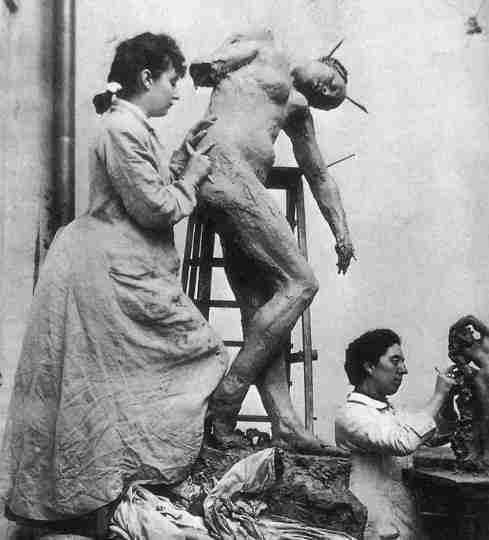
Feminist art history begins before the word “feminist” enters art discourse as a category. It begins with the structural pattern of erasure: artists framed as muses, footnotes, assistants, or “exceptions.” Camille Claudel remains a brutal emblem of how talent can be culturally isolated, pathologized, and written out of the canon.
Camille Claudel and the Invisible
The Feminist Geography
This section is an index by context. Each region opens into a short map plus selected entry points.
Europe: movements, media, body politics
A fast map of key nodes across Italy, France, Austria, Germany, and the UK.
- Italy: Rivolta Femminile, abstraction, collective rupture
- France: body as conflict, code, reinvention
- Austria: public space and feminist risk
- Germany: constraint, vulnerability, feminist form
- UK: movements, collectives, infrastructure
Italian Feminism in the 1970s: Rivolta Femminile and the break with patriarchal culture
In Italy, Carla Accardi demonstrates another early truth: abstraction can be a political language, and feminism can be embedded in formal rigor and collective action rather than iconography alone.
Carla Accardi, Abstract Art and Feminist Activism in Italy
France in the 1970s–1990s: the body as conflict, code, and reinvention
Artists such as ORLAN and Annette Messager turned the body and domestic codes into contested sites, using performance, photography, installation, and text.
Austria in the 1960s–1980s: public space, media gaze, and feminist risk
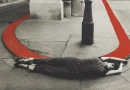
VALIE EXPORT made public space a testing ground, pushing feminist critique into street and media, where spectatorship becomes a political problem.
Germany in the 1970s–1990s: constraint, vulnerability, and feminist form
Artists explored constraint and vulnerability through sculptural apparatuses that read as both poetic and disciplinary, bodies engineered by culture.
United Kingdom in the 1970s–1980s: movements, collectives, and feminist infrastructure
Movements and collectives mattered as much as individual names. Feminist networks treated culture as a battleground of labor, reproduction, and representation.
Americas: dictatorship, institutions, counter-publics
From Latin American public performance under regimes to US feminist pedagogy and institutional critique.
Latin America: dictatorship, disappearance, and public performance
Under military regimes, feminist art formed where censorship and state violence controlled the body and erased dissent. Artists turned absence into evidence and public space into medium.
The United States in the early 1970s: consciousness-raising becomes form
Private space became public critique. That is why Womanhouse (1972) still matters, shaped by Judy Chicago and Miriam Schapiro.
Asia: censorship, labor, modernity, diaspora
Feminist tactics often become coded, layered, and strategically indirect under visibility pressure.
Asia: censorship, body politics, and diaspora strategies
Across Asia, feminist art frequently operates under censorship, borders, and culturally coded visibility. Tactics become layered, indirect, and time-based.
Middle East: borders, morality codes, visibility risks
Visibility can be both liberation and exposure. Many practices build agency while challenging rules of appearance.
Middle East: religion, borders, and visibility risks
Feminist art is shaped by morality politics, family structures, state power, and diaspora. Strategies often protect agency while resisting control.
Iranian Feminist Art: Prison, Exile, and the High-Risk Politics of Visibility
Africa: colonial legacies, archives, public space
Visibility often means negotiating who controls images, archives, and cultural memory.
Africa: colonial legacies, archives, and the politics of representation
Across Africa, feminist art intersects with colonial legacies, postcolonial governance, and representation. Visibility includes control over archives and memory.
Oceania and the Pacific: sovereignty, land, representation
Here the image can be claim, repair, and continuity across land and culture.
Oceania and the Pacific: land, sovereignty, and cultural continuity
Feminist and Indigenous perspectives often connect visibility to land, sovereignty, and continuity. The image becomes claim and repair.
Diaspora and Indigenous feminisms: counter-archives, sovereignty, the right to appear
Race, migration, counter-archives, and the politics of appearing without being aestheticized.
Caribbean and diasporic worlds: postcolonial visibility, race, and counter-archives
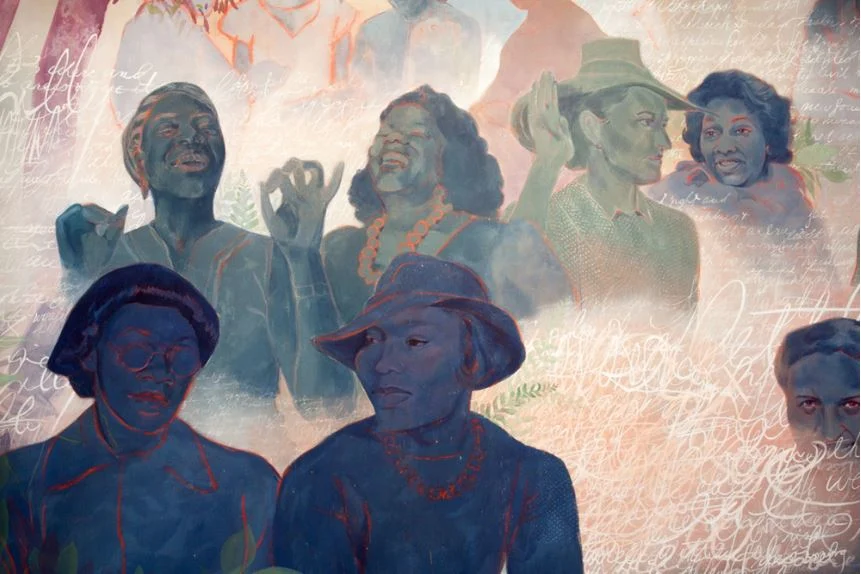
Feminist art is inseparable from race, colorism, migration, and postcolonial visibility. It resists the museum’s tendency to aestheticize pain.
Indigenous feminisms: sovereignty, land, and the right to appear
In Indigenous contexts, feminist art often aligns with sovereignty and land. Visibility can be risk, claim, and demand for repair.
The Feminism Time History
This timeline is a set of turning points. Each period opens into a short map and selected case studies.
1970s: naming the problem, building methods
Consciousness-raising becomes form, and private space becomes public critique.
In the early 1970s, a foundational method took hold: turning lived experience into form, and turning private space into public critique.
That is why Womanhouse (1972) still matters, shaped by the Feminist Art Program and the pedagogical vision of Judy Chicago, with the crucial collaboration of Miriam Schapiro.
Late 1970s to 1980s: language and media become weapons
Feminist critique learns to interrupt the image economy from inside it.
In the late 1970s and throughout the 1980s, as mass media expanded, images and slogans became one of the main ways power travelled: advertising, television, newspapers, and propaganda.
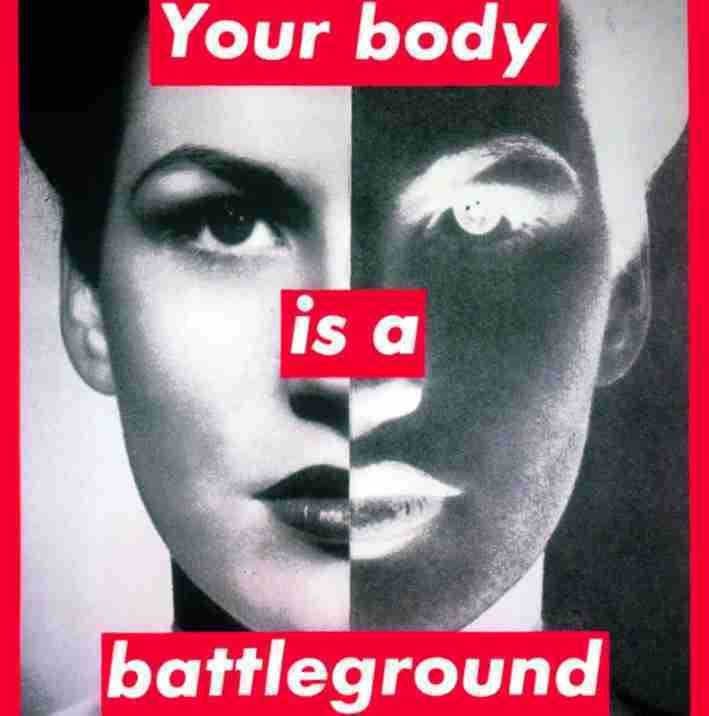
Within this shift, Barbara Kruger remains decisive because she makes the mechanism visible: the way language colonizes the body.
Guerrilla Girls translated inequality into public proof, making discrimination harder to deny.
1980s to 1990s: painting and criticism fight back
Not one canon, many canons. Value is fought in institutions and language.
Feminist art did not leave painting. Painting remained contested because it had been treated as a prestigious language of authority, where genius was historically coded as masculine.
Mira Schor is central here because she insists on two linked truths: painting is not neutral, and criticism is not neutral.
1990s to 2000s: the camera as counter-archive
Photography builds memory systems for bodies and communities reduced to stereotypes or erased.
From the 1990s onward, photography became one of feminism’s most powerful tools worldwide because it can build counter-archives.
2000s to now: the museum as battleground
Institutions distribute legitimacy, feminist interventions confront what becomes permanent.
In the 2000s and beyond, feminist action often returns to institutions because institutions decide what becomes permanent. Museums distribute legitimacy.
Today: visibility is algorithmic, counter-infrastructure grows
Platforms filter what surfaces. Feminist practices build archives, networks, and slow publishing.
Today visibility is also algorithmic. Platforms decide what surfaces, what disappears, what is labelled “controversial,” and what gets suppressed.
Feminist practices increasingly build counter-infrastructure: independent archives, community-led platforms, local networks, and long-duration projects that outlive the attention cycle.
The global present: bodies, media, care, ecology
This section maps today’s pressure points. Each theme opens a short frame plus entry points.
Bodies: desire, taboo, violence, refusal
Power is written on bodies first. Feminist art returns to the body to dismantle shame, expose control, and make trauma visible without letting institutions aestheticize it.
Across cultures, feminist art returns to the body because power is written on the body first. Some practices confront sexuality and taboo to dismantle shame. Others confront trauma and war as political reality.
Material politics: craft, ornament, and who gets called “serious”
Hierarchy is a technique: decide what counts as “major,” then attach “minor” to women, domestic labor, ornament, and non-Western traditions.
Material hierarchy is an old power move: declare some media “major” and others “minor,” then attach the “minor” to women, domestic labor, ornament, or non-Western traditions. Feminist art attacks this by reclaiming pattern, decoration, and pleasure as rigorous intelligence.
Care and time: motherhood, labor, and structural exclusion
Care is not private. It shapes time, visibility, and economic possibility, and it explains why careers are unevenly “possible.”
Care is not private. It is a system that shapes time, visibility, and economic possibility. Feminist art shows how careers are often built on someone else’s invisible labor.
Ecofeminism: the planet as a feminist site (Aviva Rahmani)
Ecofeminism becomes strongest when ecology is method: restoration, long-duration work, coalition-building, civic strategy.
Ecofeminism enters feminist history when “nature” stops being scenery and becomes responsibility. In art, it becomes powerful when ecology turns into method: restoration, long-duration projects, coalition-building, civic strategy.
Aviva Rahmani, A Visionary’s Journey
Start here: three reading routes
Route 1, foundations (1970s plus canon repair)
A fast entry into core references and early structural shifts.
Route 2, institutions and power (1980s to now)
Evidence, media critique, and institutional pressure points.
Route 3, the global present (identity, tech, care, ecology)
Counter-archives, bodies, networks, and long-duration methods.
Related articles
- Empowerment on Canvas: The Vivid Legacy of Feminist Art
- The Story of the Guerrilla Girls: Interview with Alice Neel (Robin Tewes)
- Barbara Kruger: Conceptual Art that Challenges Power, Identity, and Sexuality
- Deborah de Robertis: Art’s Greatest Scandal or Boldest Statement?
- Aviva Rahmani: A Visionary’s Journey
- Miriam Cahn: Art that Confronts Raw Reality
- Zanele Muholi: Reclaiming Identity Through the Lens
- Carla Accardi: Pioneering Abstract Art and Feminist Activism
- Bracha L. Ettinger: Art of Healing and the Matrixial Gaze
- Arlene Rush Interview