They Spent £85,000 to Erase a Banksy. But Who Gets to Decide What Art Survives?
When an Illegal Artwork Becomes Part of the History of the Wall
Britain has spent more than £85,000 dealing with a Banksy painted on the Royal Courts of Justice. The legal argument for removing it is easy to understand. The cultural one is not. At what point does an unauthorised intervention stop being something to erase and become something we should at least consider preserving?
£85,300 is not the price paid for a Banksy at auction. It is not the insurance value attached to one of his works before it enters a museum. It is what the British Ministry of Justice has spent dealing with a Banksy it did not want.
That figure alone makes the story irresistible, but the money is almost a distraction. The real question is far more complicated. If an artist places a work illegally on a building, does the owner always have the moral as well as the legal right to make it disappear?
A Mural on the Court Wall
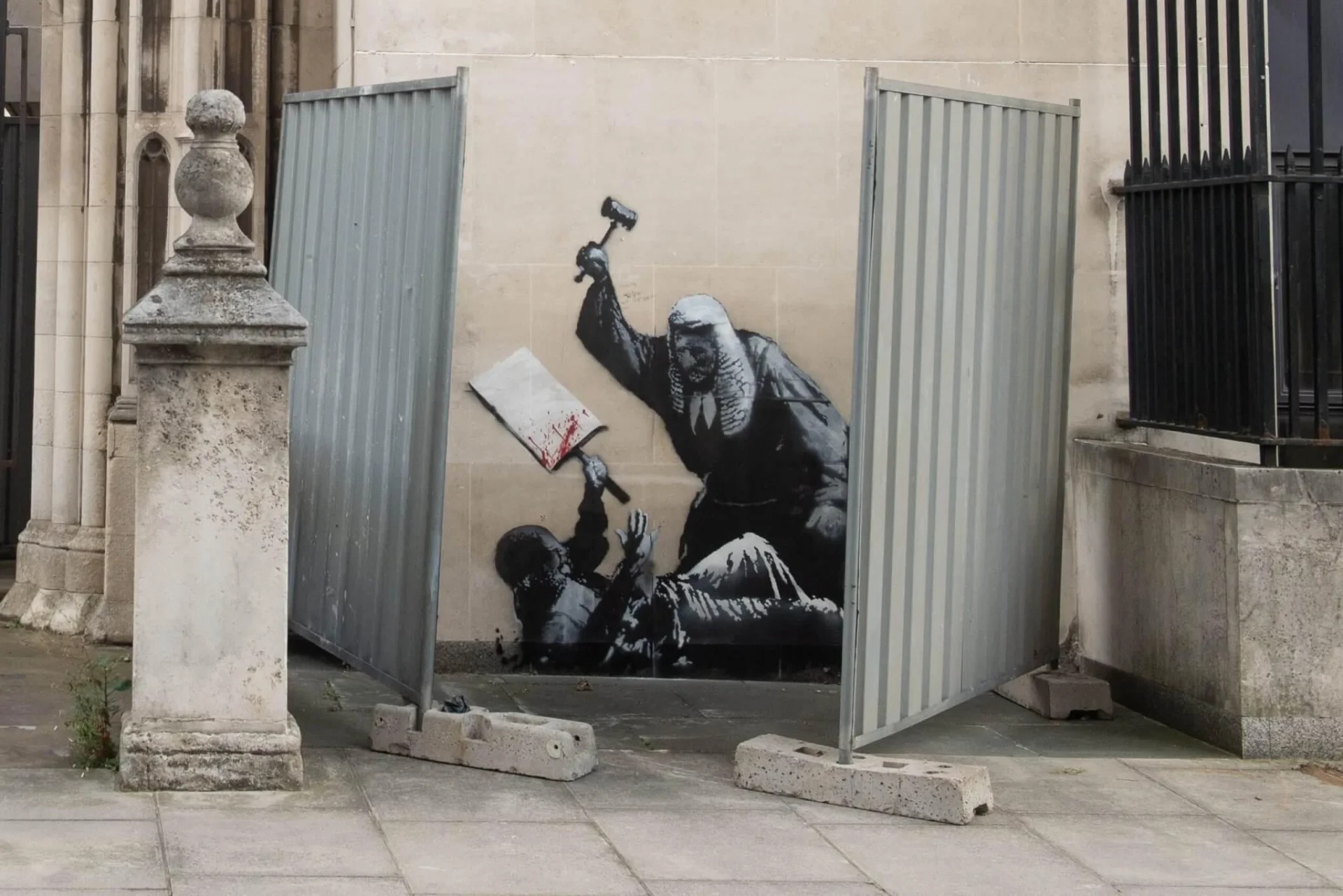
In September 2025, an image appeared on the external wall of the Queen’s Building at London’s Royal Courts of Justice. It showed a judge in a traditional wig and robe raising his gavel over a protester lying on the ground. What looked like blood stained the placard beside him. Banksy confirmed the work in his usual way, by publishing it online without explaining it.
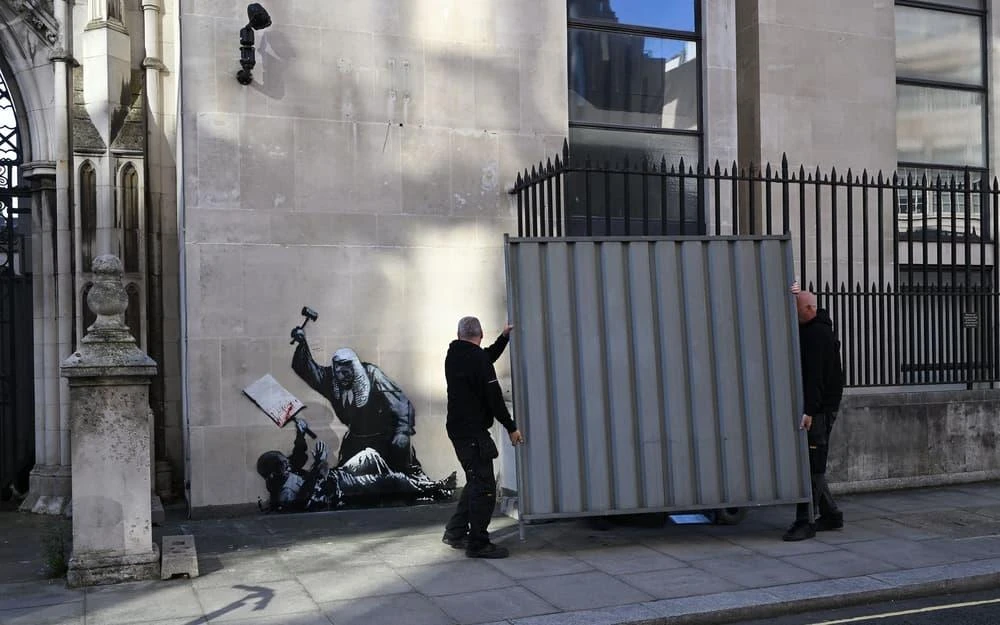
Officials covered the mural within hours and began dealing with the problem it had created. Figures later released through Freedom of Information requests showed that attempts to remove the paint cost around £50,000. Security and overtime added another £35,300. When the first cleaning attempts failed, the authorities considered other techniques, while police investigators examined the intervention as possible criminal damage.
Its timing gave the image an unavoidable political charge. The mural appeared shortly after mass arrests at demonstrations against the British government’s proscription of Palestine Action. Banksy never issued a statement connecting his work directly to those events, but he hardly needed to. A judge striking a protester on the wall of one of Britain’s most important judicial buildings already said enough.
The reaction soon divided into two familiar camps. One side saw vandalism on a historic building and wanted it gone. The other saw an important political artwork and described its removal as censorship. Both positions make sense, but both become too easy if they end the discussion.

The Law Is the Easy Part
Anyone who wants to defend Banksy has to start with an inconvenient fact: he did not own the wall. This was not an anonymous surface behind a supermarket or a temporary construction fence either. The Queen’s Building forms part of the Royal Courts of Justice complex and carries Grade II-listed status. The authorities therefore had a genuine responsibility to protect its architectural character.
Banksy’s fame cannot simply erase that responsibility. If an unknown person had painted exactly the same image on exactly the same building, very few people would demand permanent preservation. Add Banksy’s name, however, and the same unauthorised act suddenly begins to look like cultural heritage.
That contradiction matters because fame cannot become a licence to alter other people’s property. Otherwise, the more important an artist becomes, the greater their practical right to occupy walls that do not belong to them. Banksy could choose a building overnight, make an intervention, authenticate it online and leave the owner with the cost and responsibility of preserving it.
A city cannot work like that. It cannot become a museum whose acquisitions depend on which famous artist reaches a wall first. Owners have rights, historic buildings need protection and public space carries many competing claims. Yet the opposite conclusion is also too convenient: if lack of permission settles everything, we never have to ask whether an illegal act has produced something worth keeping.

When Does Vandalism Become Heritage?
Cultural value rarely arrives with planning permission. Much of what societies now preserve became important only after people learned to see it differently. Buildings, objects and images often acquire meanings that their creators, owners or first audiences never anticipated.
That makes the Royal Courts Banksy more interesting than another argument about whether street art counts as art or vandalism. The authorities wanted to protect the historic character of the building by removing something from it. That position has logic, but the logic starts to wobble if the unwanted addition has already entered the history of the building itself.
Location mattered enormously here. A judge beating a protester did not appear on an arbitrary wall. It appeared on the Royal Courts of Justice. Put the same stencil inside a commercial gallery and much of its tension disappears. On the court building, architecture became part of the work, bringing judge, protester, authority, law and punishment into the same field.
Officials then covered the mural and tried to remove it. Tens of thousands of pounds followed because the image existed. At that point, the institutional response entered the history of the work whether anyone intended it or not.
Removal Can Change the Artwork
Calling the removal censorship would make the story satisfyingly simple. It would give us a rebellious artist, an authoritarian state and a clean moral ending. Reality is less comfortable. The authorities had legitimate conservation responsibilities, and Banksy knowingly worked without permission. Street art has always lived with the possibility of erasure.
That risk is not a defect in the medium. It forms part of its language. A street artist enters a space they do not control, changes it and accepts that the owner, the weather, another artist or the state may change it again. Permanence was never part of the contract because there was never a contract in the first place.
For that reason, removing this mural may not have weakened it as much as the authorities hoped. The original image represented institutional power acting against dissent. What happened next added another layer: the image appeared on a court, officials covered it, the state investigated the act and public money funded the effort to erase it.
Meanwhile, photographs travelled much further than the physical mural ever could. The work became less visible on the wall while its image became more visible everywhere else. The irony sits comfortably inside Banksy’s practice. An attempt to remove the work from public space helped move it into public memory.

Banksy Has Been Here Before
Banksy has already played with the relationship between destruction and creation. In 2018, Girl with Balloon began shredding itself moments after a Sotheby’s sale and became Love is in the Bin. Destruction did not end the work. Instead, it changed its identity and created another history around it.
I discussed that paradox in When Destruction Becomes Creation. The circumstances at the Royal Courts of Justice are obviously different. Banksy did not control the authorities’ response in the same way that the Sotheby’s mechanism formed part of the earlier work. Yet the same disturbing question returns: can an attempt to destroy or remove an artwork become part of what that artwork eventually means?
In this case, I think it can. That does not mean Banksy deserves gratitude every time somebody cleans one of his walls. It means that actions produce consequences, and sometimes the response to an artwork reveals more than the original object could reveal alone.
The Money Makes the Contradiction Harder to Ignore
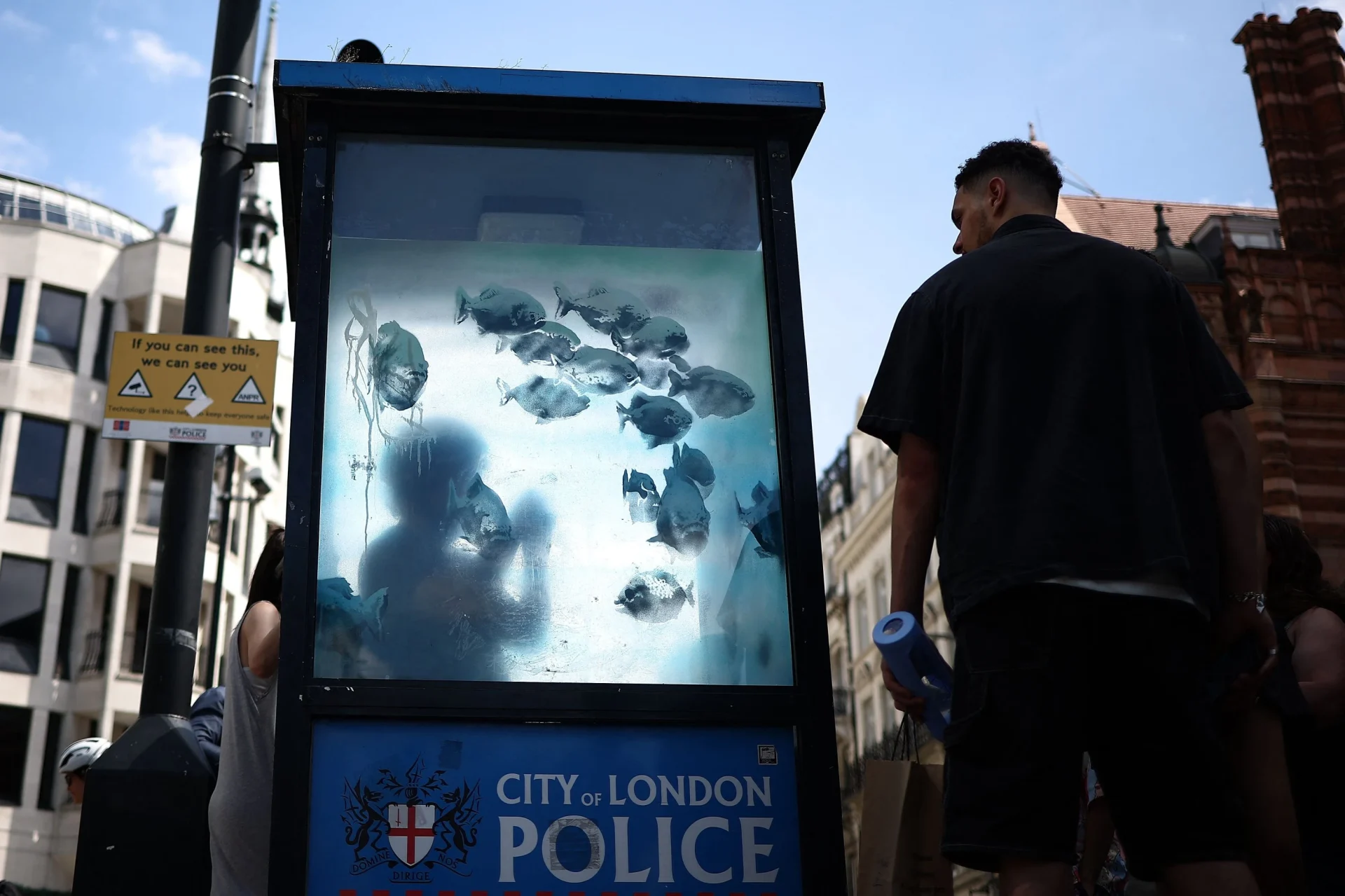
The £85,300 spent around the Royal Courts mural adds another layer of absurdity. A work can begin as unwanted paint and quickly become an expensive public problem. Other recent Banksy interventions have also generated costs through removal, security, protection and administration.
This is where our categories start to look unstable. One Banksy can count as damage that authorities want to erase, while another can become an object that institutions extract, protect and eventually display. The shift can happen remarkably quickly. Artistic quality does not explain the difference on its own because ownership, architecture, politics, market value, public pressure and practicality all influence the decision.
That is why the old question, “Is Banksy art or vandalism?”, now feels almost useless. Of course it is art, and it can also involve vandalism. Those two facts do not cancel each other out. The real argument starts afterwards, when an illegal act produces something that society may later want to keep.

Banksy Cannot Have a Veto Over the City
Defending urban art does not require us to romanticise every unauthorised gesture. If every authenticated Banksy had to remain where it appeared, the artist would gain a strange private power over public and private architecture. His reputation would effectively limit what an owner could do with a wall after the fact.
That would be hard to justify. A city contains competing rights and competing memories. Owners, residents, governments, architects, artists and communities all make claims on the same space. Street art matters partly because it interrupts the tidy procedures through which society usually negotiates those claims, but rejecting the procedure cannot mean controlling the outcome forever.
Banksy can choose where he paints, but he cannot automatically choose what survives. Accepting that principle, however, still leaves an enormous space between automatic preservation and automatic erasure. That is the space we should examine more carefully.
Why Is Erasure the First Reflex?
Once an unauthorised intervention acquires obvious cultural significance, irreversible removal should not always provide the first response. Banksy does not need a special law, and every piece of graffiti does not deserve protection. Cultural importance, however, can appear before institutions have had time to classify it.
Authorities could allow a short assessment period in exceptional cases. Conservation specialists could examine the building and the artwork together, then consider damage, public interest, artistic value, temporary preservation, documentation or relocation. After that process, removal might still make perfect sense. Preservation should never become automatic simply because an artist has a famous name.
The point is not to guarantee the artwork’s survival but to recognise what it may have become before destroying it. That distinction matters especially with public art interventions, because location often carries half the meaning.
Once a government spends tens of thousands of pounds removing an image by one of the world’s most recognisable living artists from one of Britain’s most symbolically charged buildings, the operation has moved beyond routine maintenance. Whatever language officials use, they are also making a cultural decision.
Preserving Everything Would Be Equally Absurd
There is another reason to resist an easy answer. If society treated every unauthorised artwork as potential heritage, cities would quickly become paralysed by their own caution. Cultural value needs judgement, and judgement inevitably means that some things survive while others disappear.
The difficulty lies in deciding who makes that judgement and when. The market cannot make it alone because price does not equal cultural importance. Property ownership cannot provide the whole answer either because ownership tells us who controls a wall, not what an image may come to mean. Popularity presents the same problem. An artwork does not become historically important simply because millions of people share it online.
Perhaps we need no universal rule at all. Perhaps exceptional works on exceptional sites require exceptional decisions. That sounds less efficient than immediate removal, but culture has never been particularly efficient.
Who Owns the Meaning of a Wall?
The legal question remains clearer than the cultural one. An artist who paints without permission does not acquire ownership of the wall. Copyright, property, preservation and cultural value remain different things, even when public debate mixes them together.
Public memory works differently. An image can enter a city’s collective history without a commission, an acquisition committee or an invitation. That does not transfer legal ownership to “the public,” nor does it strip the property owner of their rights. It simply means that ownership may no longer answer every question.
The Royal Courts Banksy may have been illegal, and the authorities may have had good reasons to remove it. Its architecture deserved protection. Banksy also cannot expect every wall he touches to become permanent. All of those statements can remain true at the same time.
What troubles me is the speed with which our language moves from unauthorised to remove. That jump leaves almost no space for cultural judgement. It assumes that because nobody asked for the work, nobody needs to ask whether the work matters.
There should be something between those two moments. Not every Banksy deserves preservation simply because Banksy made it, yet not every work should disappear simply because nobody gave permission for it to exist. The distinction may be inconvenient, subjective and difficult to regulate. That does not make it unnecessary.
Perhaps the Wall Is No Longer the Work
The judge on the Royal Courts of Justice may eventually vanish from the wall. Yet the image of a judge striking a protester has already acquired another life. The machinery of justice then spent public money trying to remove that image from its own building, and that sequence will prove considerably harder to erase.
This is why the most interesting part of the story may no longer concern whether Banksy had the right to paint there. He probably did not. Nor does it concern whether the authorities had the right to remove the work. They had serious reasons to do so.
The question comes afterwards. When an artwork enters public memory before anyone has authorised its existence, should legality alone decide its physical fate? And when removal itself adds meaning to the work, are we still removing the artwork or merely changing its form?
Perhaps that is where this Banksy now exists: not entirely on the wall and not entirely in the photograph, but in everything that happened because somebody decided it should not remain there.
Further reading: For a broader account of Banksy’s work, anonymity, political interventions and complicated relationship with the art market, see Banksy: The Man behind the Wall: Revised and Illustrated Edition.