The Polish Pavilion at the Venice Biennale: Language Beyond the Human in Liquid Tongues
Through sign language, whales, and bodies immersed in water, the Polish Pavilion at the 2026 Venice Biennale presents one of the most intense and destabilizing projects of this edition. With Liquid Tongues, artists Bogna Burska and Daniel Kotowski, together with curators Ewa Chomicka and Jolanta Woszczenko, challenge the Western idea of communication as the domination of voice and control over meaning.
Link to the Italian version on Artribune
Inside the Polish Pavilion, almost nothing spectacular happens. No monumental image, no immediate impact, no sentence designed to become a Biennale slogan. And yet Liquid Tongues is one of those projects that continues to work inside the viewer long after leaving the space.
The work by Bogna Burska and Daniel Kotowski, curated by Ewa Chomicka and Jolanta Woszczenko together with the collective Choir in Motion, slowly transforms language into something unstable, almost physical. The voice loses its centrality, silence becomes presence, and the body stops accompanying communication and begins to replace it.
Through sign language, underwater immersions, choreography, and whale songs, Liquid Tongues does not simply construct a discourse about inclusion. It does something more radical: it questions the very idea that human language stands at the absolute center of how we understand the world.

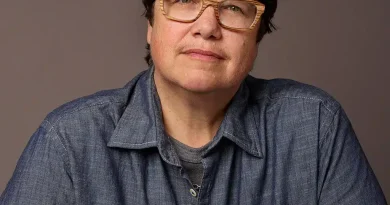
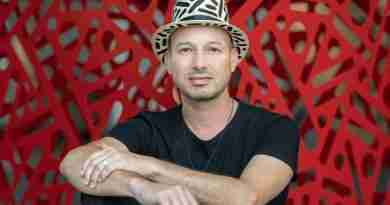
Interview with artists Daniel Kotowski, Bogna Burska, and curator Ewa Chomicka
Your work challenges the idea that communication must primarily be vocal. How much of what society considers “normal communication” is actually a system of exclusion?
Daniel Kotowski: Society considers the voice as the dominant model of communication. Everything outside this system is perceived as deviation or lack. For me, it was important to show that multiple forms of language exist and that none of them should be considered inferior. Sign language, gesture, movement, even silence itself can create relationships as profound as spoken words.
In the pavilion, silence feels almost physical. Do you think silence can still resist power today, or has everything already become noise and content?
DK: Today silence is almost revolutionary. We live inside a system that constantly produces content, images, and opinions. Silence instead creates a space where the body and perception can emerge without being immediately transformed into information. For me, it is not absence. It is another form of presence.
The pavilion explores forms of communication beyond human language through whales. Are they a metaphor, or a genuine interest in forms of intelligence humans may never fully understand?
DK: We did not want to use whales as a romantic symbol. We are genuinely interested in the fact that there are systems of communication humans still cannot fully understand. This challenges the idea that human language is the absolute center of intelligence.

Inside the pavilion, whale songs move through the space like a strange and almost unsettling presence. They do not function as poetic decoration, but as a destabilizing element. As if Liquid Tongues continuously suggests that human language may not represent the most evolved form of communication on Earth.
Many Biennale projects today speak about vulnerability and inclusion. How do you avoid turning these themes into institutional aesthetics?
Bogna Burska: The risk always exists. Today inclusion can easily become a reassuring aesthetic surface. That is why we did not want to build an illustrative or didactic project. Misunderstanding and difficulty are part of the experience.
Your work often transforms the body into a political space. Today, is the body still capable of resistance, or has it been completely absorbed by performance and media culture?
BB: I think the body remains one of the last spaces that cannot be totally controlled. Even inside highly mediatized systems, the body still preserves fragility, error, and slowness. It is precisely this vulnerability that still carries the possibility of resistance.
In the pavilion there is a constant sense of incomplete translation. Do you think contemporary society is losing the ability to truly understand the experience of others?
BB: We communicate constantly, but that does not necessarily mean understanding each other. We wanted to create a space where it would also be possible to perceive the limits of translation. Some experiences cannot be completely transferred from one person to another without losing something.

And this is probably where the Polish Pavilion finds its real strength. Nothing is ever fully translated, explained, or stabilized. The visitor remains inside a continuous zone of perceptual slippage, where language stops functioning as an instrument of control and returns to being fragility, body, and relationship.
This year’s Biennale speaks about “minor keys.” How does the Polish Pavilion interpret this idea politically rather than only poetically?
Ewa Chomicka: For us, minor keys does not simply mean representing minorities. It means questioning which perceptual and communicative systems are considered central by dominant culture.
Today many institutions claim to amplify marginalized voices. How do you prevent inclusion itself from becoming a cultural performance?
EC: It is a very delicate question. I believe the risk always exists. That is why we tried to avoid a moralistic or celebratory approach. We did not want to tell the audience what to think. We were more interested in creating a situation where people would be forced to confront their own communicative limits.
The pavilion creates an unstable sensory environment where communication constantly slips away. Was it important to disorient visitors rather than inform them?
EC: Yes, absolutely. Today we are used to receiving immediate and perfectly translated information. But artistic experience does not necessarily have to function in that way. We wanted to create a space where meaning would never become completely stable.
At a historical moment shaped by war, polarization, and algorithmic communication, do you think humanity is losing its ability to listen?
Ewa Chomicka: I think we are mainly losing the ability to accept the complexity of listening. There is a continuous pressure toward simplification and immediate translation. But some experiences require slowness, attention, and even the possibility of not fully understanding everything.
In recent days many artists and pavilions have taken positions regarding the conflict in Gaza. The Polish Pavilion also joined ANGA, participating in the May 8 protest by closing the pavilion at 4pm. How important is it today for a cultural institution to take a public position?
EC: We believe it is no longer possible to completely separate the political context from cultural practice. Joining ANGA and symbolically closing the pavilion was a gesture of solidarity and responsibility. We did not want to transform it into spectacle or slogan, but to recognize that there are historical moments when cultural institutions must also question their own role and their own silence.

The unresolved complexity
At the end of Liquid Tongues, what remains is a feeling that has become rare at this Biennale: the sensation of standing before a work that does not try to simplify the world, but suddenly makes it more complex.
And perhaps it is precisely this unresolved, fragile, and deeply human complexity that continues to resonate even after leaving the pavilion.
Venice // through November 22, 2026
Liquid Tongues – 61st International Art Exhibition of Venice
POLAND PAVILION – Giardini della Biennale